

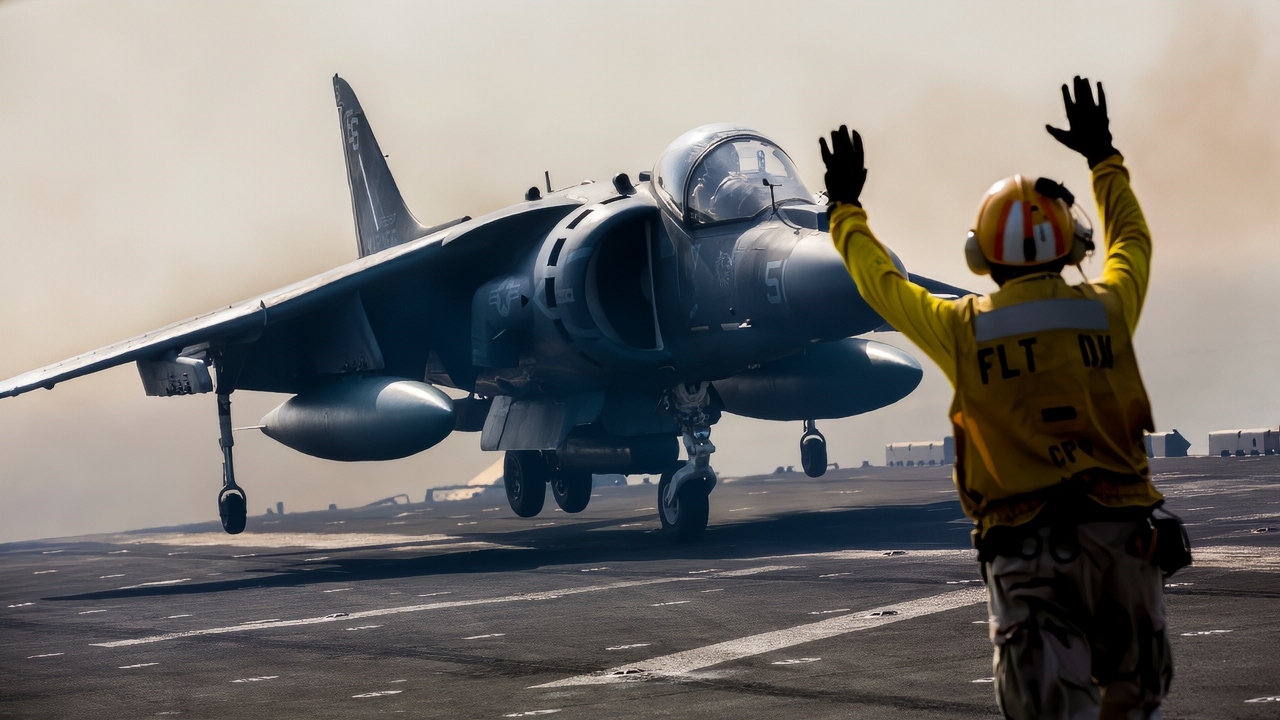
Key Points and Summary – While high combat losses can often indicate a great aircraft used in high-risk missions, like the A-10 Warthog, this analysis asks if they tell a different story for the AV-8B Harrier II.
-The Harrier might be a candidate for the worst U.S. fighter jet ever, depending on the data one looks at.
-Like the A-10, the “jump jet” has a high number of losses due to its dangerous close-support role.
-However, unlike the famously tough A-10, the Harrier was not built with the same level of survivability, making its loss rate a potential sign of a fatal vulnerability.
AV-8B Harrier: Worst Fighter Ever?
It may not seem possible to determine which fighter jet or proposed fighter jet might be considered the worst of all time, as the history of aircraft development across the world is unquestionably full of failed programs.
In some cases, promising or successful programs may have been canceled, and there are likely many others, such as proposed fighter jet projects, that were correctly avoided or stopped.
History is undoubtedly filled with troubled or ultimately unsuccessful efforts to engineer future fighter jets, and somewhat paradoxically, the most damaged or lost aircraft in combat may be the best-performing fighters.
What History Shows Us
Examining the US fleet of fighter jets, the casualty numbers may not accurately reflect the effectiveness of the aircraft.
For instance, available specs indicate that the famous A-10 Warthog is the aircraft that suffered a higher amount of combat losses compared with other aircraft, yet the aircraft is cherished for its successful combat performance and, of course, has spent most of its life in extremely contested, high-risk environments.
Therefore, although the A-10 has been destroyed or lost in combat seven times, it is by no means the worst US fighter jet.
By contrast, the aircraft with the greatest casualty numbers may be among the best to fight, as they were consistently chosen to perform the highest-risk missions.
This would certainly be the case with the A-10, as the aircraft has faced incoming enemy fire from low altitudes for decades and remains revered as one of the most survivable aircraft ever to exist.
Why the AV-8 Harrier II Might Take A Not-So-Good Prize
The AV-8B Harrier II and the F-16C Fighting Falcon have each been lost in combat five times, yet another indication that the aircraft perform extremely high-risk missions.
In the case of the Harrier jet, combat losses may in part be due to its slower speed and its role as a vertical take off “jump jet” driver between combat areas and aircraft carriers.
Essentially, the Harrier Jet may have suffered losses due to its high-risk mission, similar to the A-10. Yet, unlike the A-10, the Harrier Jet is not built with the redundancy or titanium hull sufficient to withstand incoming enemy fire.
Additionally, the Harrier jet is a large attack plane, as explained by the Navy, which operates with a mission to “attack and destroy surface and air targets and escort helicopters.”
Specifically, the Navy’s description of the Harrier jet states it is tasked with extremely high-risk missions, such as conducting “offensive and defensive anti-air warfare,” combat patrol and armed escort missions. Clearly this mission set might help explain why more Harriers have been lost in combat compared with other aircraft. In fact, the Navy write up on Harrier jets says the aircraft was the first to arrive in theater during Desert Storm in 1991.
“Operation Desert Storm in 1991 was highlighted by expeditionary air operations performed by the AV-8B. During the ground war, AV-8Bs were based as close as 35 nautical miles (40.22 miles) from the Kuwait border, making them the most forward deployed tactical strike aircraft in theater.
The AV-8B flew 3,380 sorties for a total of 4,083 flight hours while maintaining a mission capable rate in excess of 90 percent. Average turnaround time during the ground war surge rate flight operations was 23 minutes,” the Navy.mil write up states.
About the Author: Kris Osborn
Kris Osborn is the President of Warrior Maven – Center for Military Modernization. Osborn previously served at the Pentagon as a Highly Qualified Expert with the Office of the Assistant Secretary of the Army—Acquisition, Logistics & Technology. Osborn has also worked as an anchor and on-air military specialist at national TV networks. He has appeared as a guest military expert on Fox News, MSNBC, The Military Channel, and The History Channel. He also has a Masters Degree in Comparative Literature from Columbia University.


