
The Iran war is fast approaching its eight-month anniversary. A conflict U.S. President Donald Trump said would end within weeks has dominated the U.S. political landscape for most of the year. Both Tehran and Washington’s refusal to budge suggests the conflict won’t end anytime soon.
The conflict will cost the GOP its majority in Congress, leaving an uncomfortable final two years of Trump’s second term with a Democrat-controlled chamber set to limit much of his desired agenda.

A B-52 Stratofortress lands at Patrick Space Force Base, Florida, April 15, 2021. The aircraft was featured at the Cocoa Beach Air Show April 17 – 18. The B-52 is is a long-range, heavy bomber capable of flying at up to 50,000 feet. (U.S. Space Force photo by Tech. Sgt. James Hodgman)
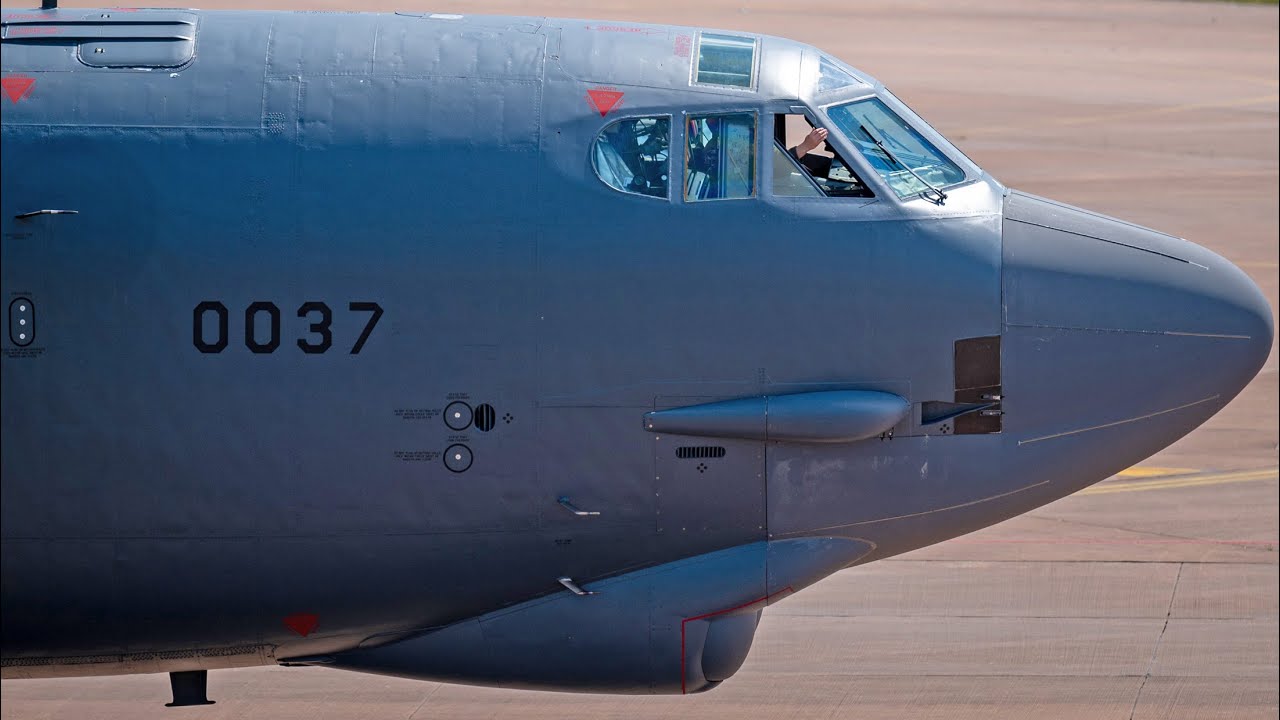
B-52 bomber. Image Credit: Creative Commons/USAF.
Unlike previous conflicts, however, it’s not the loss of U.S. personnel that has frustrated millions of U.S. households, but rather the rise in living costs brought on by the Iran war.
Hormuz Knock-On Effects
Iran’s closure of the Strait of Hormuz has been the key driver of rising costs.
Ever since the conflict began at the end of February, the Strait of Hormuz, which is important for oil exports from the Middle East, has been closed by Iran.
Since U.S. and Israeli bombs rained down on Iran, Tehran has used its chokehold on the strait – which is only 24 miles wide at its narrowest point – to limit the flow of commercial shipping traffic through the body of water.
As a result, oil prices have risen. Brent crude, the global benchmark for oil prices, has regularly surpassed $100 per barrel since February.
By comparison, Brent crude peaked at $74 per barrel in the 12 months before the war began.
Gasoline and Diesel
Few Americans ever buy crude oil directly, but they rely on gasoline and diesel, two byproducts of crude.
Before the conflict began, the average price of gasoline in the United States was $2.78 per gallon.
Since then, it has jumped to $4.50 per gallon, and the average price hasn’t fallen below $3.78 since March.
Diesel tells a similar story, hitting a record high last month.
While the price per gallon has fallen below its $6.52 peak, the average price of diesel remains well above $6 per gallon.
In the month before the conflict began, diesel averaged as little as $3.52 per gallon.
Effects on All
Diesel is vital to American life. Although a consumer may drive to the grocery store in an electric vehicle, diesel powers the production, harvesting, and transport of the food they buy.
In parts of the country where winter temperatures drop significantly, people use diesel for heating.
Millions of drivers also use it on America’s public highways.
Diesel is an unavoidable commodity in the American economy, and its price rise is reflected in the year-on-year increase of the Consumer Price Index (CPI) since the Iran war began.
The Bureau of Labor Statistics uses the CPI to measure inflation, and it rose 3.7% from the previous year, up from an annual rate of 3.4% in August.
Wages have not kept pace with inflation since the war began, leaving workers effectively worse off.
In February this year, workers were earning an inflation-adjusted average of $38.28 per hour.
By September, that average had dropped to $37.81 per hour.
That’s equivalent to a loss of $18.80 per week, or nearly $1,000 per year, adjusted for inflation.
Election Looming
The country heads to the polls on Tuesday, 3rd November, to elect the House of Representatives and two-fifths of the Senate for the final two years of President Trump’s presidential career.
Any scenario other than the Republican Party retaining control of Congress will complicate the President’s planned agenda until he leaves the White House in January 2029.
The economy is always a key issue for voters, and that’s bad news for the GOP ahead of next month’s vote.
A recently released Washington Post/ABC News/Ipsos poll found that economic approval of Trump’s administration is down to 28% – his lowest ever as President of the United States.
By comparison, Trump’s economic approval rating was at 33% in July, 41% in February, and 49% just before the 2018 midterm elections.
Three-quarters of Americans said the economy is either not so good or poor, with a slim majority of Republicans (53%) believing the economy is at least good.
Furthermore, almost half (48%) of respondents said they felt financially worse off than when Trump returned to the White House in January 2022, the highest figure of any comparable poll since 1986.
For the first time in more than a decade, the poll shows Democrats are more trusted on the economy than the Republican Party.
About the Author: Shay Bottomley
Shay Bottomley is a British journalist. He has written for the Western Standard, Business Insider, Maidenhead Advertiser, Slough Express, Windsor Express, Berkshire Live and Southend Echo.