

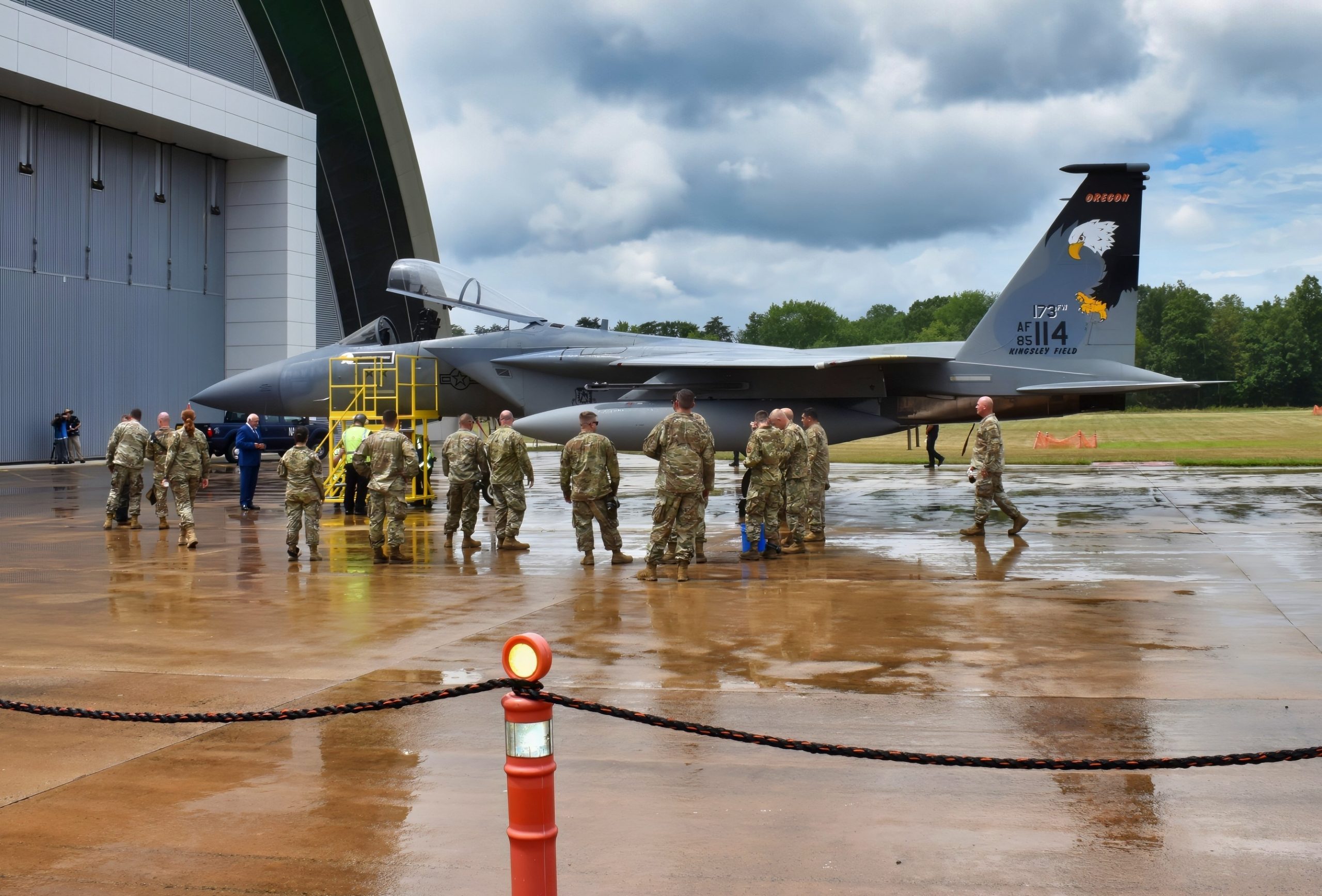
PUBLISHED on August 13, 2025, 5:02 PM EDT – A Pilot with the Right Stuff Explained to Me Why He Loves His F-15C Eagle.
Steven F. Udvar-Hazy Center, Chantilly, VA – The F-15C Eagle is one of the most historic fighter jets that have graced the skies. Its combat record over the last 50 years has been magnificent.
The F-15C is an air superiority, all-weather fighter that has an unblemished history of aerial dogfighting.
No F-15 has ever been shot down. Pilots at the controls of the F-15 have “killed” more than 100 enemy aircraft.
And today was my lucky day: I was not only able to get as close as the law allows to a real F-15C, but I was also able to talk to a legendary pilot of this amazing warplane.
The F-15C Eagle Brings Much to the Table
It has an eye-watering top speed of MACH 2.5. The F-15C has high acceleration and a robust turning radius making it a tough customer in one-on-one aerial battle.
The rate of climb is unmatched. The F-15C has two Pratt & Whitney F100-PW-100, 220, or 229 turbofan engines with afterburners. These enable a range of 3,450 miles and a ceiling of 65,000 feet.
Carrying an Outstanding Weapons Load
The F-15C Eagle is heavily armed. It can carry four AIM-9 Sidewinders and four AIM-120 AMRAAMs or eight AIM-120 AMRAAMs. The F-15C also features an internal M-61A1 20-mm, six-barrel cannon with 940 rounds of ammunition.
I Was Close Enough to Touch the F-15C
On August 13, I visited the Smithsonian National Air and Space Museum to see the F-15C Eagle up close.
One of the warbirds was making its last landing at Washington Dulles International Airport, which included a final taxi to the Smithsonian’s Udvar-Hazy Center in Chantilly, Virginia.
Stud Fighter Pilot Recalls His Days at the Controls of the F-15C
Waiting to welcome the museum’s latest exhibit was U.S. Air Force pilot Cesar “Rico” Rodriguez who flew the very same F-15C Eagle that had made its final touchdown to begin a long-term stay at the museum.
Almost an Ace
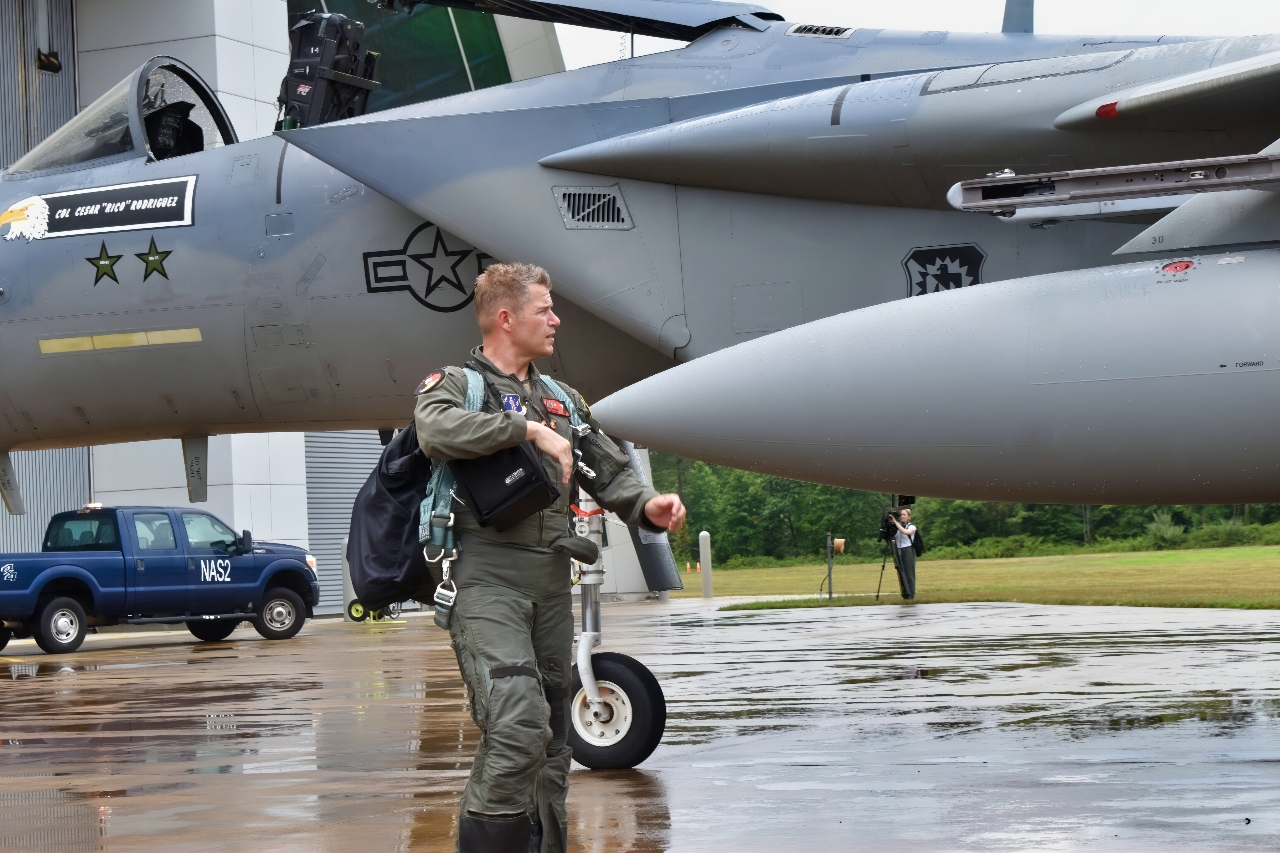
F-15C Pilot National Security Journal Photo. Image Credit: Brent M. Eastwood/National Security Journal.
Rico Rodriguez is one of the most famous F-15 pilots in the game.
He shot down two Iraqi MiG fighters during Operation Desert Storm in 1991 while flying the same F-15C that will be at the museum.
Then in 1999, Rodriguez destroyed another enemy MiG-29 during Operation Allied Force over the Federal Republic of Yugoslavia in the NATO mission to protect Kosovo.
Rodriguez is one of only four Americans since 1972 to shoot down three enemy airplanes. He is the closest pilot to becoming an “ace” since the Vietnam War.
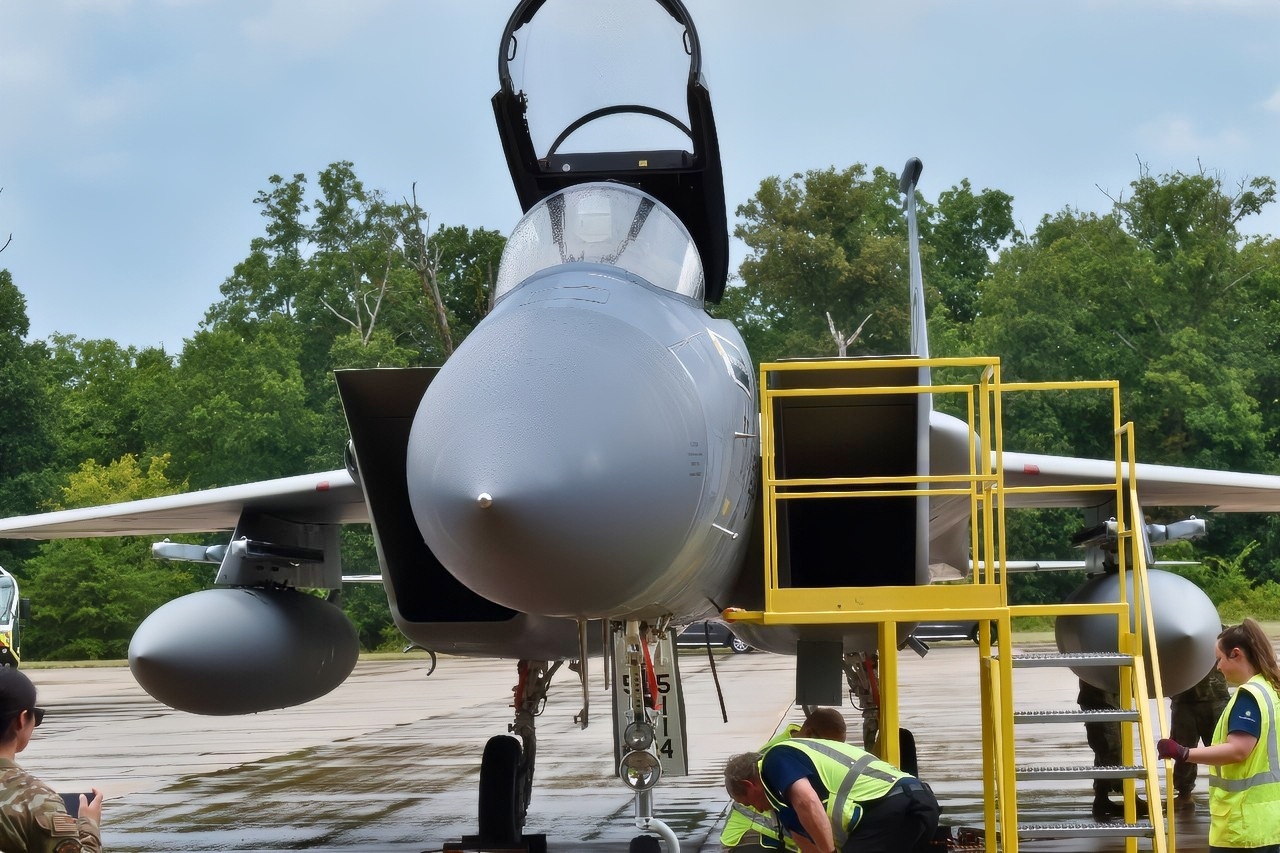
Rain on an F-15C Fighter at the Smithsonian outside of DC. National Security Journal Photo. Taken on August 13, 2025, by Brent M. Eastwood.
I had the opportunity to interview Rico at the coming-out ceremony for the F-15C, which will be on permanent display at the museum. He was emotional while standing beside his old Eagle and thanked as many people as he could.
“It’s not about me. It’s about everybody whose fingerprints are on this airplane. When you think about it, since the 90s, when this airplane was issued to the Air Force, it has flown with five different operational squadrons. It’s been to combat. It’s had many emergencies when the aircraft might not have survived but for the work that the Eagle-keeper community, the maintainers, everybody who’s been a part of this jet flying. That’s what it is all about. It’s about hundreds of thousands of airmen, community partners, and family members that have been part of what we’re doing today,” Rodriguez said.
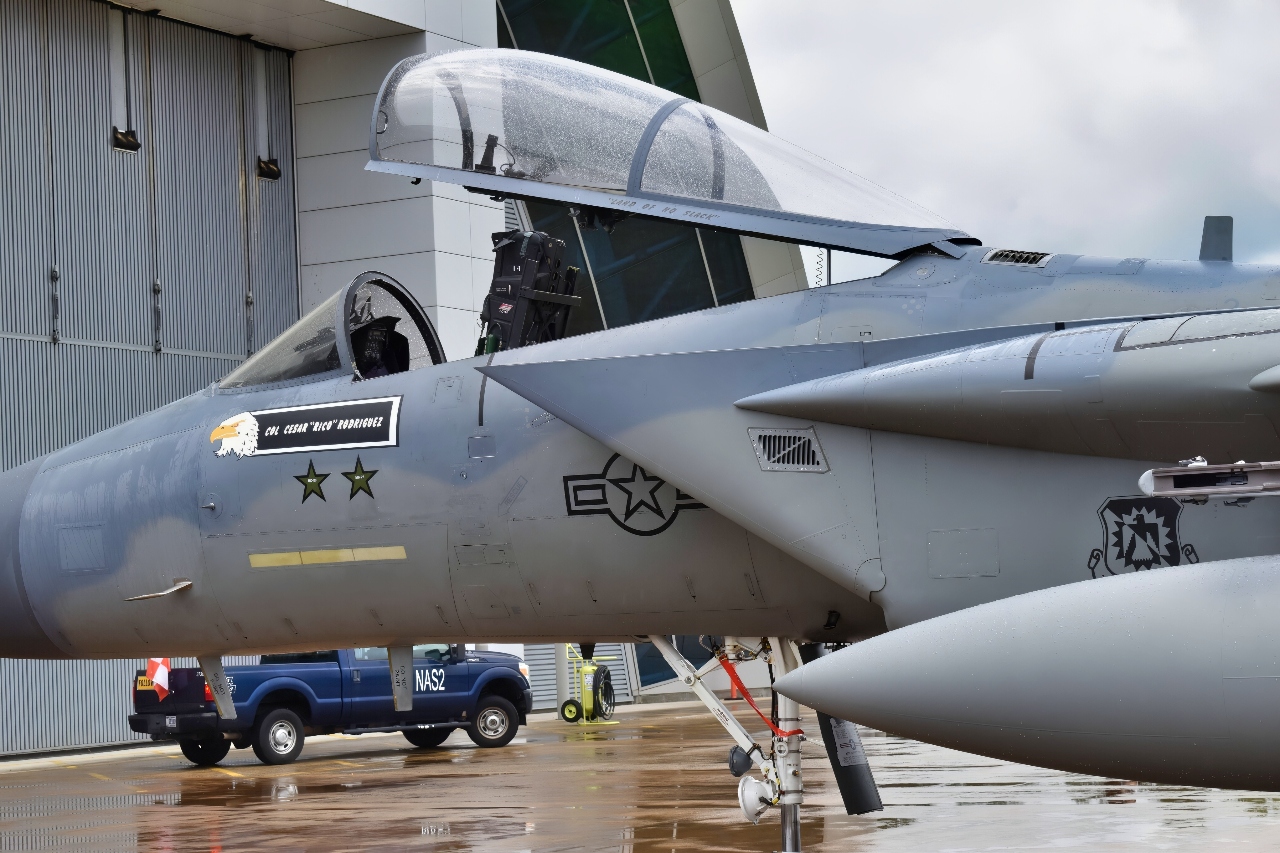
F-15C Fighter at Smithsonian, August 13, 2025. Image Credit: National Security Journal.
Rico believes that flying the F-15C has been a privilege. He was excited every time he strapped in at the controls. He thought the airplane was a different animal during each flight.
“In order to get to a point where you’re proficient in combat, you have a lot of training events that we go through…everybody in the service who’s training to prepare for that ultimate event,” Rodriguez said. “And that airplane allowed me to let training take over…you just go through the ‘I’ve been there before. I can do this again.’ And then you know I put a lot of pain on that airplane, and the crew chiefs fixed her up and got her going again the next day. So, it was a lot of fun, lot of scary moments, but I wouldn’t trade it.”
It was this type of realistic training that prepared Rico for actual combat. His teammates in the air made his job easier him.
He called out the incredible people that are in the E-3 Sentry AWACS early warning aircraft and his wingmen, in addition to others flying in attack formation.
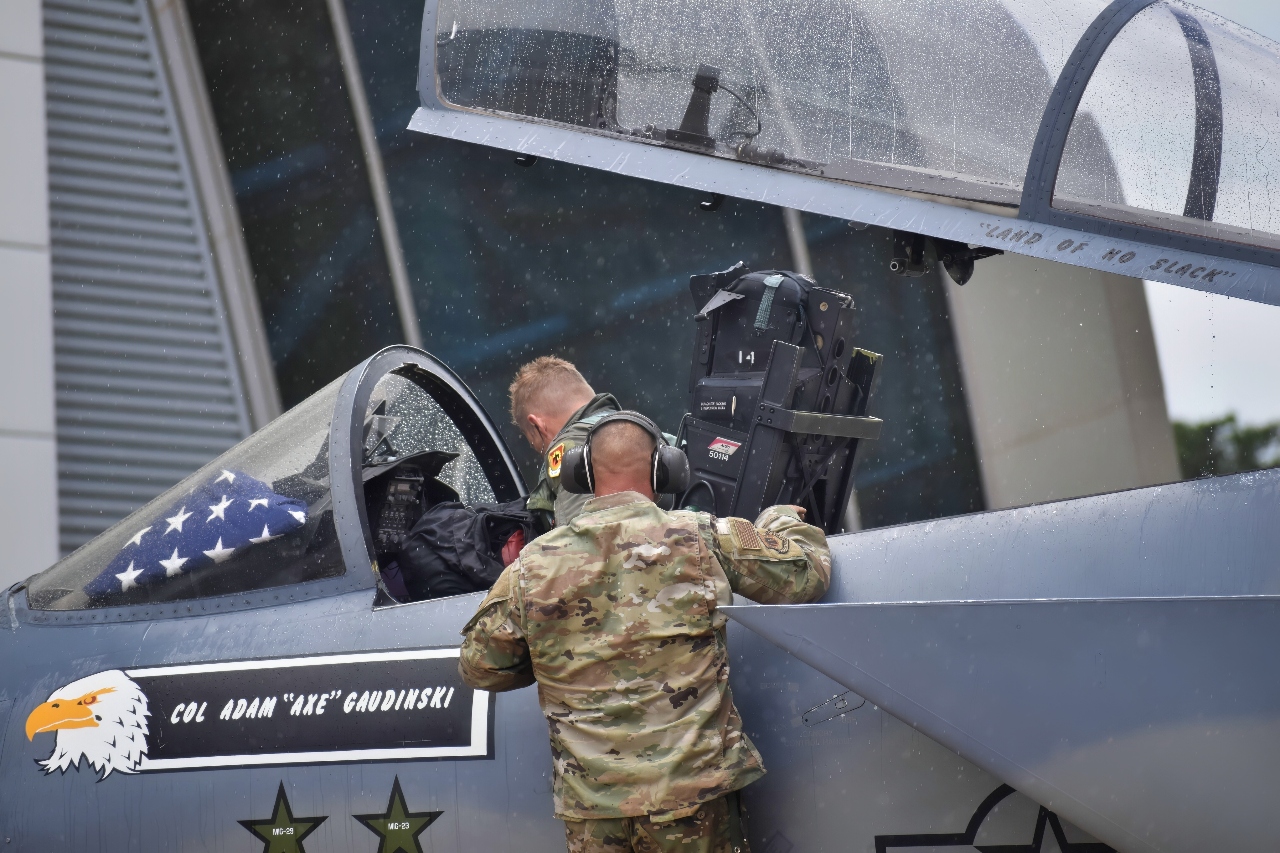
F-15C in the Rain at Smithsonian Outside DC. Image Credit: Brent Eastwood/National Security Journal.
“When you switch the red guarded switches to on. Then this airplane becomes a completely different beast. She has amazing electronic warfare capability. She has launch and leave weapons systems that are available too. She has an early warning receiver that tells you when the bad guys are trying to do something. All of that comes on in a very different way when we go ‘Red Guard’ switches up,” Rodriguez explained.
Rico discussed how so many people are responsible for the success of Air Force combat operations and training missions.
“Every young kid, every senior citizen, every American and their international coalition partners have their fingerprints on that mission. And we are a more powerful Air Force. We’re a more powerful nation when we are on one team. So, as we say in the Air Force, fly, fight, and win.”

F-15C Fighter at Smithsonian National Security Journal Photo.
About the Author: Dr. Brent M. Eastwood
Brent M. Eastwood, PhD is the author of Don’t Turn Your Back On the World: a Conservative Foreign Policy and Humans, Machines, and Data: Future Trends in Warfare plus two other books. Brent was the founder and CEO of a tech firm that predicted world events using artificial intelligence. He served as a legislative fellow for U.S. Senator Tim Scott and advised the senator on defense and foreign policy issues. He has taught at American University, George Washington University, and George Mason University. Brent is a former U.S. Army Infantry officer. He can be followed on X @BMEastwood.


