

The Secret U.S. Hormuz Route That Appears To Be Working – Two unnamed American officials told Axios this week that the U.S. military has established a shipping corridor through the Strait of Hormuz that is successfully challenging Tehran’s claim over the waterway and moving millions of barrels of oil each day. The claim comes as reports suggest that Iran is losing control over the strategic waterway, but amid ongoing traffic disruptions that are causing global economic pain.
What Axios Claims

Littoral Combat Ship. Image Credit: Creative Commons.
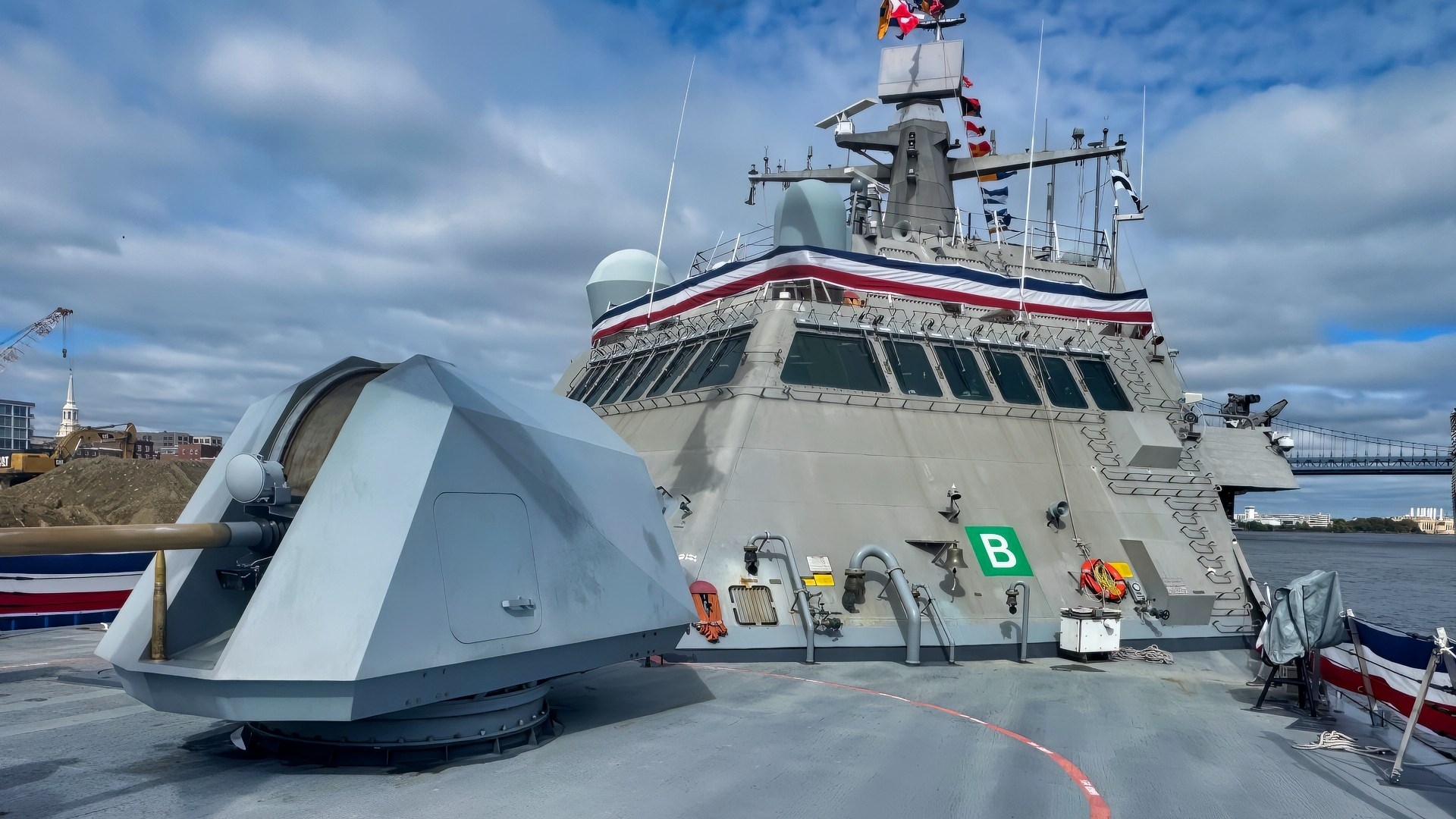
Top of USS Cooperstown Littoral Combat Ship. Taken by National Security Journal on October 14, 2025.
According to the two sources, the operation has been underway for the last several weeks. Under the scheme, U.S. vessels have assisted the movement of 15-20 tankers in and out of the strait every night.
The route is said to move through a southern channel close to the coast of Oman.
If accurate, it conflicts with Tehran’s claim to control the strait and opens up vessels moving through the strait to potential Iranian missile and drone strikes. It also risks Iran-Oman negotiations over a temporary shipping arrangement, which both sides have claimed is close to being finalized for several weeks already.
Axios also claims that around 10 million barrels of oil are being moved through the Strait of Hormuz per day under the new U.S. route, which is roughly half of the pre-war volume. The news helps explain why oil prices have yet to reach the most troubling estimate by analysts from earlier this year, when experts warned that the price of a barrel of oil could quickly reach $200.
How the U.S. Operation Works
The operation is substantially more complicated than simply escorting loaded tankers through the strait.
According to Axios, a task force operating from Army headquarters at Fort Bragg, North Carolina, is coordinating the movement of ships with Gulf governments and creating separate daily lists for vessels leaving the Persian Gulf and empty tankers entering to collect new oil cargoes. And rather than allowing those ships to move independently, the tankers are being grouped together and sent through the southern channel during designated nighttime windows.
Under the system, one line of ships moves outbound toward the Arabian Sea, followed by a new inbound movement of empty ships.
The U.S. Air Force is supporting the effort, providing fighter aircraft for protection against Iranian drones and cruise missiles.
The U.S. officials who spoke to Axios said that American forces have intercepted eight Iranian drones and two cruise missiles over the last week, although some vessels have still been struck.
The system creates what could be described as a protected conveyor belt that keeps Gulf oil moving, even as the strait remains generally dangerous for vessels attempting to pass.
Why Iran Is Struggling to Stop It
According to the report, the corridor became possible to establish following a two-week CENTCOM campaign that severely damaged Iran’s radar and maritime surveillance network around the strait. It means that Iran is currently incapable of tracking vessels as it did before and does not have the infrastructure in place to conduct large-scale strikes.
Iran has reportedly restored only a small number of radars and has become largely dependent on IRGC personnel aboard small boats to visually identify passing vessels.
According to officials, Iran has now resorted to firing drones and cruise missiles at areas where it believes ships are moving rather than consistently tracking individual targets.
Shipping Moves to the Omani Side
There is also evidence that commercial traffic is moving back toward the Omani side, despite recent reports that ships were beginning to use the Iran-approved route to the north of the strait over concerns that they may be hit by Iranian projectiles.
Kpler data cited in recent reporting shows that more than 80% of liquid cargo movements over the last two weeks either used the Omani route or involved vessels’ crews switching off tracking systems and potentially using the same southern corridor. A month earlier, almost no commercial traffic was using the Omani route.
Hormuz Is Not Back to Normal
Not only is the current system unlikely to be sustainable, with Iranian forces working to rapidly restore their capabilities, but it also isn’t ensuring the usual quantity of oil moves through the strait. Normal shipping has not resumed.
Kpler data shows that only nine commodity vessels passed through Hormuz on Tuesday and Wednesday this week, which is dramatically lower than the roughly 130 ships that crossed the strait every day before the war began. Some additional vessels almost certainly crossed with their AIS transponders switched off, but it does mean that the claim that nearly 10 million barrels per day are moving through the strait cannot be independently verified.
And as the Hormuz disruption continues, so too does the economic pressure.
Brent crude climbed to $93.81 per barrel on Thursday, August 20 – its highest level in more than three weeks.
The news also risks Oman-Iran negotiations over a new shipping arrangement for the waterway, which both governments have been teasing for several weeks.
About the Author: Jack Buckby
Jack Buckby is a British researcher and analyst specializing in defense and national security, based in New York. His work focuses on military capability, procurement, and strategic competition, producing and editing analysis for policy and defense audiences. He brings extensive editorial experience, with a career output spanning over 1,000 articles at 19FortyFive and National Security Journal, and has previously authored books and papers on extremism and deradicalization.


