

Iran is threatening to attack data centers, undersea internet cables, and Gulf energy installations if U.S. and Israeli strikes resume.
Mohsen Rezaei, secretary of the Iranian Supreme Council of National Security, told left-leaning outlet Drop Site News that Iran intends to do so.

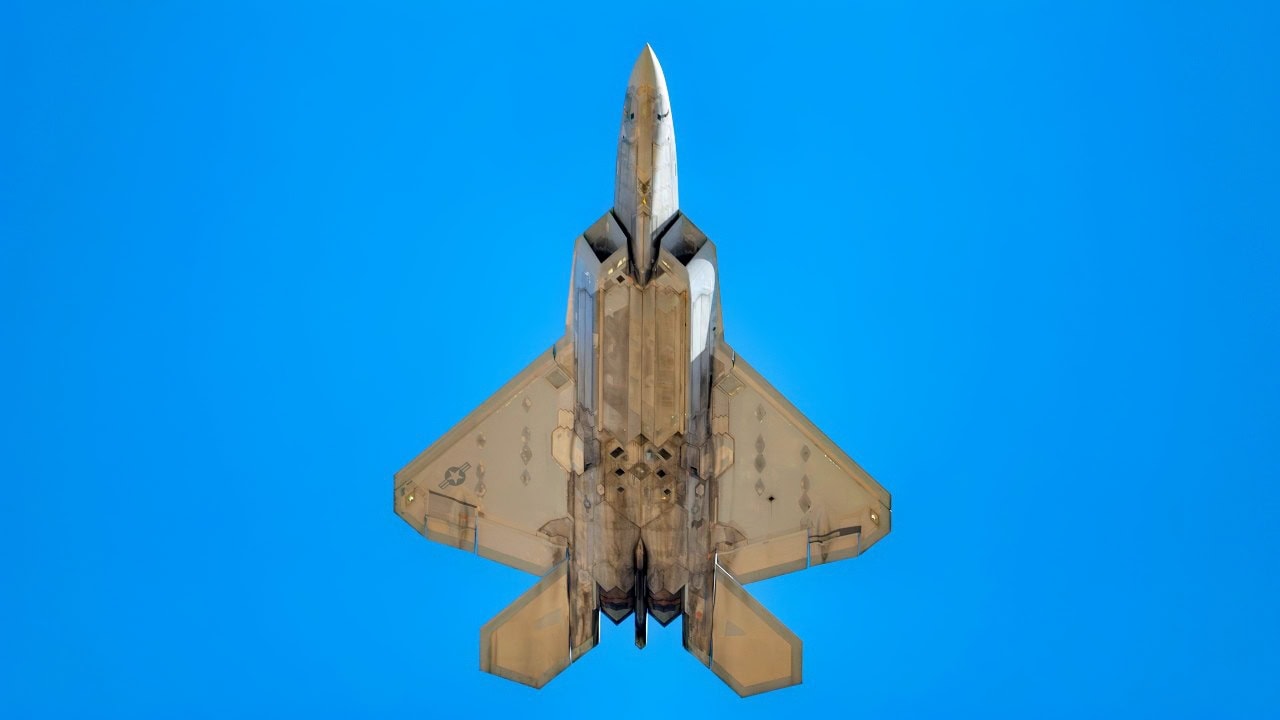
U.S. Air Force Maj. Josh Gunderson, F-22 Demo Team commander, enters into the Raptor Slide during the Millville Airshow, Sept. 3, 2021, at Millville Army Airfield, Millville, New Jersey. During the Raptor Slide the aircraft actually slides down and backwards under control before Gunderson adjusts the aircrafts position and powers out of the maneuver. (U.S. Air Force photo by Staff Sgt. Don Hudson)

A B-2 Spirit assigned to the 419th Flight Test Squadron, conducts flight tests above Rogers Dry Lake on Edwards Air Force Base, California, August 3, 2023. (Air Force photo by Giancarlo Casem)
“If the conflict begins again, we will have a broader plan,” Rezaei said.
Rezaei remains subject to an Interpol Red Notice relating to his alleged involvement in a terror attack on a Jewish community center in Argentina in 1994.
Mehdi Mohammadi, an adviser to Parliament Speaker Mohammad Ghalibaf, told The Guardian that another war would constitute an existential threat to the Islamic Republic, and that it would respond accordingly.
Iran Has Already Targeted Cloud and Oil Infrastructure
Hossein Mohebbi, a spokesperson for Iran’s Revolutionary Guards Corps (IRGC), said seven major internet cables run beneath the Strait of Hormuz, then referred to potential “new targets” and “new weapons.”
The IRGC is listed as a foreign terrorist group by the U.S. government. It extensively funds and trains terror proxies across the Middle East.
“Seven major internet cables pass under the Strait of Hormuz,” Mohebbi said, according to Anadolu Agency.
Amazon’s cloud computing business has also been hit particularly hard.
In March, Amazon Web Services announced that drones directly hit two data centers in the United Arab Emirates.
A third data center, located in Bahrain, was damaged by a drone strike nearby.
Amazon’s outages persisted long after the attack, too.
Last month, Amazon announced that some data housed exclusively in one UAE availability zone was irrecoverable.
Andreas Krieg, a security expert at King’s College London, explained to Al Jazeera that attacks on digital facilities do “not necessarily need to destroy the servers themselves to render an entire facility inoperable.”
The Gulf’s oil infrastructure has been hit much more heavily.
According to a recent Reuters report, there have been at least 135 strikes by Iran and its allies on 84 installations in seven countries since February 28.
The report was notable both for its detail and for finding that Iran and its allies used drones to strike Fujairah’s oil facilities at least 19 times, and to damage two critical cooling units at Qatar’s Ras Laffan gas complex and Saudi Arabia’s East-West Pipeline.
Ryan Stevens, a former US Marine Corps airstrike coordinator who reviewed the report, said the attacks represented “precision, targeting expertise, and patience.”
Sultan Al Jaber, the UAE’s industry minister and chief executive of Abu Dhabi National Oil Company, said Iran’s attacks were targeting “our way of life.”
Washington’s Military Preparations Collide With Two Elections
The timing for a new round of American attacks is a potentially delicate issue for both President Trump and Israeli Prime Minister Benjamin Netanyahu.
The Pentagon directed the commander of U.S. Central Command to finalize plans for possible attacks against Iran, Axios reported on October 7.
“The Department’s job is to develop and present military options to the President,” a Pentagon official said. On Thursday, ABC News also reported that American and Israeli military planners had drafted proposals for a joint attack in the coming weeks.
An Israeli defense official said that attacks could begin right after the midterm elections on November 3.
The White House has ruled out attacking Iran before the elections.
“The United States will not be attacking Iran at any time before the midterm elections,” White House spokesperson Anna Kelly said, according to ABC.
Trump was less forthcoming. “Something one way or another will happen, fairly soon,” he said to reporters on Thursday, according to The Times of Israel.
Israel is due to hold its own election on October 27, and Netanyahu has made toppling Iran’s government a campaign issue.
“The regime must fall, and I will bring it down,” he said to journalists on October 18, according to The Times of Israel.
Danny Citrinowicz, a former Israeli military intelligence officer, agreed. “Netanyahu wants to attack Iran; that’s not even a question,” he told the Associated Press.
Seven Tankers Reportedly Hit as Oil Climbs Above $114
Iran’s Revolutionary Guard claimed Thursday that seven tankers were damaged or set on fire near Hormuz. The claims have not been independently verified.
The impact of the losses already reported would be significant. The International Maritime Organization has recorded 120 maritime incidents and 24 deaths at sea as of October 22.
Among the vessels that have been attacked was the Singapore-flagged GFS Pride, which sank on October 13.
Despite the risks, tankers carrying crude oil continue to transit a shipping channel near Oman secured by American warships.
Lloyd’s List Intelligence has reported that some shipping companies are navigating the channel at night with tracking devices turned off and transferring cargo to other tankers outside the strait.
The risks are reflected in of prices. On Friday, Brent crude hit $115 a barrel before easing to $114.57 per barrel by 11:38 a.m. GMT, according to Reuters.
This uptick arrived following the resumption of Houthi terrorist attacks on Saudi Arabia, prompting Aramco to evacuate its Dhahran headquarters.
About the Author: Georgia Gilholy
Georgia Gilholy is a journalist based in the United Kingdom who has been published in Newsweek, The Times of Israel, and the Spectator. Gilholy writes about international politics, culture, and education.


