
Two Assumptions That Defined Trump’s Strategy In Iran Were Never Going To Work: When U.S. President Donald Trump authorized military action against Iran earlier this year, the administration appeared to be pursuing an obvious strategy: to apply overwhelming military pressure and then offer diplomacy from a position of strength. It’s a strategy the U.S. has used before, and one that would work against perhaps more rational enemies. But the regime in Tehran is ideological and irrational – and worse, it holds strategic leverage that has allowed it to punch well above its weight in the months that followed.
The thinking was obviously that Iran would recognize that it could not win a conventional war against the United States, come to the negotiating table, and ultimately accept a deal that would end its nuclear ambitions and reduce tensions across the Middle East. But five months later, the conflict has only worsened – and it’s because Iran never needed to win a conventional war against the United States.

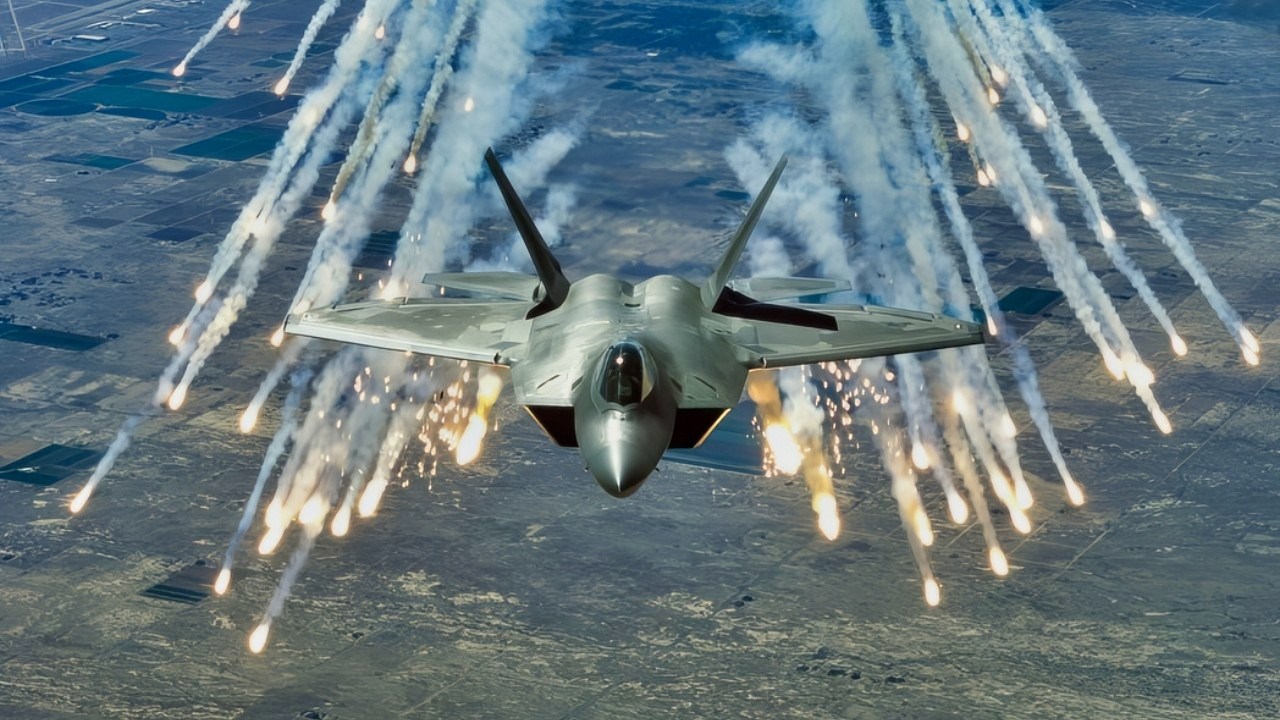
An F-22 Raptor soars over the Pacific Sea Test Range on December 19, 2024. The aircraft is assigned to the 411th Flight Test Squadron, Air Dominance Combined Test Force, at Edwards Air Force Base, CA. (Courtesy photo)

F-22 Raptors from the 1st Fighter Wing and 192nd Fighter Wing, participate in a total force exercise at Joint Base Langley-Eustis, Virginia, Feb. 28, 2019. Both wings partnered with the 633rd Air Base Wing during the Phase I exercise to showcase their readiness and deployability of the F-22s. (U.S. Air Force Photo by Tech Sgt. Carlin Leslie)
Today, the Strait of Hormuz is effectively closed, with crews and shipping companies hesitant to cross even as CENTCOM insists the U.S. Navy can guarantee safe passage. And to the south, the Bab el-Mandeb Strait is now under pressure, leaving Washington with few options to save global oil markets without making major concessions to Iran.
This isn’t to say a war with Iran could have been avoided, or indeed that Iran posed no threat. Choosing to wage war against an ideological Islamic regime is no easy decision to make. But at the same time, the strategy deployed so far has obviously failed.
Military Pressure Didn’t Create Political Leverage
Since the war began, Washington has repeatedly alternated between military escalation and diplomatic outreach, spending more time focusing on the latter. U.S. aircraft have struck missile production facilities and drone factories, Iranian command centers, air defense systems, coastal defense batteries, and general military infrastructure. U.S. Central Command has even expanded operations into Iran’s maritime capabilities and targeted facilities that supported naval operations across the Persian Gulf and Strait of Hormuz.
U.S. military strikes have been nothing short of overwhelming and devastating in many respects. The attacks are not the problem, but the lengthy diplomatic pauses between them may have been, having given Tehran time to regroup while Washington waited for negotiations that never meaningfully materialized.
After the initial strikes, Trump agreed to the flawed memorandum of understanding (MOU) ceasefire framework that temporarily halted military operations while negotiators pursued a lasting settlement. Even as negotiations struggled to progress, Trump told the media that he was happy to see the deadline extended beyond the original 60 days, as long as Tehran was “behaving.” The comment was symptomatic of a problem that undercut the entire process: the president’s assumption that Tehran would ever truly “behave” or engage in good faith.
A preference for diplomacy is not inherently a bad trait. It goes to show that Trump is honest when he says he despises war. But those diplomatic pauses have proven hugely valuable for Tehran, not only giving the regime time to rebuild defenses and begin work clearing its nuclear sites, but also pushing the world closer to an oil crisis that it could also use as leverage.
Money Was Never Going to Trump Ideology
On top of giving Iran time to recover, Trump has also based negotiations on the assumption that money talks. Whether he’s negotiating trade deals and tariffs or even peace agreements, the president’s instinct has been that sufficiently attractive economic incentives are enough to persuade adversaries to change course. That same thinking has appeared throughout the Iran conflict, with the prospect of sanctions relief and access to frozen funds, and even temporarily permitting oil exports, being the center of his negotiating tactics.
He did the same with Gaza, speaking repeatedly about rebuilding the territory through massive international investment that would deliver modern infrastructure and commercial development. The assumption was that the promise of creating the “Riviera of the Middle East” would be enough to end the conflict. But it didn’t work there, and similar promises of international investment in Iran have failed, too.
The problem is not that economic incentives don’t work. They do, and Trump knows they do because it’s how he has made his billions. The problem is that neither Iran’s leadership nor its regional proxies have ever suggested economic prosperity is their highest priority. The Islamic Republic has accepted decades of sanctions and inflation, diplomatic isolation, and general economic decline, all while continuing to finance Hezbollah, Hamas, the Houthis, and Iraqi militias. Iran’s goal is to govern ideologically for the long term, not to become an economic powerhouse.
That does not mean diplomacy with Iran is completely impossible, nor does it mean military action was necessarily the wrong decision. It does, however, suggest that the administration may have fundamentally misunderstood the nature of the adversary it was confronting.
Revolutionary governments built around ideological objectives rarely calculate costs and benefits the same way a Western government would. And if those revolutionary governments have points of leverage over the much greater powers attacking them, economic incentives are even less likely to work.
As it stands, the cost of this miscalculation is high – and once the United States’ strategic reserve begins to run dry and oil prices skyrocket, as they inevitably will, Iran could stand to benefit greatly from the president’s mistakes.
About the Author: Jack Buckby
Jack Buckby is a British researcher and analyst specializing in defense and national security, based in New York. His work focuses on military capability, procurement, and strategic competition, producing and editing analysis for policy and defense audiences. He brings extensive editorial experience, with a career output spanning over 1,000 articles at 19FortyFive and National Security Journal, and has previously authored books and papers on extremism and deradicalization.


