

U.S. military operations have degraded Iranian capabilities, but they have not altered Tehran’s belief that it can outlast Washington or continue threatening neighboring Arab states and commercial shipping in the Strait of Hormuz. A coordinated revenue-denial campaign across five principal channels, beginning with Kharg Island’s loading infrastructure, is more likely to produce a verifiable agreement than continued attrition alone. Although the administration has adopted important components of that strategy, the revenue channels that finance Iran’s endurance remain substantially open.
The Political Objective
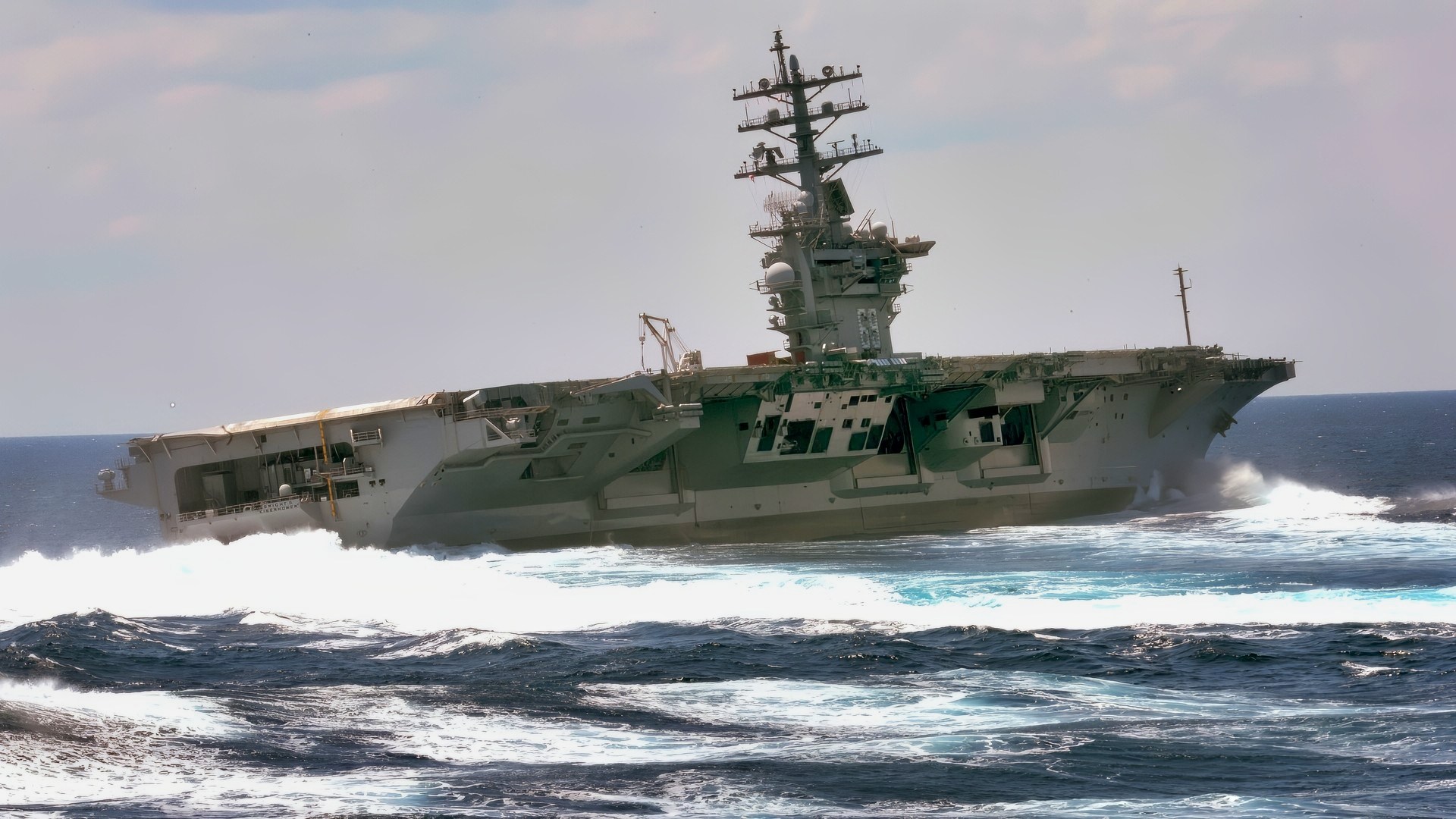
The Nimitz-class aircraft carrier USS Dwight D. Eisenhower conducts rudder turns during sea trials.
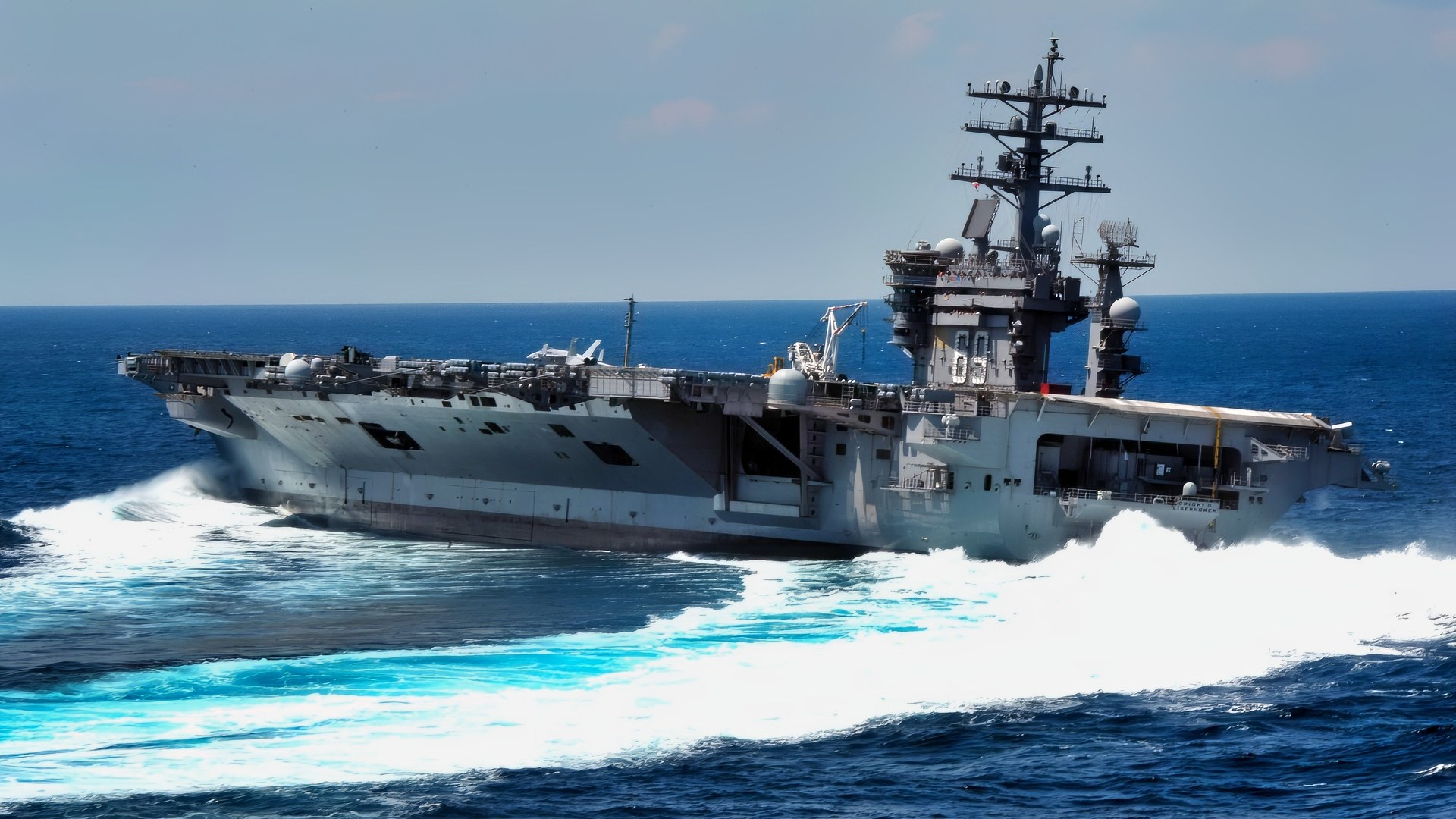
The Nimitz-class aircraft carrier USS Dwight D. Eisenhower conducts rudder turns during sea trials. Dwight D. Eisenhower completed a nine-month planned incremental availability at Norfolk Naval Ship Yard on June 10, 2011.
The appropriate political objective of this campaign is not regime change, which would likely require extensive ground forces Washington has ruled out. It is not acceptance of a permanently nuclear-armed, internationally isolated Iran. It is the strong version of outcome three; specifically, a verifiable agreement in which Iran accepts no nuclear weapons program with full International Atomic Energy Agency (IAEA) access, limits on ballistic missiles and long-range attack drones capable of threatening regional states and commercial shipping, an end to IRGC funding, arming, training, and operational direction of foreign proxy forces, and an open Strait of Hormuz under international maritime law without Iranian toll authority or coordination requirements. The latter requirement avoids the ambiguity created by Article 5 of the Islamabad Memorandum. President Trump was correct to end the Islamabad Memorandum. What is needed now is a stronger agreement than anything previously attempted.
Achieving this requires conditions comparable to those that led Iran’s leadership in 1988 to conclude that the cost of continued resistance exceeded the cost of compliance. The IRGC controls vast segments of Iran’s economy including oil, construction, banking, telecommunications, and ports, and will resist any terms threatening the commercial empire that secures its political dominance. The mechanism that shifts that internal calculation is progressively reducing the IRGC’s ability to finance external operations and regenerate capabilities, creating conditions for Iran’s pragmatist faction to negotiate. Financial compellence coupled with military pressure has a greater probability of achieving this than military pressure alone.
Why the Current Campaign Has Not Compelled Iran
Nearly two weeks of repeated CENTCOM strikes have done real damage to Iran’s air defense, coastal radar, and missile storage. Airstrikes carry less risk of US casualties than ground operations and can continue in the near term. However, the Institute for the Study of War assessed in its July 20 Special Report that while some senior Iranian officials appear concerned the conflict will deepen Iran’s economic problems, those concerns have not meaningfully impacted the calculus of the IRGC. The Wall Street Journal reported on July 14 that the contest was becoming increasingly one of endurance. Iran is counting on the approach of the U.S. midterm elections, depleting US interceptor inventory, and eventual political pressure for an exit. Every night of kinetic exchange burns inventory that cannot be replaced on this campaign’s timeline while Iran uses retained revenue to purchase replacement missiles.
Iran’s simultaneous strikes against Bahrain, Kuwait, Qatar, Jordan, UAE, and Oman, US basing countries, none of which are parties to the conflict, reflect that endurance strategy in action. The Arab League has condemned the attacks as flagrant aggression against state sovereignty. Iran has alienated the Muslim world diplomatic cover its endurance strategy requires, but it can sustain these proxy and missile operations as long as its revenue channels remain open. On July 19, US strikes reportedly hit the Darkhovin nuclear power plant construction site in southwest Iran, which the IAEA said it was investigating; the site was not an operating nuclear reactor, but the strike marks a further kinetic escalation that nonetheless leaves the IRGC’s revenue intact. Closing those channels is the principal instrument that breaks the endurance cycle. Iranian interest in renewed negotiations may indicate that military pressure is affecting Tehran’s calculations, but its continued attacks and refusal to restore normal maritime passage demonstrate that the pressure has not yet produced compliance.
The Logic of Revenue Denial
Compellence works when the adversary concludes that continued resistance costs more than compliance. It requires three things to be simultaneously true: the imposed cost must be escalating and credible, the adversary must have no viable path to endurance, and the demanded terms must be achievable with an attainable off-ramp. The strikes satisfy the first. The second remains unsatisfied. Iran’s path to endurance runs through Kharg Island, the dark fleet, and the financial networks that convert hydrocarbons into IRGC operational funding. Those channels remain open.
What the Energy Market Has Demonstrated
The hesitation on Kharg is principally driven by fear of rising oil prices, a legitimate concern the market has substantially tested. Even approaching $100 following twelve consecutive nights of US strikes, a reimposed naval blockade, simultaneous Houthi threats to Red Sea shipping, and attacks on the Caspian Pipeline Consortium in the Black Sea, Brent remains approximately 18 percent below the April intraday high of $120.88. Oil markets have demonstrated substantial adaptive capacity. The market has already demonstrated several significant workarounds. Saudi Arabia’s East-West pipeline pushed toward seven million barrels per day, US net petroleum exports at an all-time high of roughly nine million barrels per day in April, and Goldman Sachs projecting that bypass pipelines could insulate 45 percent of Gulf producers’ exports from Hormuz shocks by end of 2027. The EIA’s July 7 forecast, completed before the latest hostilities resumed, projected Brent averaging $74 per barrel in the third quarter, assuming continued restoration of shipping flows. Refined product markets have no comparable buffer. The market’s adaptation has weakened, though not eliminated, the oil-price case for leaving Kharg’s loading infrastructure untouched.
The bypass adaptation holds for crude, not for refined products. Gasoline, diesel, and jet fuel have no pipeline alternative to Hormuz, which is why crack spreads have widened to multi-year highs in Europe and the US even as Brent stays below its April peak, and why pump prices crossed $4 a gallon this week. Closing Iran’s revenue channels would reduce the IRGC’s capacity to sustain the maritime threat that keeps refined-product shipping at risk, addressing both the crude and the refined-product disruption over time.
The Wall Street Journal has identified three simultaneous energy strangleholds across Hormuz, the Red Sea, and the Black Sea, collectively imperiling a quarter of global oil supply. Some analysts have argued the adaptation ran on SPR releases now at Reagan-era lows. That correctly identifies a time constraint. Every week Iran’s revenue channels remain open narrows the window before the adaptation case fails. That urgency makes the revenue denial package described below time critical.
The Five-Part Revenue-Denial Package
Striking Kharg alone is not the strategy. The strategy is a five-part package that closes the principal external channels the IRGC uses to convert hydrocarbons into operational cash and employs a newly formed Joint Interagency Task Force (JIATF) to coordinate the specific revenue denial effort.
First, temporarily disable Kharg’s loading infrastructure. Kharg handles the large majority of Iranian crude exports. The objective should not be destruction of the island or its storage facilities but the temporary disabling of loading arms, pumping systems, and electrical distribution while avoiding storage tanks and facilities whose damage could cause a major spill. The April 13 blockade proved the financial mechanism. Oxford Economics estimated the blockade cut off approximately 70 percent of Iran’s export income. Treasury Secretary Scott Bessent estimated resulting losses at roughly $170 million per day. The Foundation for Defense of Democracies independently estimated broader combined daily losses at $435 million. Those loading terminals are still operating. Trump told reporters: “I said, hit everything but the oil. Leave that little area.” The market’s adaptation has weakened, though not eliminated, the oil-price case for leaving Kharg’s loading infrastructure untouched.
Second, systematically interdict the dark fleet in open water. United Against Nuclear Iran (UANI) documented 47 ghost armada tankers generating over $5 billion in IRGC revenue through dark fleet exports since the MOU was signed. CENTCOM’s May 29 disabling of the M/V Lian Star demonstrates one limited enforcement model for vessels that enter a declared blockade area, refuse lawful instructions, and continue toward a prohibited destination.
Third, enforce secondary sanctions on petrochemical buyers and prevent rebuilding of export capacity. Israeli airstrikes on Mahshahr and Asaluyeh in April 2026 struck sites identified as responsible for approximately 85 percent of Iran’s petrochemical exports. Iran halted all exports on April 16 to prioritize domestic supply after the damage. As Iran attempts to rebuild production during any ceasefire period, secondary sanctions on Chinese and Indian end buyers enforced through Treasury’s Operation Economic Fury should substantially limit the reconstitution of Iranian petrochemical revenue. Simultaneously, Washington should facilitate alternative crude, condensate, and petrochemical supply from the United States, Gulf partners, Venezuela, and the Atlantic Basin, tailored to the products Chinese and Indian buyers currently obtain from Iran, providing commercial cover to avoid Iranian supply as production is rebuilt.
Fourth, close the air logistics channel. The IRGC uses Mahan Air, designated by Treasury since 2011, as its primary weapons logistics airline, supporting IRGC-Qods Force logistics across the region. But Mahan is not the only vector. Treasury has also designated Caspian Air, Meraj Air, and Pouya Air for providing support to IRGC operations. Washington should press governments and aviation service providers to deny landing rights, refueling, maintenance, ground handling, and other support to Office of Foreign Assets Control (OFAC)-designated carriers wherever current flight operations can be documented, closing the air logistics channel without kinetic action.
Fifth, disrupt the financial network. Iran accesses dollar-denominated transactions through front companies in the UAE, Turkey, and China. A coordinated Treasury action targeting these correspondent banking relationships would materially constrict the remaining formal financial channels.
No single instrument is sufficient; all five applied simultaneously would confront the IRGC with a widening fiscal crisis across its principal external funding networks.
The coordinating mechanism executing all five instruments simultaneously does not currently exist. JIATF-South in Key West provides the template. Operating under U.S. Southern Command, JIATF-South coordinates military, law-enforcement, and intelligence partners through a single coordinating headquarters to detect and interdict drug trafficking. Results improved measurably when the JIATF model replaced fragmented agency-by-agency enforcement. The Iran revenue denial mission is structurally very similar. CENTCOM owns the blockade. Treasury owns sanctions. Commerce owns export controls. Justice and FinCEN own money laundering prosecution. State owns diplomatic pressure on third countries. Each is doing something. A Joint Interagency Task Force for Iran Revenue Denial (JIATF-Iran), modeled on JIATF-South and combining those agencies through a unified coordinating structure, would convert the five instruments from a fragmented effort into an executable campaign design. As a concrete example, Pakistan formalized six overland trade corridors into Iran in April 2026, creating overland channels that can circumvent portions of the maritime pressure campaign. Washington was not consulted. Without that integration, financial compellence remains a list of recommendations rather than a strategy.
Executing the five instruments requires one operational prerequisite: protecting the Omani corridor as the only mine-cleared transit route through the strait. The Joint Maritime Information Centre (JMIC) advisory of June 18, 2026, reported a designated southern transit route through Omani territorial waters confirmed clear of mines, while warning that mines remained elsewhere and clearance operations were continuing. Although the United States has not ratified the United Nations Convention on the Law of the Sea (UNCLOS), it recognizes Articles 38 and 44 as reflecting customary international law, with Article 38 establishing the right of transit passage through international straits and Article 44 prohibiting bordering states from hampering that passage. The United States seeks to maintain the Omani corridor for commercial traffic.
Admiral Daryl Caudle has testified that sustained escort operations through a mined and contested strait would impose demands exceeding what the Navy could effectively sustain, and that normal shipping cannot resume until the strait is no longer contested. The strait stops being contested only when financial compellence removes the IRGC’s capacity to sustain the threat.
Risks and Counterarguments
Four objections may be raised against this strategy. Each deserves a direct answer.
Iran could escalate rather than comply. Revenue denial does not guarantee political concession. Mitigation requires coordinated Gulf air defense, explicit escalation thresholds, and open humanitarian channels. Continued attrition without revenue closure carries its own risks as interceptor stockpiles deplete.
Third-party vessel interdiction raises legal complications. The interdiction model must distinguish between visit and query, diversion, and disabling after refusal, operating within established blockade enforcement law.
China may resist secondary sanctions. The inducement is not alternative supply alone but graduated secondary sanctions on vulnerable banks, insurers, and dollar-clearing access, imposed incrementally with clear suspension terms, which make the commercial cost of continued Iranian purchases exceed the discount.
A Kharg strike could temporarily raise oil prices. Staging the action as temporary loading disablement rather than terminal destruction, coordinating with strategic reserve releases, and maintaining Saudi and UAE bypass capacity as a buffer reduces but does not eliminate this risk.
The Path to Negotiation
In 1988, Khomeini accepted Resolution 598 despite having vowed never to accept its terms, because military reversals and economic exhaustion converged simultaneously. The present campaign is pursuing military degradation. Comprehensive financial compellence has not yet been attempted.
Revenue denial must be paired with a verifiable off-ramp. Staged suspension of specific measures should be exchanged for verified Iranian steps, with automatic restoration if Iran violates the arrangement. The demanded agreement leaves Iran with a functioning state and civilian economy. It removes the capabilities the IRGC uses to threaten neighbors. Although Washington has abrogated the MOU, Tehran may still use the August 17 date to assert toll authority and attempt to establish a maritime fait accompli. The window for presenting a credible off-ramp before that date remains open.
Conclusion
Degrading Iran’s military without closing its revenue is the wrong bet. Tehran is counting on outlasting Washington. The administration has correctly abrogated the MOU, reinstated the blockade, and revoked the oil waiver. It must now convert those measures into comprehensive revenue denial by closing the five channels through which Iran continues to finance endurance and regeneration under a JIATF-Iran. Closing all five channels simultaneously under joint, interagency command has a greater probability of producing the verifiable agreement this campaign seeks than continued attrition against capabilities Iran retains the revenue to regenerate. Form JIATF-Iran. Strike the loading infrastructure. Interdict the fleet. Sanction the buyers. Ground the airlines. Freeze the networks. Open the strait. The strategy can now place the chalice before Tehran
About the Author: Lance B. Gordon
CAPT Lance B. Gordon (U.S. Navy, ret.) is a retired Navy intelligence officer, graduate of the Army War College and NYU School of Law, and former Partner/Principal at Ernst & Young LLP. He has written on the 2026 Iran campaign at RealClearDefense (where this first appeared) and Small Wars Journal since March 2026.


Hujjathullah M.H.B. Sahib
July 25, 2026 at 1:43 pm
If Trump had cared for the UNCLOS he would not have signed the MOU in the first place, because the MOU clearly undermined some of the clauses of that multilateral pact. It is unbelievable, that Trump infamous for ditching a well-anchored earlier multilateral pact, I.e. the JCPOA, would then willing capitulate to the MOU. Is Trump systematically attempting to root out multilateralisms in favour of his Transactional obsession. Forget about adapting a Joint-Taskforce template if that is what Trump pursues. Iran sure knows how to exploit his obsession !