

Iran has spent years under Western sanctions, but the regime in Tehran has spent that time finding ways to sell oil anyway.
And it has done so successfully, building a sprawling network of shadow-fleet tankers and intermediaries that have enabled it to sell huge volumes to China.

A U.S. Air Force B-1B Lancer assigned to the 345th Expeditionary Bomb Squadron is photographed after landing at Dyess Air Force Base, Texas, Aug. 22, 2025. Three bombers deployed for Bomber Task Force Europe with a total force integration team composed of roughly 30% active-duty and 70% reserve Airmen from the 7th Bomb Wing and 489th Bomb Group. (U.S. Air Force photo by Senior Airman Jade M. Caldwell)
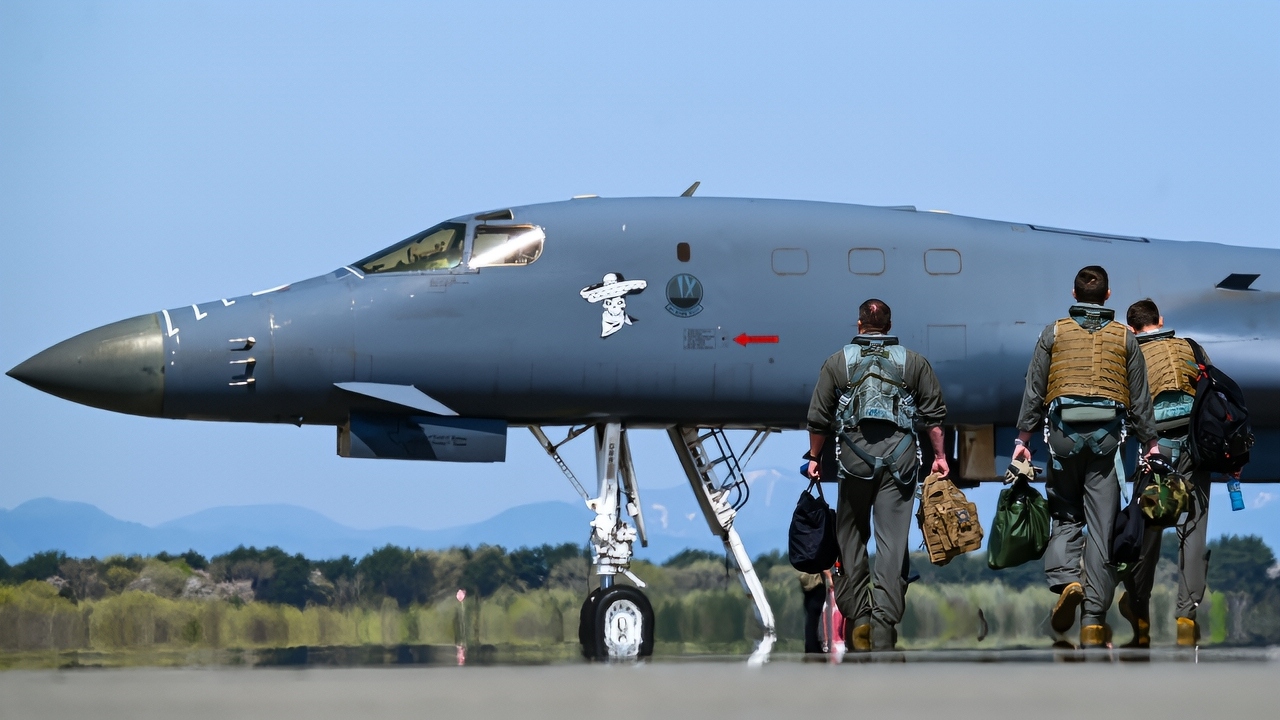
9th Expeditionary Bomb Squadron aircrew step out to the B-1B Lancer during Bomber Task Force 25-2 at Misawa Air Base, Japan, May 9, 2025. BTF 25-2 demonstrates Allied strength by forging strong alliances, showcasing our resolve, and deterring aggression, while also supporting global stability and security and strengthening military capabilities. (U.S. Air Force photo by Airman 1st Class Mattison Cole)
But after six months of war, the United States appears to have found a much harder obstacle for Tehran to circumvent: physically preventing tankers from reaching Iranian ports.
Iran, however, insists that it is still getting oil to customers.
Iranian Petroleum Minister Mohsen Paknejad said on August 27 that crude sales had continued despite the U.S. naval blockade, although he acknowledged that volumes had fallen.
“At some points, it became possible for us to transport oil to the point of delivery to the customer, which was a significant amount.
Up to this point, the process of oil sales, in the sense of delivery to customers, outside our territorial waters, in distant waters, is continuing,” he said, adding that he would not provide further details for fear of those methods being used by the “enemy.”
Independent shipping data, however, appears to suggest that whatever Iran is doing, it is not providing a sustainable replacement to the oil trade it maintained before the blockade, and the damage Trump is inflicting is causing serious harm to the country’s economy.
Iran Is Still Selling Oil
Iran knew how to move crude oil even under sanctions. Its shadow fleet used a mix of confusing ownership structures, manipulated tracking information, and ship-to-ship transfers to obscure where cargoes originated and where they ultimately went.
Those methods are still being deployed, but less successfully now that tankers are being physically blocked from moving through the Strait of Hormuz.
A Washington Post investigation published in May identified at least 13 tankers transferring Iranian crude near Indonesia’s Riau Archipelago, for example, after the blockade was first imposed.
Satellite imagery and vessel-tracking information showed Iranian oil being transferred between ships thousands of miles from the Persian Gulf, allowing cargoes that had already escaped the blockade to continue moving through Tehran’s clandestine distribution network.
Dozens of Iran-linked vessels are still active today, too, despite the blockade.
David Tannenbaum, the director of the U.S.-based sanctions and anti-money-laundering consultancy firm Blackstone Compliance Services, said this month that his firm had identified 51 Iran-linked shadow fleet tankers still operating in the Gulf of Oman and another 81 still delivering cargoes in Asia or waiting off Malaysia.
Separate tanker tracking data seems to support that conclusion, too, with Vortexa, a British freight analytics company, estimating that Iran still had 107 million barrels of crude aboard tankers as of August 26, much of it being positioned beyond the area where U.S. forces are preventing vessels from returning to Iranian ports.
That means Iran has not been fully cut off from the international oil market – but it also doesn’t mean it is easily surviving the blockade. Iran’s big problem now is replenishing supplies as it sells them.
Iran Is Running Out Of Oil It Can Sell
The scale of the problem for Iran is becoming quite obvious, with estimates from Vortexa and Kpler cited by Reuters showing that Iran loaded only around 220,000 to 255,000 barrels per day of crude oil and condensate last month.
That was down from around 749,000 barrels per day in July, and down further from 2 million barrels per day in March.
Kpler, Vortexa, and TankerTrackers.com have also failed to identify a single Iranian crude cargo vessel successfully traveling through the Strait of Hormuz to China since Washington restored the blockade on July 14.
Meanwhile, Vortexa’s tracking data showed that the total volume of Iranian crude stored aboard tankers fell from around 135 million barrels at the end of July to 107 million barrels by August 26.
The figures show why Iran cannot truthfully claim it is still selling oil to any meaningful degree.
Tehran is drawing down crude that had already made it past the blockade, without proving it can move enough new oil out to replace it.
The Blockade Is Starting to Hurt
The consequences of Iran’s problems are being felt well beyond the oil industry. Crude oil exports are Tehran’s most critical source of foreign currency.
Without that revenue, the regime cannot pay for imports, support the rial, or cover state spending.
That’s why U.S. President Donald Trump continues to insist that Iran is a “failed state” that cannot even pay its soldiers.
Inflation is wreaking havoc on the national economy, too, with the International Monetary Fund expecting inflation to close in on 70% this year. The rial also continues to fall against the dollar as the war drags on.
About the Author: Jack Buckby
Jack Buckby is a British researcher and analyst specializing in defense and national security, based in New York. His work focuses on military capability, procurement, and strategic competition, producing and editing analysis for policy and defense audiences. He brings extensive editorial experience, with a career output spanning over 1,000 articles at 19FortyFive and National Security Journal, and has previously authored books and papers on extremism and deradicalization.


