

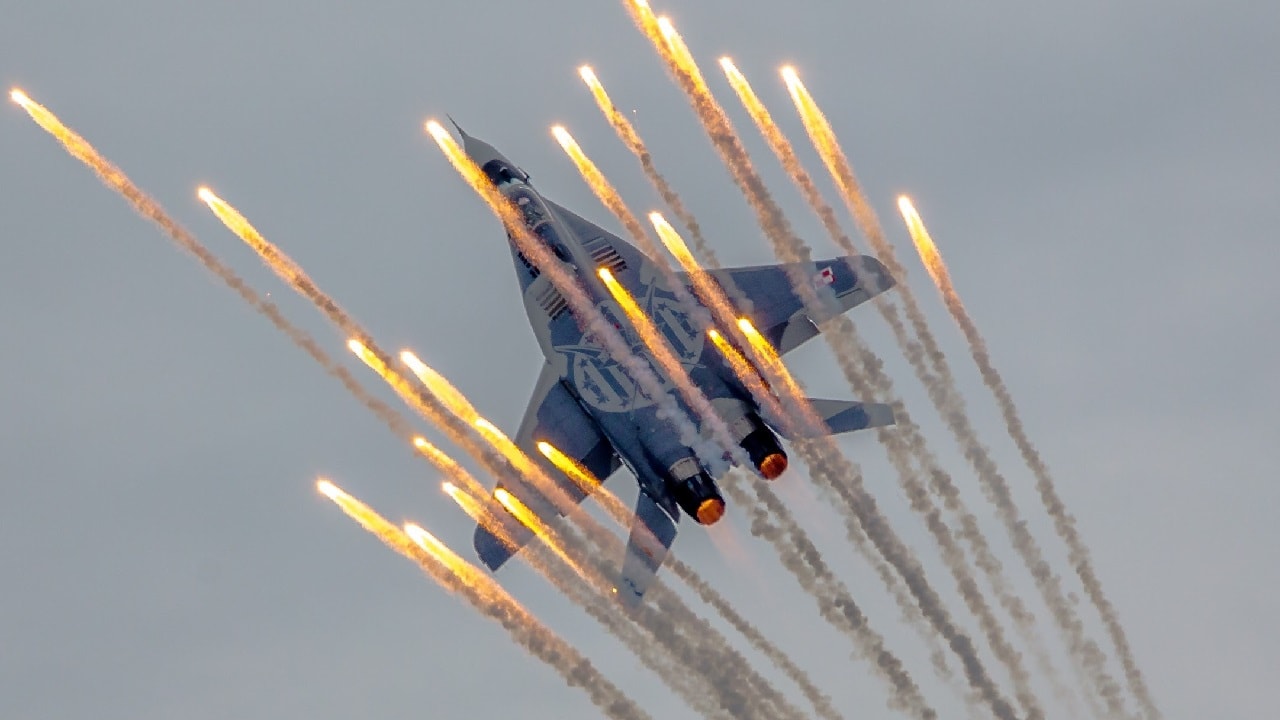
Key Points – Iran’s two squadrons of Russian-built MiG-29 fighters, tasked with defending the capital, have been conspicuously absent from the skies during Israel’s “Operation Rising Lion” air campaign.
-Despite being among the most capable jets in Iran’s aging air force, they have not challenged the Israeli aircraft flying with impunity over Tehran.
-This inaction highlights the technological gap between Iran’s older Soviet-era hardware and Israel’s modern, US-made F-35s, F-15s, and F-16s.
-Reports suggest Iran may have shuttled its fighters to far-flung airfields to protect them from strikes, effectively ceding air superiority to Israel over its own capital.
Iran’s MiG-29 Fighters Were To Protect Tehran, But Have Been MIA
The Iranian government relies primarily on its ground-based air defenses to defend against air attack, as well as the deterrent capabilities of its drone and ballistic missile arsenals, which can launch massive retaliation.
The country also deploys 17 squadrons of fighter aircraft, which provide secondary air-to-air and strike capabilities. Among the fighter aircraft are two squadrons of old Russian-built MiG-29s. Tehran tasks these 35 aircraft with defending the capital of Iran.
The Iranian Air Force fighters have been noticeably absent during the Israeli bombing campaigns over Iran, especially the MiG-29s in Tehran. With the Israeli Air Force (IAF) destroying Iran’s missile defenses, Israeli aircraft fly unchallenged over Tehran, even in daytime.
Iran has over 300 fighter aircraft; however, the number of airworthy airframes is another matter. Most of them date back to the mid-to-late 1970s. Iran neglected its air force to build missiles and drones and concentrated its army on asymmetric warfare. Now, they are paying the price.
Iran’s MiG-29s Are Old and Invisible While Tehran Gets Hammered
When the Shah was deposed in 1979, Ayatollah Khomeini, who was virulently anti-American, but Russia was a close second. When he died a decade later, the Russians moved quickly to change the narrative in Tehran.
Within two years, Iran had purchased the aforementioned two squadrons of MiGs and a squadron of Su-24M strike fighters. The MiG-29 was a medium-weight fighter, falling within the same weight range as the American F-18 Hornet—larger than an F-16 but smaller than an F-15. It had outstanding flight characteristics.
When the Soviet Union collapsed in 1991, the pipeline to Soviet aircraft was closed. While the older MiGs are still good aircraft, they are no match for the American-built F-35 or F-22. The Israeli version, the F-35I Adir, is an outstanding aircraft and has been wreaking havoc in Syria, Lebanon, Gaza, and Iran.
In October of 2024, Israel destroyed Iran’s anti-aircraft defenses before conducting airstrikes on Iran’s nuclear research facilities to send a message. There was not an Iranian fighter in sight. Since the June bombings began during Operation Rising Lion, the Iranians have been shuttling their fighters to far-flung airfields in the north of the country. Still, there hasn’t been any air-to-air combat between the IAF and the Iranian Air Force (IRIAF).
The big question centers on Iran’s MiG-29 fighters and their apparent disappearance from the field of view raises questions about where they could have gone and what is happening with Iranian combat aircraft in general.
Features of the MiG-29 of Iran
Iran’s Islamic Republic of Iran Air Force (IRIAF) operates a fleet of MiG-29 fighter jets, with around 24 to 30 aircraft confirmed to be in active service. These aircraft, primarily acquired from the Soviet Union in the early 1990s, are considered a key component of Iran’s air defense capabilities.
While the MiG-29s are among the most capable fighters in Iran’s arsenal, they are generally considered to be technologically outmatched by modern Western fighters, such as the F-35.
The MiG-29 remains a capable fighter, but its avionics and weapon systems are outdated compared to those of more modern aircraft. However, they are still seen as a valuable asset for local air defense and can force potential adversaries to allocate resources to counter them. Again, it is a puzzlement why Iran hasn’t flown them yet. What could they be saving them for?
As pointed out above, the MiG-29s in Iran’s inventory are mostly older, basic models and have not been significantly upgraded to more modern standards like the MiG-29SMT.
The US Blocked Iran and Bought 21 MiG-29s From Moldova
After the collapse of the Soviet Union, Iran attempted to purchase 30 MiG-29s from Moldova, which couldn’t afford to retain them.
Iran expressed the willingness to purchase these second-hand MiGs from Moldova in 1997. Washington feared that Moldova would sell Iran the MiGs, particularly the nuclear-capable MiG-29C version, which Iran allegedly sought at the time.
However, the US intervened and purchased six MiG-29As, one MiG-29B, and 14 MiG-29Cs, along with 500 air-to-air missiles and all the necessary spare parts and diagnostic equipment at the Moldovan air base, where the aircraft were stationed in 1997.
Iran’s Supreme Leader keeps threatening the US and Israel, but time is running out for this regime. People took President Trump’s advice and have been streaming out of Tehran. It’s been reported that as much as 80 percent of the people hate the regime.
And the vaunted Soviet-built MiG-29s are nowhere to be found over the skies of the capital.
About the Author:
Steve Balestrieri is a National Security Columnist. He served as a US Army Special Forces NCO and Warrant Officer. In addition to writing on defense, he covers the NFL for PatsFans.com and is a member of the Pro Football Writers of America (PFWA). His work was regularly featured in many military publications
Fighter Jet Fails
Russia’s Su-57 Felon Stealth Fighter Is a Waste of Rubles


Pingback: The F-22 Raptor Stealth Fighter Has Just 1 Mission - National Security Journal
Pingback: The US Military Bought a 'Fleet' of 'Nuclear-Capable' MiG-29 Fighters - National Security Journal