

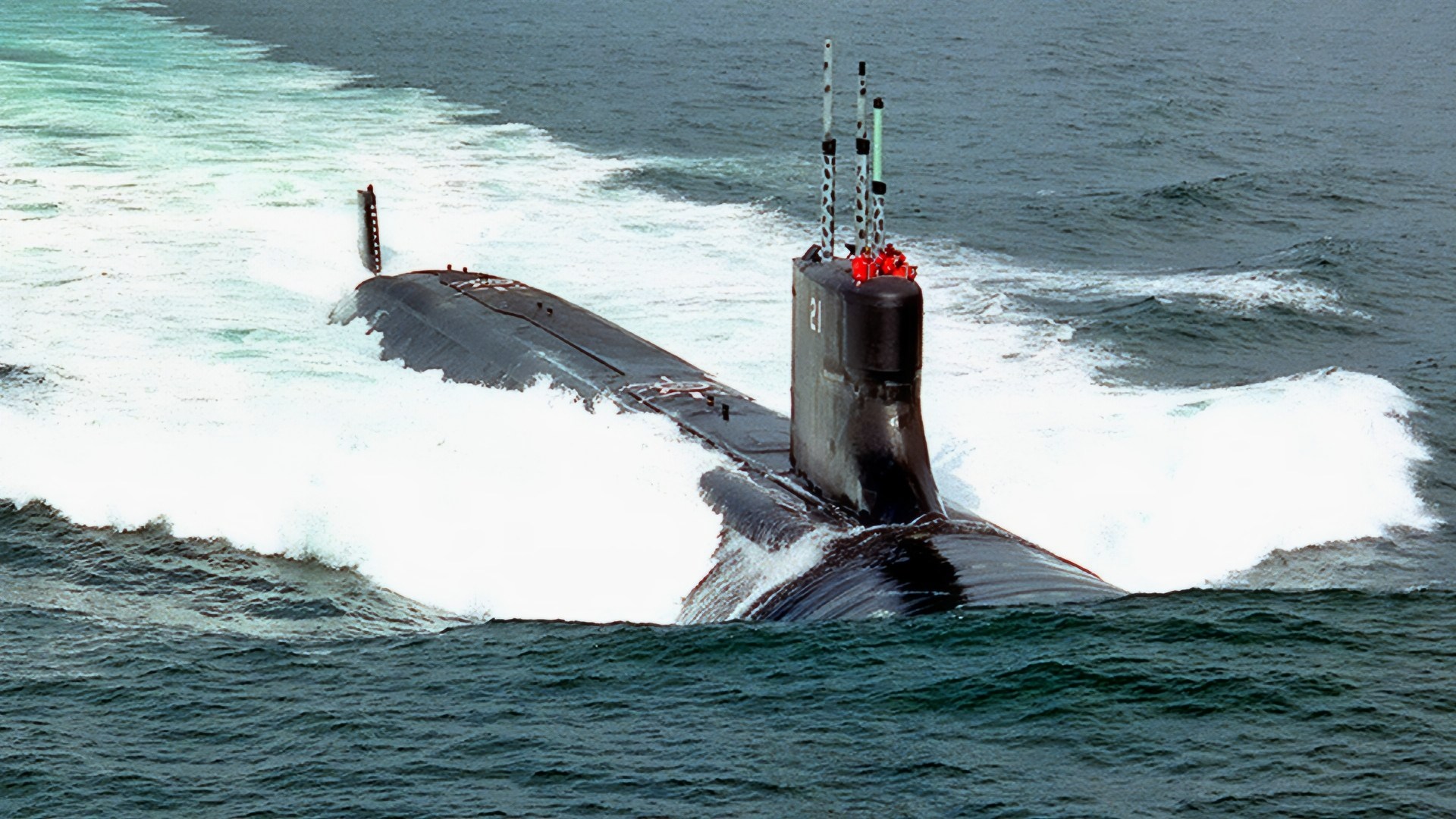
Key Points and Summary – AI-enhanced sensors, quantum magnetometers and swarming undersea drones are making it harder for submarines to stay hidden, raising fears that the age of stealth subs is ending.
-Chinese researchers tout new anti-submarine networks that could shrink escape odds to just 5 percent and make future oceans nearly “transparent.”
-Yet navies are responding in kind, pushing quieter propulsion, smarter signature management, deeper operations and manned-unmanned teaming.
-Nuclear boats remain central to deterrence, and the U.S. still fields the world’s most capable undersea force.
-The contest is shifting from simple quietness to intelligent, networked stealth—not the end of subs, but a far riskier era.
China Thinks It Can See Every Submarine. Here’s Why That’s Wrong
Advances in artificial intelligence, detection systems, and signal processing, combined with swarming autonomous underwater drone systems, could make it effectively impossible for submarines to maintain their stealth.
While the era of the stealth submarine isn’t over, the platform is being forced to evolve because of the evolution of AI and new sensing technologies such as quantum sensors) that challenge traditional stealth. This is leading to an arms race: Subs need smarter, more integrated stealth and detection capabilities to remain viable for the coming decades.
While threats are increasing, navies are adapting with new quieting tech, AI, drones, and deeper operations to maintain undersea superiority, suggesting a shift towards intelligent stealth, rather than its end.
AI & Advanced Sensors Are Improving
A recent study from China, published in the journal Electronics Optics & Control in August, reportedly revealed an advanced AI-driven anti-submarine warfare (ASW) system capable of detecting and tracking even the quietest submarines.
Meng Hao, an engineer at the China Helicopter Research and Development Institute, highlighted how intelligent, real-time decision-making could drastically reduce a submarine’s chances of escaping detection.
The findings suggest that traditional submarine stealth strategies could soon be far less effective against AI-enhanced naval technologies.
Non-Acoustic Detection
Quantum sensors and advanced gravimeters could detect magnetic or gravitational disturbances from submarines, bypassing traditional sonar.
According to NASA, “A superconducting quantum interference device (SQUID) is a gadget used to measure extremely weak signals, specifically magnetic flux. It can detect subtle energy changes, up to 100 billion times weaker than the electromagnetic energy required to move a compass needle.”
The Chinese study also claims that the ASW system could reduce a submarine’s chance of escaping detection to just 5 percent.
Once deployed, the ASW system could rapidly determine where to search, how to configure its sensors, and how to respond when a submarine attempts evasive maneuvers such as zigzagging, going silent, or deploying decoys.
Ocean Transparency
Some studies predict the oceans could become “transparent” to detection by the 2050s, though this is debated.
However, in April, scientists from the China Aerospace Science and Technology Corporation said they had developed a drone-mounted quantum sensor system capable of tracking submarines with pinpoint accuracy.
They claim the coherent population-trapping atomic magnetometer is as sensitive as the MAD-XR system used by NATO countries but far cheaper, enabling deployment at a massive scale.
Rose Gottemoeller, former deputy secretary-general of NATO, warns that “the stealth of submarines will be difficult to sustain, as sensing of all kinds, in multiple spectra, in and out of the water, becomes more ubiquitous.”
But before we absolutely declare that submarines are obsolete, remember that submarine technology is also improving.
Submarines Are Evolving As Well As Detection
Submarines are getting quieter through the use of pump-jets and better hull coatings and are using advanced signature management techniques such as degaussing and decoys.
The adoption of stealth principles in submarine design will significantly expand in the next few years. As more countries recognize the strategic advantages of stealth submarine design, the technology will improve.
Manned subs will be integrated with and work with unmanned underwater vehicles and surface vessels, creating a networked advantage.
AI for Defense & Offense
AI helps submarines think and adapt faster, enhancing their ability to evade detection and process complex data.
New designs such as the U.S. Columbia-class focus on extreme quietness, longer service life, and space for future technology. Nuclear submarines remain crucial for deterrence, providing second-strike capability, and this role ensures their relevance for the foreseeable future.
Submarines have long been a cornerstone of naval strategy. They can conduct nuclear strikes, gather intelligence, or target carrier groups while remaining nearly undetectable. The U.S. Navy, for example, argues that its fleet of nuclear submarines serves as a crucial deterrent against the rapidly expanding People’s Liberation Army Navy.
The U.S. operates about 71 nuclear-powered submarines, including about 50 attack submarines such as the modern Virginia-class and older Los Angeles-class, plus 18-19 ballistic missile submarines and guided-missile Ohio-class boats. Together, they form the world’s most capable underwater force.
Despite all the proclamations by the Chinese that ASW makes submarines obsolete, they are rapidly building their own submarine fleet, with about 65 submarines as of today.
These vessels can blend into the ocean’s background noise and deploy advanced drones designed to confuse and distract enemy tracking systems.
The battle is shifting from mere quietness to greater intelligence and connectivity, with AI and new sensors driving continuous evolution in undersea warfare.
The era of the stealth submarine may not be over just yet, but it is getting more dangerous for those in the silent service.
About the Author: Expert Steve Balestrieri
Steve Balestrieri is a National Security Columnist. He served as a US Army Special Forces NCO and Warrant Officer. In addition to writing on defense, he covers the NFL for PatsFans.com and is a member of the Pro Football Writers of America (PFWA). His work was regularly featured in many military publications


