

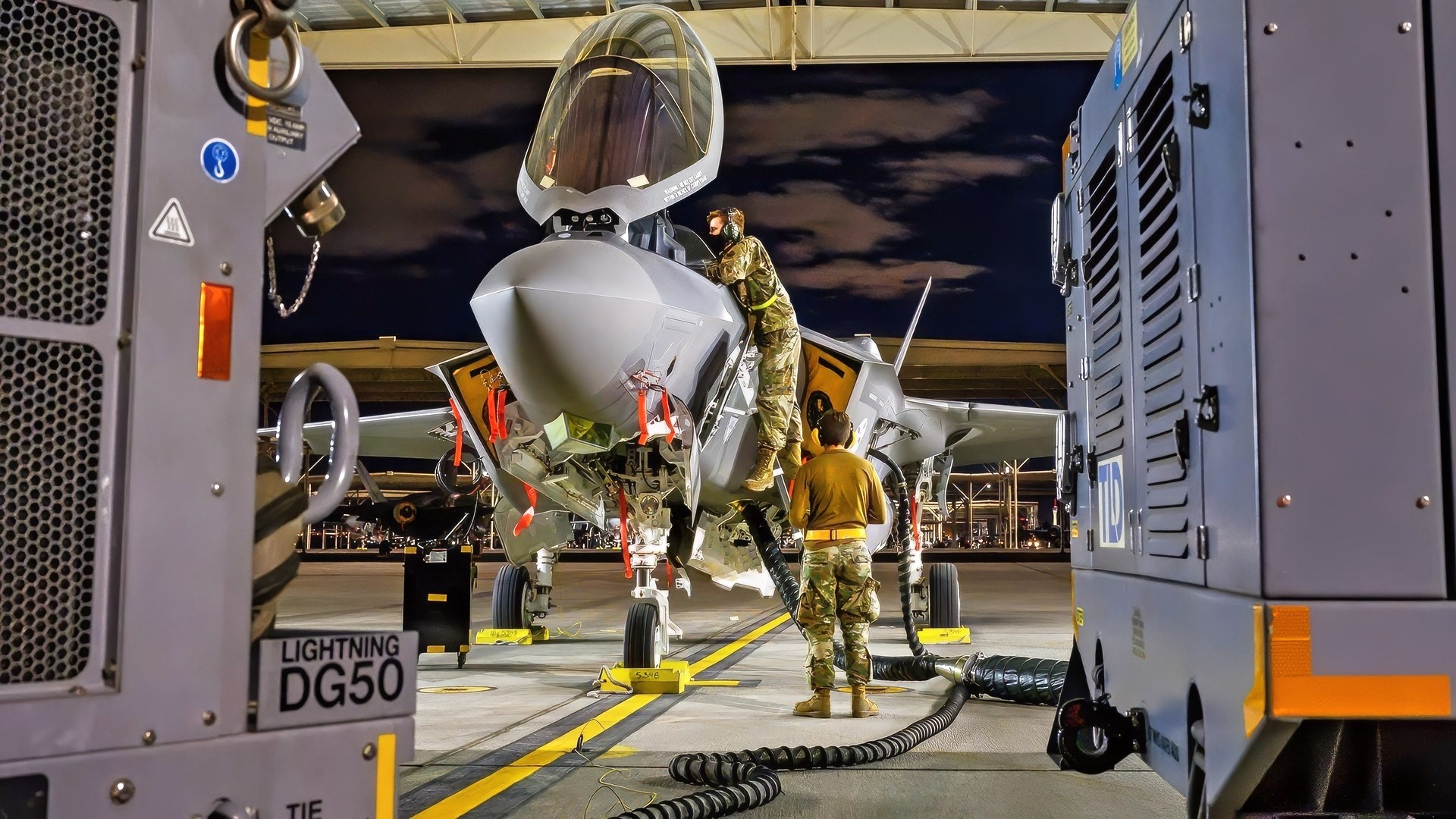
The House Armed Services Committee pushed through its version of the fiscal 2027 defense policy bill late last week, adopting new “right to repair” provisions.
The committee adopted the FY27 National Defense Authorization Act (NDAA) in a 44-12 vote, with Democrats making up all of the “no” votes. However, despite most of the amendments being split along party lines, the “right to repair amendment was one of the rare moments that enjoyed wide bipartisan support.
The amendment, which was introduced by a bipartisan duo of Reps. Maggie Goodlander (D-NH) and former Green Beret Pat Harrigan (R-NC), would enable the Defense Department to obtain government-purpose rights by default for “any technical data, computer software, or computer software” unless the contractor provides evidence that it needs to retain more restrictive intellectual property rights.

Capt. Andrew “Dojo” Olson, F-35 Demonstration Team pilot and commander performs aerial maneuvers during the Wings Over Houston Airshow Oct. 18, 2019, in Houston, Texas. The show featured performances from the U.S. Air Force Thunderbirds, Tora, Tora, Tora, and Oracle. (U.S. Air Force photo by Senior Airman Alexander Cook)

A U.S. Air Force F-35A Lightning II assigned to the 56th Fighter Wing, Luke Air Force Base, Arizona, performs a strafing run during Haboob Havoc, April 24, 2024, over Barry M. Goldwater Range, Arizona. Haboob Havoc is a total force exercise that provides a way for pilots from various bases to demonstrate their skills across a diverse range of aircraft, including F-35 Lightning IIs, F-16 Fighting Falcons, and A-10 Thunderbolt IIs, while also testing their abilities in different mission sets such as dogfighting and gun runs. (U.S. Air Force photo by Airman 1st Class Mason Hargrove)
The Amendment Is “Deeply American”
“Right to repair is in the House’s final version of the NDAA, and every service that asked us for it is going to get it,” Harrigan said in a released statement.
“When you are contemplating a protracted conflict in a far-off contested environment, where access to contractors may be limited and rapid organic maintenance is critical to mission success, this is a readiness requirement, not a nice-to-have.”
Goodlander stated that the amendment was common sense and “deeply American, to give American servicemen and women the tools and ability to fix and maintain their own equipment.
“For decades, our military has been forced to operate under a broken system that makes even routine repairs unnecessarily difficult, threatens readiness, and costs taxpayers billions of dollars,” Goodlander said. “This amendment cuts red tape, closes loopholes, and helps ensure our warfighters can do the jobs we’ve asked them to do.”
Allowing The Military To Fix Their Own Equipment Is Common Sense
Virginia Burger, senior defense policy analyst at the government watchdog POGO, was happy that the amendment was finally passed.
“Allowing the military the right to repair its own equipment is common sense: it benefits taxpayers, service members, and the country’s national security as a whole,” she said.
The current law forces military members to rely on service contractors to repair equipment, which increases costs and delays and gives far too much financial advantage to companies, rather than allowing service members the flexibility to repair the equipment themselves.
Last year’s NDAA included right-to-repair provisions written into it by both the House and the Senate. However, those provisions were ultimately removed from the compromise bill, even though the Trump administration had stated it supported them.
Burger used a hypothetical scenario in which a Marine on an island in the Pacific has a generator knob break off.
“Wouldn’t it be handy if you could just fix that yourself?” Burger said. “However, when you purchased or procured that piece of equipment, it was written into the contract that only the defense contractor you purchased it from can fix it or replace it.
“You are then left in a lurch. Where are we sending this generator, back to stateside? Are we shipping out a new one? What are the costs of that, right? That’s a simplified example, but this is the reality of what happens. The U.S. military pays to fly out contractors, civilian-sourced repair officials, to fix stuff on deployed ships.”
The HASC Authorizes A New Destroyer, And Sets On Names
In other news, the Armed Services Committee authorized a $500 million boost to help pay for a second Arleigh Burke-class guided missile destroyer in FY27. To pay for it, the committee canceled funds for submarine tenders, littoral combat ship modernization, and KC-46 tanker development to increase DDG-51 spending.
One of the more heated debates centered around the Pentagon’s name. In a 29-27 vote along party lines, Republicans adopted an amendment from Rep. Ronny Jackson (R-TX) that would formally rename the Defense Department as the “Department of War.”
Rep. Adam Smith (D-WA), the committee’s ranking Democrat, thought the idea was a waste of time.
“I really think this is one of the dumbest things that has been done by this administration, and it doesn’t make any sense, but practically speaking, it makes no freaking difference whatsoever,” he said.
Two Republicans joined Democrats and voted 29-27 to revert the names of military bases in the South that were rebranded from the names of Confederate generals during the Civil War back to the names chosen by a congressionally chartered commission in 2022.
Pentagon chief Pete Hegseth changed the names back to the Confederate names early in the Trump administration’s second term.
About the Author: Steve Balestrieri
Steve Balestrieri is a National Security Columnist. He served as a US Army Special Forces NCO and Warrant Officer. In addition to writing on defense, he covers the NFL for PatsFans.com and is a member of the Pro Football Writers of America (PFWA). His work was regularly featured in many military publications.


