


Key Points and Summary – A hypothetical matchup between China’s 5th-gen J-20 and South Korea’s new 4.5-gen KF-21 highlights a critical capabilities gap.
-The J-20 is a true stealth fighter with internal weapons bays. The KF-21, while faster, is currently a “stealthy-shaped” but non-stealth aircraft because its initial version carries weapons externally, massively increasing its radar signature.

KF-21 Boramae Fighter KAI Image
-In a beyond-visual-range fight, the J-20 would likely win by detecting and engaging first.
-While a close-range dogfight is a closer race, the J-20’s fundamental stealth advantage gives it a decisive edge in most combat scenarios.
KF-21 vs. J-20: Fighter Showdown That Could Happen?
China currently poses the biggest threat to the U.S. and its allies in Southeast Asia. Its Air Force boasts a formidable fleet of J-20 fifth-generation aircraft that can penetrate enemy airspace and carry out devastating strikes.
To counteract this threat, South Korea has recently been aiming to modernize its air fleet to remain competitive.
Rather than requiring American jets like Japan has done, South Korea has instead sought a domestically produced solution. The result is the KAI KF-21, a multi-role strike fighter that incorporates several fifth-generation technologies.
However, is it enough to beat back the Chinese tide?
Two Fighters That Have Never Seen Combat
The J-20, developed by China’s Chengdu Aircraft Corporation, is a fifth-generation stealth air superiority fighter. It was designed to achieve dominance in long-range engagements and maintain survivability in contested airspace.
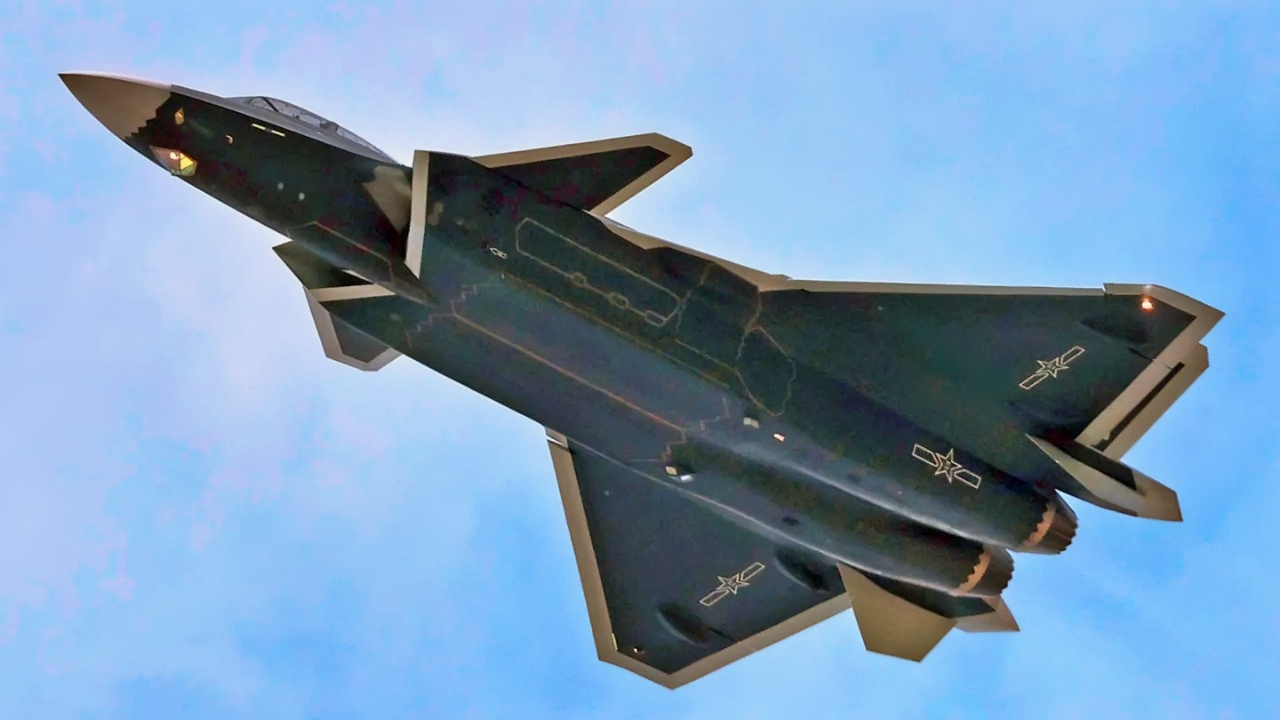
J-20S Fighter from X Screenshot. Image Credit: X.
The aircraft first flew in 2011 and entered service with the People’s Liberation Army Air Force (PLAAF) in 2017. It has since evolved through several variants, including the J-20A, the upgraded J-20B with improved engines, and the J-20S, a twin-seat version intended for manned-unmanned teaming.
In contrast, the KF-21 Boramae is South Korea’s ambitious attempt to develop a next-generation multirole fighter. Produced by Korea Aerospace Industries (KAI), the KF-21 is currently classified as a 4.5-generation aircraft, though future variants aim to reach fifth-generation capabilities.
Its first flight occurred in 2022, and it is expected to enter service around 2026.
The KF-21 is being developed in stages, with Block I focusing on air superiority and Blocks II and III introducing multirole and stealth enhancements, respectively.
The J-20 vs Korea’s 4.5-Generation Fighter
The design philosophies of the two aircraft diverge significantly. The J-20 emphasizes stealth and long-range interception.
It features a canard-delta wing configuration, which enhances maneuverability, and diverterless supersonic inlets (DSI) that improve stealth and airflow efficiency.
Its internal weapons bays allow it to carry missiles without compromising its radar cross-section.

KF-21. Image Credit: Creative Commons.
The aircraft is coated with radar-absorbent materials and is powered by thrust-vectoring engines, currently the WS-10C or WS-15 (sources vary).
The KF-21, on the other hand, is designed with modularity and cost-effectiveness in mind. While it incorporates stealth shaping and advanced avionics, its Block I variant lacks internal weapons bays, meaning it must carry weapons externally, which reduces its stealth profile.
Future Block III variants are expected to include internal bays and improved stealth coatings, bringing it closer to fifth-generation standards.
The KF-21 is powered by two GE F414 engines, which are reliable but less powerful than the J-20’s planned WS-15 engines.
Engine Performance and Avionics
Performance-wise, the KF-21 actually surpasses the J-20 in some metrics. It has a higher top speed, reaching Mach 2.5 compared to the J-20’s Mach 2.0. Its service ceiling is also slightly higher, and it matches the J-20 in rate of climb.
However, the J-20 has a longer combat range and benefits from more powerful engines, which enhance its overall agility and payload capacity. Sources differ on the J-20’s actual power plant but is believed to use domestically made WS-10 or WS-15 engines.
In terms of avionics and sensors, both aircraft are equipped with active electronically scanned array (AESA) radars, infrared search and track (IRST) systems, and electronic warfare suites.
The J-20, however, has more mature sensor fusion capabilities and includes a distributed aperture system (DAS) that enhances situational awareness. Its twin-seat variant, the J-20S, is designed for manned-unmanned teaming, allowing it to coordinate with drones and other assets in complex combat scenarios. The KF-21’s avionics are advanced and modular, which allows for future upgrades, but little is known about these systems and their capabilities.
Armament is another area where the J-20 holds an advantage. It is equipped with internal bays that can carry around 24,000 lb of munitions. These include PL-15 long-range air-to-air missiles and PL-10 short-range infrared missiles, allowing it to engage targets without compromising stealth.
The KF-21 Block I carries weapons on external hardpoints, including AIM-120 AMRAAMs and AGM-65 Mavericks. While future variants will include internal bays and potentially integrate Meteor missiles, the current configuration is less suited for stealthy engagements.
Which Fighter Wins?
Comparing these two fighters is difficult considering the lack of concrete data we have on these systems, but the KF-21’s inferior stealth capabilities are a significant downside.
In a beyond visual range (BVR) fight, the J-20 would likely win.
Its stealth profile, advanced sensors, and long-range missiles give it a significant advantage in detecting and engaging the KF-21 before being seen. The KF-21’s external weapons and larger radar cross-section make it more vulnerable in such scenarios.
In a within visual range (WVR) dogfight, it’s a much closer race. The KF-21’s higher speed and ceiling could offer tactical advantages, allowing it to maneuver aggressively and potentially evade incoming missiles.
The J-20, while not as maneuverable as the F-22 or the Su-57, is still highly maneuverable thanks to the WS-15 engines, which reportedly feature thrust vectoring.
Additionally, the J-20’s superior situational awareness and sensor fusion would likely give its pilot an edge in tracking and targeting.
In a close-range battle, the victory is decided by who can lock on to whom first.
About the Author: Isaac Seitz
Isaac Seitz, a Defense Columnist, graduated from Patrick Henry College’s Strategic Intelligence and National Security program. He has also studied Russian at Middlebury Language Schools and has worked as an intelligence Analyst in the private sector.
More Military
Why the U.S. Navy Loves the F-14 Tomcat
F-14 vs. MiG-29: The Winner Is Clear


David
September 9, 2025 at 10:59 pm
The Chinese J-20 especially the J-20s is not primarily designed for dogfight. From the 03 Sep parade showdown, they are now focusing on manned-unmanned teaming. The second pilot, supported by AWACS such as KJ-3000, controls the drones and loyal wingmen to search and attack beyond the visual range. Since the loyal wingman drones are unmanned, they are not constrained by the effects of gravitational acceleration (G-forces) on human pilots, giving then a significant advantage in performing high-manoeuvrability fight operations. Most likely, the KF-21 is shot down by the drone’s air-to-air missile beyond the visual range without even detecting the J-20s.
Yasser
September 9, 2025 at 11:08 pm
Despite the many provocative misleading pieces of data, the one that stands out is your claim that the KF-21 is faster than the J-20, from where on earth did you bring this joke?