

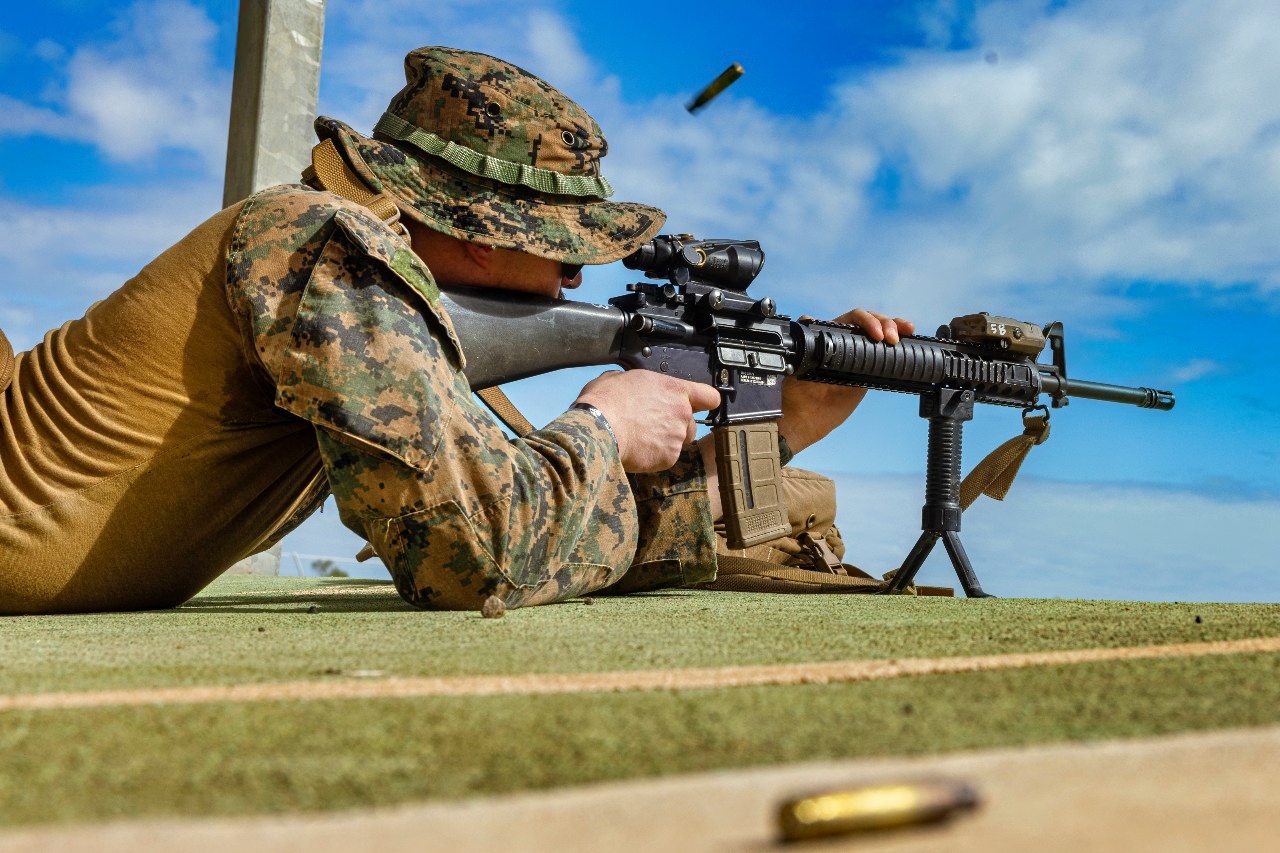
Key Points – The M16A4 served as the primary service rifle for the US Marine Corps from 1997 until 2015.
-Essentially an M16A2 with a flat-top receiver and a MIL-STD-1913 rail system, it allowed for the mounting of modern optics and accessories.
-While its 20-inch barrel provided a longer effective range, Marines operating in Iraq and Afghanistan found the rifle too long and unwieldy for close-quarters battle and vehicle-borne operations.
-In 2016, listening to this feedback, the Marine Corps officially began replacing the M16A4 with the lighter, more compact M4 carbine for its infantry units, though the A4 remains in use with support personnel.
M16A4, The Marine Corps’ Rifle
The Marine Corps has characterized the M16A4 Service Rifle and the M4 Service Carbine as 5.56mm, magazine-fed, gas-operated, air-cooled, shoulder-fired weapons that can be fired either in automatic three-round bursts or semiautomatic single shots, depending on the position of the selector lever.
The M16A4 uses a direct gas impingement system to cycle the action. When a round is fired, high-pressure gases are tapped from the barrel, travel through a gas tube, and enter a chamber in the bolt carrier.
This pressure pushes the bolt carrier back, retracting the bolt, extracting the spent cartridge, and loading a new one.
Although the Marine Corps largely replaced the M16A4 as the standard-issue rifle for Marine Corps infantry units, it was not entirely phased out of service.
The M4 carbine was approved to replace it starting in 2016. The switch was driven by a need for a more compact and manageable weapon, particularly in close-quarters combat. While some units still use the M16A4, it’s primarily used by support personnel and non-infantry Marines.
Colt M16 History
The M16 Rifle and its variants had a storied, if uneven, history. Eugene Stoner, an engineer for ArmaLite Corp., developed the AR-15 rifle in the late 1950s. Armalite received favorable reviews but failed to secure a sale to the government.
The rifle replaced the M14’s wooden stocks with black plastic, and the caliber was changed to .223/5.56mm from .30 caliber.
In 1959, Colt obtained a license for the design and sold it to the US Air Force in 1962. The Department of Defense redesignated the rifle, the M16, and since then, the upgraded and variant models of the M16 have served in the US military.
Early Issues In Vietnam
Early models of the M16 were used in Vietnam during the mid-1960s but were prone to malfunction due to jamming. Most of the issues were resolved through improved training on cleaning the weapon, adjusting the powder in the ammunition used, and developing the forward assist, which reduced the frequency of malfunctions. This weapon was called the M16A1.
The rifle was used throughout the US military until the early 1980s when the military modified the design to incorporate a heavier barrel for longer sustained fire. Additionally, the fully automatic feature was removed because it was deemed wasteful of ammunition and inaccurate.
Instead, the rifle incorporated the three-round burst. This model was dubbed the M16A2.
The M16A4 and the M4 Carbine were first issued to select units in the mid-90s. In the Special Forces, we were issued M4s around 1995. The Marine Corps adopted the M16A4 in 1997. It was the primary weapon of Marines until 2015 when the Corps announced its switch to the M4.
Meet The M16A4
The fourth-generation M16A4 is essentially an M16A2 but with a flat-top receiver, a MIL-STD-1913 rail, and a handguard. It also has an optional M5 Adapter Rail System for mounting a range of accessories. The system can accommodate modern optics and accessories and incorporate both the M203 and M320 40mm Grenade Launchers.
The Marine Corps published a video for recruits explaining all parts of the M16A4. The Marines continued to use it in Iraq and Afghanistan for years, although the weapon was becoming outdated and prone to jamming in each location’s dusty environs.
The Army had used the M4 carbine for approximately 15 years before the Marine Corps adopted it.
However, the M16A4 is still used by support or non-infantry Marines. Marine Corps Commandant Gen. Robert Neller approved the switch, listening to his Marines, who had complained that after years of close-quarters battle, vehicle-borne operations, and urban combat, the M16A4 was too long and unwieldy for such operations.
While the M16A4 had a longer effective range due to its 20-inch barrel, the M4A1, with a collapsible butt stock and 14.5-inch barrel, was lighter and more compact, more maneuverable, and easier to handle in close quarters, making it better suited for close-quarters combat and urban environments.
Debates rage over which one was better. And it ultimately depends on the situation for which it is being used.
About the Author:
Steve Balestrieri is a National Security Columnist. He served as a US Army Special Forces NCO and Warrant Officer. In addition to writing on defense, he covers the NFL for PatsFans.com and is a member of the Pro Football Writers of America (PFWA). His work was regularly featured in many military publications.
More Military
How Do You Replace the Main Battle Tank?
The F-35 ‘Ferrari’ Fighter Might Be ‘Coming Soon’ to a War Near You
The B-21 Raider Bomber Question We Keep Asking
KF-21: South Korea Wants Its Very Own F-35-Style Stealth Fighter
‘Go Home’: F-22 Raptor Flew Right Under Iran’s Old F-4 Tomcat (Unseen)


