


Key Points and Summary – Boeing’s X-51A “Waverider” was a hypersonic tech demonstrator built with AFRL, DARPA, and Pratt & Whitney Rocketdyne to validate scramjet flight.
-Air-dropped from a B-52, the near-wingless vehicle rode compression lift from its own shockwave and burned JP-7 in a SJY61 scramjet.
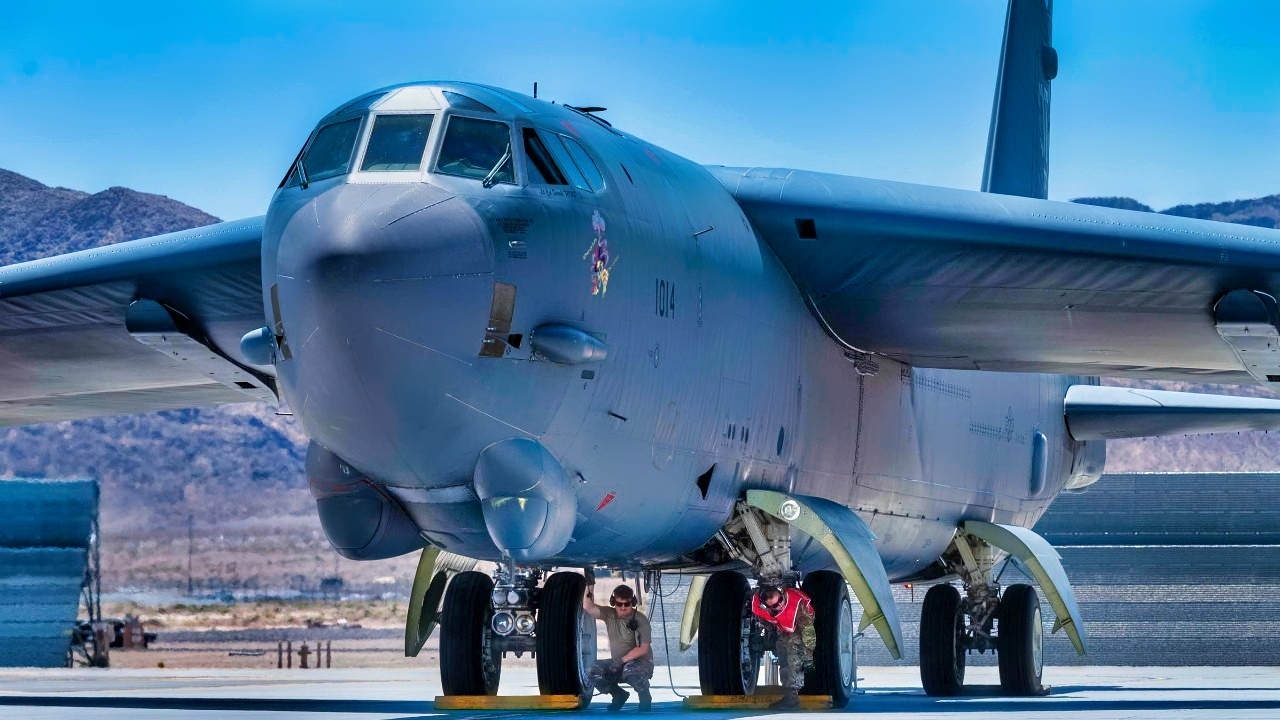
U.S. Air Force Tech. Sgt. Jacob Durham, left, and Staff Sgt. Kenneth Garris, crew chiefs assigned to the 307th Aircraft Maintenance Squadron, Barksdale Air Force Base, Louisiana, prepare to launch a B-52H Stratofortress in support of U.S. Air Force Weapons School Integration (WSINT) at Nellis Air Force Base, Nevada, June 3, 2025. WSINT serves as the culminating exercise for U.S. Air Force Weapons School students, bringing together air, space, and cyber forces in realistic, mission-critical training scenarios that mirror the complexities of modern warfare. (U.S. Air Force photo by William R. Lewis)

A U.S. Air Force B-52 Stratofortress, assigned to the 2nd Bomb Wing, flies over Southwest Asia during a aerial refueling mission with KC-135 Stratotanker aircraft assigned to the 340th Expeditionary Air Refueling Squadron Dec. 10, 2020. Bomber Task Force missions or deployments showcase the Air Force’s capability to rapidly and effectively support missions around the globe and seamlessly integrate into operations. (U.S Air Force photo by Master Sgt. Joey Swafford)
-After a 2010 debut to roughly Mach 5, the program’s capstone came on May 1, 2013: Mach 5.1 around 60,000 feet and 210 seconds of powered flight before a planned Pacific splashdown.
-Using advanced thermal protection and composites, the X-51A wasn’t a weapon but a pathfinder—informing future hypersonic strike, ISR, and potentially low-cost space-access concepts.
Meet the X-51A: The Big Hypersonic Experiment
Upon hearing or seeing the word “waverider,” chances are one thinks of it as a maritime term—one describing a ship or a human surfer “hanging 10.”
However, “waverider” can also be used in an aeronautical context—sound waves and electromagnetic waves travel through the air. The term can also refer to the way aircraft take advantage of the compression lift produced by their own shock waves.
Accordingly, National Security Journal now takes a look at a vehicle specifically designated to ride the aerial waves: the X-51A Waverider experimental aircraft.
X-51A Waverider Initial History
The X-51A Waverider was manufactured by Boeing, which is appropriate, given that company built the behemoth B-52 Stratofortress strategic bomber, which operated as the Waverider’s launching platform.
It was a collaborative venture between Boeing Phantom Works (presumably the equivalent of Lockheed Martin’s legendary “Skunk Works” division), Pratt & Whitney Rocketdyne, the Air Force Research Laboratory (AFRL), and the Defense Advanced Research Projects Agency (DARPA).
The vehicle was conceived as part of AFRL’s Scramjet Engine Demonstrator program in late 2003 and officially received its X-51 alphanumeric designation on Sept. 27, 2005.
The X-51 was not designed to be a prototype for a specific weapons system, but rather as a technology demonstrator that would provide a foundation of knowledge for future hypersonic weapons, hypersonic intelligence, surveillance, and reconnaissance (ISR), and access to space.
The X-51A was the Air Force’s most significant investment in hypersonic flight since the rocket-powered X-15 program, which flew 50 years earlier and attained an incredible record airspeed of Mach 6.7.

X-15 Long Shot and Engine Photo. Image Credit: National Security Journal.

North American X-15 Head On. Image Credit: National Security Journal.
X-51A Technical Specifications and Vital Stats
Courtesy of the official U.S. Air Force Fact Sheets…
Length: Full stack 25 feet; Cruiser 14 feet; Interstage 5 feet; Solid rocket booster 6 feet
Wingspan: N/A; “The nearly wingless cruiser is designed to ride its own shockwave, thus the nickname, Waverider”
Weight: Approx. 4,000 lbs.
Powerplant: JP-7 fueled/cooled SJY61 supersonic combustion ramjet (AKA “scramjet”)
Fuel Capacity: Approx. 270 lbs. JP-7 (the same fuel that powered the SR-71 Blackbird, which is still the fastest air-breathing aircraft ever made)
Range: 400+ nautical miles
Service Ceiling: 70,000 + feet
Max Airspeed: 3,600+ miles per hour (at Mach 6)
The aircraft made use of scramjet technology—scramjets burn atmospheric oxygen, thereby obviating the need to carry large fuel tanks containing oxidizer like conventional rockets, and potentially providing a way to more efficiently launch payloads into orbit.
The Waverider’s scramjet—considered the heart of the system—sat within the shark-nosed cruiser that bore controllable fins rather than true wings for stabilization.
The vehicle was primarily constructed of standard aerospace materials such as aluminum, steel, inconel, and titanium.
Meanwhile, some carbon and carbon composites were used for the leading edges of the fins and cowls.
Perhaps most significantly for an aircraft traveling at such high speeds, the X-51 utilized a Boeing designed silica-based thermal protection system, as well as Boeing Reusable Insulation tiles similar to those on board NASA’s Space Shuttle Orbiters.
A total of four X-51As were built for the Air Force.
Operational History
The Waverider made its first so-called captive carry flight test on Dec. 9, 2009.
On that day, the vehicle remained attached to the Stratofortress’ wing.
The test served to verify the bomber’s high-altitude performance and handling qualities with the X-51 attached, and it also tested communications and telemetry systems .
The X-51’s operational maiden flight took place on May 26, 2010, off the Pacific Coast of Southern California.
As noted by the USAF Fact Sheets, “Officials said the flight test vehicle flew as anticipated for nearly 200 seconds, with the scramjet accelerating the vehicle to approximately Mach 5, nearly 3,400 miles per hour.
“The fuel-cooled scramjet performed as planned transmitting normal telemetry for more than 140 seconds, then observing a decrease in thrust and acceleration for another 30 seconds. An anomaly then resulted in a loss of telemetry, and the test was terminated and vehicle was destroyed by flight controllers on command.”
On May 1, 2013, the Waverider made its fourth and most successful flight test, reaching Mach 5.1 at an altitude of 60,000 feet and flying on its own power for 210 seconds before running out of fuel.
It made a controlled dive into the Pacific Ocean off Point Mugu after the conclusion of its mission.
Where Are They Now?
Alas, the X-51A Waverider was not designed for recovery. Ergo, none of them were preserved for posterity.
About the Author: Christian D. Orr, Defense Expert
Christian D. Orr is a Senior Defense Editor. He is a former Air Force Security Forces officer, Federal law enforcement officer, and private military contractor (with assignments worked in Iraq, the United Arab Emirates, Kosovo, Japan, Germany, and the Pentagon). Chris holds a B.A. in International Relations from the University of Southern California (USC) and an M.A. in Intelligence Studies (concentration in Terrorism Studies) from American Military University (AMU). He is also the author of the newly published book “Five Decades of a Fabulous Firearm: Celebrating the 50th Anniversary of the Beretta 92 Pistol Series.”
More Military
‘Long Way from Production’: China’s J-36 Might Be ‘Paper Tiger’ Stealth Fighter
‘Mach 2’ JAS 39 Gripen Is a Rocket Fighter Plane
New ‘Ferrari’ F-35 Stealth Fighter Is Aimed Right at Russia and China
Putin’s Poseidon Nuclear “Doomsday” Torpedo Looks Like a Bluff
The Air Force’s B-21 Raider Stealth Bomber Plan Doesn’t Make Any Sense


Michael W Winslow
October 31, 2025 at 8:11 am
I have a message for the title writer:
scroll through garbage
more
.
.
.
.
.
.
you’re lazy