

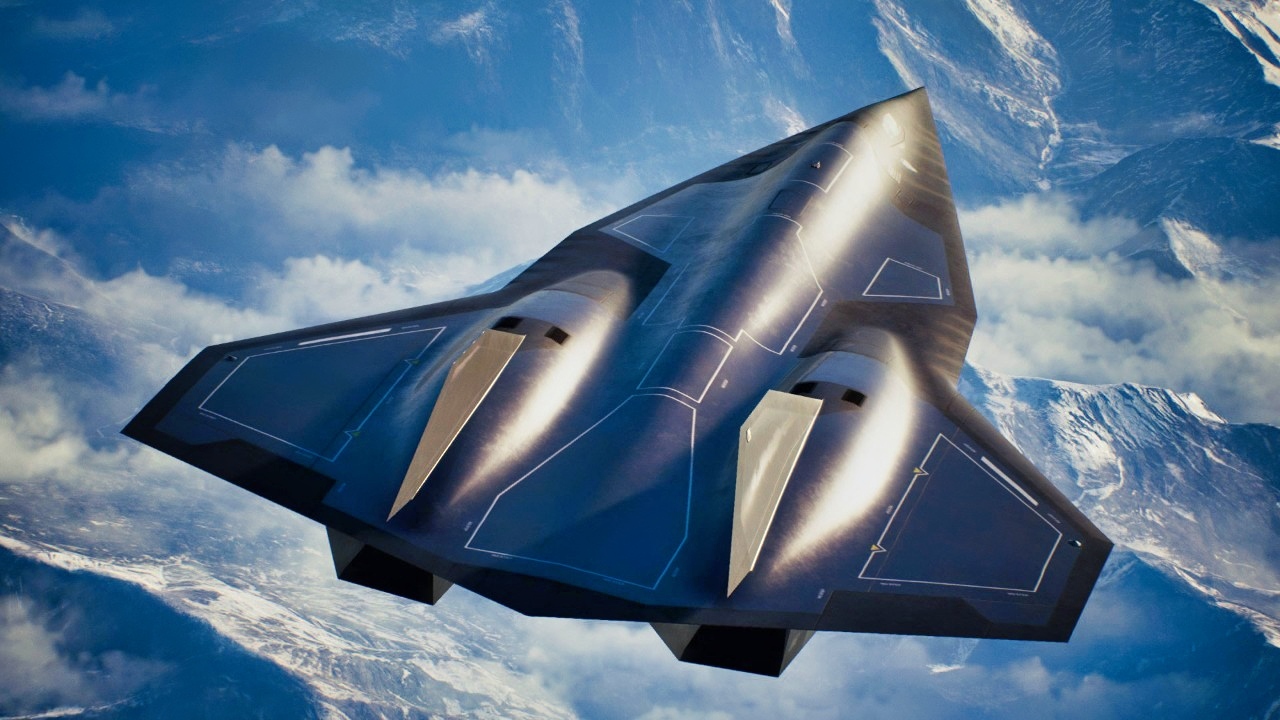
Key Points – The SR-72 “Darkstar,” Lockheed Martin’s anticipated successor to the SR-71 Blackbird, is designed for uncrewed Mach 5+ hypersonic flight, focusing on intelligence, surveillance, reconnaissance (ISR), and potentially as a launch platform for hypersonic strike weapons.
-Its revolutionary Turbine-Based Combined Cycle (TBCC) engine, merging turbofan and scramjet technologies, is key to this extreme speed, aimed at penetrating advanced air defenses.
-While the “Darkstar” mockup in Top Gun: Maverick (designed with Skunk Works input) fueled public imagination and reportedly even Chinese satellite interest, the real SR-72 is definitively not a fighter jet; its purpose is high-speed penetration for ISR and strike.
SR-72 Darkstar: A Hypersonic Fighter, Bomber, or Recon Aircraft?
The US plans to fly the SR-72 Darkstar very soon, and this should be another feather in Lockheed Martin’s Skunk Works’ cap. The much-anticipated aircraft, which supposedly will travel at Mach 5+ (nearly 4,000 mph), will rewrite the book on stealth and speed among aircraft.
Designed to replace the SR-71 Blackbird, the unmanned SR-72 will focus on intelligence, surveillance, and reconnaissance missions. The jet will feature a turbine-based cycle propulsion system, combining a turbofan and scramjet for efficient hypersonic travel.
The SR-71 Blackbird was well ahead of its time. It could streak across the sky at Mach 3.2 (some claim even faster) and simply outrun enemy missiles. Over 4,000 missiles were fired at it during its operational life, but none ever hit it. Now, its namesake will be flying even faster.
The SR-72, also known as the Son of a Blackbird (SOB), may have other hidden talents. The aircraft is envisioned to have reconnaissance and strike capabilities, making it a versatile platform for intelligence gathering and potentially offensive operations. But a hypersonic fighter jet?
The Super-Secretive Darkstar Program
The Darkstar is slated to take flight sometime in 2025. Hopefully, we’ll get a look at it. I saw a Blackbird fly once, and it was incredible. If you’re a fan of aviation, this will be a game-changer.
The SR-72 could be a launch platform for hypersonic strike weapons, integrating the High-Speed Strike Weapon (HSSW) currently under development. This groundbreaking project draws upon the operational legacy of the SR-71, enhancing speed and survivability with a fundamentally different propulsion system.
The program’s potential in-service date is supposed to be by 2030 when the Air Force plans to have its hypersonics online. However, this timeline hinges on overcoming the propulsion, thermal management, and materials challenges inherent to sustained hypersonic flight.
The SR-72’s high speed is designed to counter modern air defense systems by reducing time-on-target and exposure windows, marking a transformative milestone in aerial reconnaissance and strike capability.
New Propulsion Technology Melding Old And New
Of course, the SR-72’s revolutionary propulsion system is at the core of its capabilities. The aircraft will feature a turbine-based combined cycle (TBCC) propulsion system, merging a traditional turbofan engine with a supersonic combustion ramjet (scramjet).
This dual-mode propulsion is essential as no single engine can efficiently operate across the full subsonic-to-hypersonic flight envelope. The turbofan engine is used during subsonic operations, such as takeoff and landing, while the scramjet sustains speeds of Mach 5 once the aircraft goes above Mach 1.
This cutting-edge propulsion system is crucial for the SR-72 to achieve its operational requirements. The SR-72 aims to redefine how the United States projects power in denied-access environments by leveraging next-generation propulsion technologies and uncrewed systems architecture.
The TBCC configuration is not merely a performance enhancement but an operational necessity, enabling the SR-72 to execute missions with unmatched speed.
Maya Carlin wrote Lockheed’s program manager Brad Leland noted that “Hypersonic aircraft, coupled with hypersonic missiles, could penetrate denied airspace and strike at nearly any location across a continent in less than an hour,” adding that “Speed is the next aviation advancement to counter emerging threats in the next several decades. The technology would be a game-changer in theater, similar to how stealth is changing the battlespace today.”
Hollywood Even Hired The Skunk Works
One of the coolest hints that the SR-72 Darkstar aircraft is coming came in the 2022 film Top Gun: Maverick. In the opening scenes, Tom Cruise’s character pilots a hypersonic aircraft called “Darkstar,” which may broadly resemble what the real SR-72-like aircraft might look like.
We know filmmakers can create some awesome stuff with AI and CGI. However, Lockheed Martin and Skunk Works collaborated with the filmmakers to develop the aircraft’s outward appearance, concluding that the airframe is at least nominally grounded in actual aerospace design concepts.
If an SR-72 does exist, the Darkstar featured in Top Gun might represent either a pre-production prototype or an early mock-up. Wouldn’t it be awesome if the Darkstar resembled the aircraft in the film?
The Chinese were sold. China reoriented a spy satellite to take pictures of it, thinking it was a real experimental aircraft.
But The SR-72 Darkstar Is Not a Fighter Jet
Unlike fighter jets, the SR-72 is not designed for close-quarters aerial combat, maneuverability, or air-to-air missiles.
While the SR-72 is expected to be capable of carrying weapons, its primary focus is on high-speed penetration and reconnaissance rather than traditional fighter combat roles. The Darkstar’s primary role is for high-speed reconnaissance, intelligence gathering, and potentially strike missions rather than engaging in aerial combat.
About the Author: Steve Balestrieri
Steve Balestrieri is a National Security Columnist. He served as a US Army Special Forces NCO and Warrant Officer. In addition to writing on defense, he covers the NFL for PatsFans.com and is a member of the Pro Football Writers of America (PFWA). His work was regularly featured in many military publications.
The SR-72 Could Be a Game Changer


Mark T. Chapman
May 18, 2025 at 11:32 pm
Nice article! I love stuff like that.
My father-in-law, Charlie Merritt, retired from Lockheed (Marietta, GA) about 40 years ago. He was a tool designer who worked on many of the military aircraft of the time. He was well-known around Lockheed as Gopher. If anyone needed a tool or blueprint they couldnt find, they’d ask him and he’d find it if it existed. There’s probably no one still there who’s old enough to remember him. He’s 96 now. He might have been a good subject for an article a few years ago, but after a couple of microstrokes, his mind is failing him now. Too bad. He was sharp as a knife before that. He told me some cool stories about his time at Lockheed.
Just thought I’d give him a shout out to someone who might have a passing interest in him.
Thanks again for the article. That kind of technology always fascinates me. The combo turbofan/scramjet, especially. I started writing a novel (my 6th) a number of years ago, where I proposed a 3-stage orbital spaceplane that contained a fanjet, a scramjet, and a small rocket engine to boost the vehicle the rest of the way, but I was never certain whether that much “engine” could all fit in one vehicle. But by integrating a dual fanjet/scramjet engine and a separate rocket engine, hmm, perhaps I need to finish that novel. lol.
Again, thanks for a very interesting article!
Mark.
P.S. I included my author’s webpage url, even though I haven’t updated it in years. Besides sci-fi, I also wrote nonfiction books about the OS/2 operating system, IBM servers and the English language.
Pingback: Could the SR-72 Darkstar Spy Plane Hit Mach 10? - National Security Journal
Pingback: A Stealthy Super Hornet? How Boeing Reduced the F/A-18's Radar Signature - National Security Journal