


Since the time that the war in Ukraine appeared to turn into a failed enterprise that would ultimately fulfill any of his declared objectives, there have been any number of projected end scenarios for the end of the rule of Russian President Vladimir Putin.
Then there is the specter of 1917 being repeated.

Su-57 Felon Fighter from Russia. Image Credit: Creative Commons.
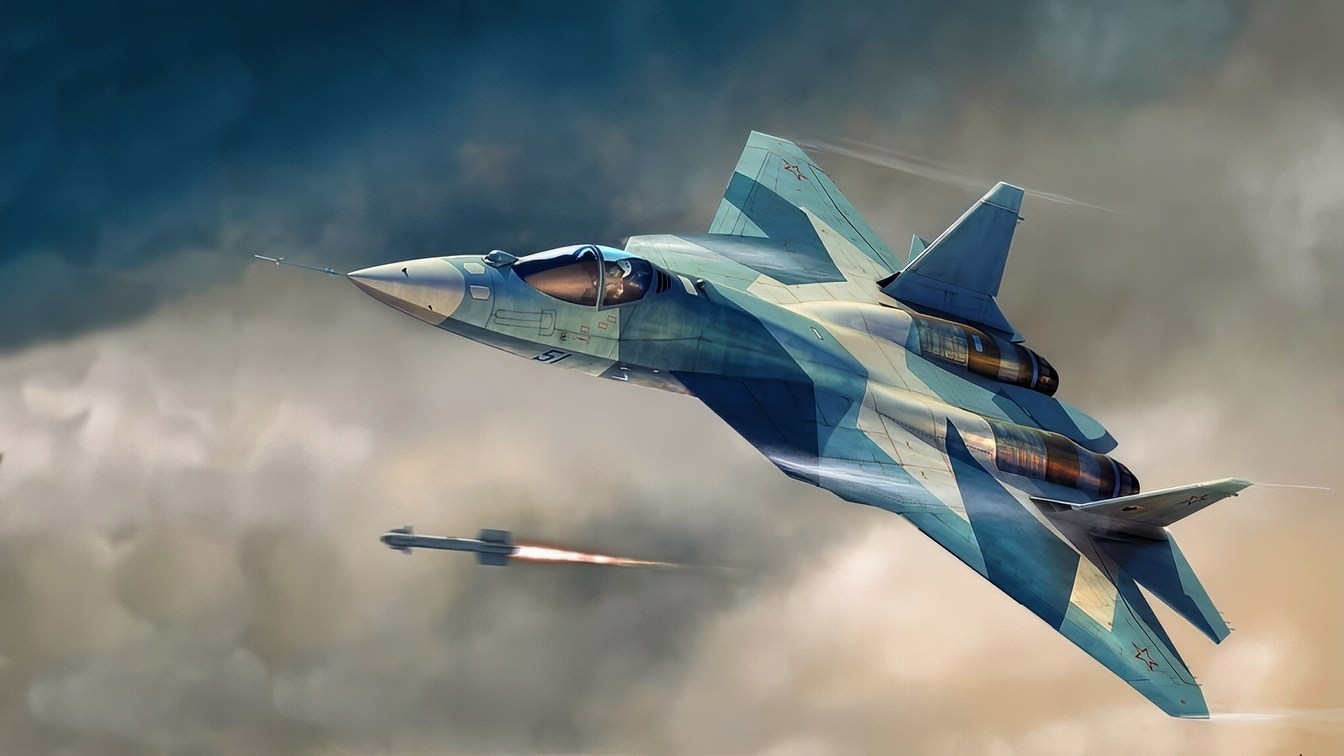
Su-57 Felon in the Sky. Image Credit: Creative Commons.
The Russian Army gets tired of being sent to die in senseless attack waves against enemy positions.
Reports of corruption and incompetence at the highest levels in the capital convince the soldiers to abandon the front and return home to join a popular revolt.
But another and perhaps more probable end to Putin’s dictatorship has been advanced today by the former British Army officer and well-published retired Col. Hamish de Bretton-Gordon OBE.
The former Desert Storm tank commander, chemical-biological weapons specialist, and military affairs commentator sees that the ultimate end for Putin could come – in line with some of British military history’s great victories – as a result of Russia’s opponent, Ukraine, being far better at the intelligence game than Moscow could ever have imagined.
Spoofing Air Defense
“Throughout military history, superior intelligence has often proved more decisive than s superior firepower,” writes de-Bretton Gordon in today’s London Daily Telegraph. “Ukraine appears to have learned that lesson better than anyone. Operation Spider’s Web, in which large numbers of Putin’s strategic aircraft were destroyed by a covert operation deep inside Russia, demonstrated beyond doubt that Kyiv is able to mount complex operations on Russian soil,” he continues.
Russia is often thought of as a nation that has some of the most ingenious and masterful intelligence services in the world.
But like the lackluster career of its President in the much-vaunted Soviet-era KGB, who never rose above the rank of Major while in active service, Moscow has been repeatedly outmaneuvered by Ukraine and embarrassed in countless incidents where its military was lured into one manner of entrapment or another.
Col. de-Bretton Gordon singles out last week’s event when one of the very few 5th-generation fighter aircraft, a Sukhoi Su-57 model, crashed at an aerodrome near Moscow shortly after take-off.
Losing one of the country’s almost irreplaceable advanced fighters was one level of embarrassment, but the full story that is coming out adds insult to injury.
At first, even the usually loyal to the Kremlin military bloggers were almost immediately speculating that the aircraft was brought down by one of Russia’s own forces, supposedly the local BARS-Moscow air defense unit.
But later reporting is that the crash came as a result of Ukraine’s cyber-intelligence sources from the Security Service of Ukraine (SBU) having hacked into Russia’s integrated air defense network.
This cyber hack is now said to have enabled Ukrainian intelligence services to intercept the Russian air defense operation center’s algorithms and then directed the Russian batteries to fire against their own aircraft.
According to the InformNapalm intelligence news service, this operation began days earlier. On 17 July, investigators are reported to have gained access to a large cache of intercepted data.
This included live video streams literally from the training ground where the BARS Moscow air defense crews were being trained.
A Pivotal Moment
If this sequence of events, as reported, is true, writes deBretton-Gordon, this would “represent one of the most audacious intelligence coups of the war.”
He then recounts that in a separate story this week, Ukraine sank an Iranian tanker in the Caspian Sea.
This merchant ship was reportedly carrying Russian munitions destined for Tehran, where they were intended to buttress Iranian operations against US military forces in the Middle East.
While these two events are separate, the Caspian Sea incident proves that the war in Ukraine and the one in Iran are inextricably linked; they suggest that the conflict has reached another watershed moment.
If the report about the Russian air defense unit being spoofed and this being the cause of the Su-57 shootdown is accurate, then this proves the SBU has infiltrated not just one communications channel or a single air defense node, but the entire network architecture of Putin’s air defenses.
The Russian leader’s “obsession with personal security and survival has created layers of protection around the Kremlin, but those same layers may have their vulnerabilities,” writes the former tank commander.
“History teaches us that great empires rarely collapse solely because of defeat on distant battlefields. They unravel when confidence disappears at the center,” he continues. Just like in 1917.
Two aspects of this conflict that are not well understood in either Washington or most European capitals, writes deBretton-Gordon, are that Ukraine’s President Volodymyr Zelenskiy understands much better than his Russian counterpart does, firstly, that you strike not just “where the enemy is weakest, but where political, military and strategic effects combine.”
“Every successful operation now appears designed not only to weaken Russia’s battlefield capability, but also to expose the Kremlin’s inability to protect its own strategic assets while simultaneously strengthening the wider Western alliance.”
Secondly, Zelensky understands that, for months before the war began and up to today, there has been a clear lack of understanding that this conflict has ripple effects on continents far from the battlefields of Europe.
The Ukraine war is having a major impact on the calculations of the People’s Republic of China (PRC), Iran, the Democratic People’s Republic of Korea (DPRK), etc. Everything is demonstrably connected to everything else.
The ideas expressed by some as far back as 2021 that conceding Ukraine to Russia would lead to stability and allow the US to focus entirely on the PRC were a dangerous miscalculation, if not an outright fantasy.
Failing to deter Russia from its 2022 invasion has resulted instead in a deepening strategic alignment between Moscow and Beijing.
Rather than separating Russia from the PRC or pacifying the Kremlin, the conflict has instead bound the two powers closer together.
An example of the kind of strategic thinking not to repeat in the future.
About the Author: Reuben F. Johnson
Reuben F. Johnson has thirty-six years of experience analyzing and reporting on foreign weapons systems, defense technologies, and international arms export policy. Johnson is the Director of Research at the Casimir Pulaski Foundation. He is also a survivor of the Russian invasion of Ukraine in February 2022. He worked for years in the American defense industry as a foreign technology analyst and later as a consultant for the U.S. Department of Defense, the Departments of the Navy and Air Force, and the governments of the United Kingdom and Australia. In 2022-2023, he won two awards in a row for his defense reporting. He holds a bachelor’s degree from DePauw University and a master’s degree from Miami University in Ohio, specializing in Soviet and Russian studies. He lives in Warsaw.


