

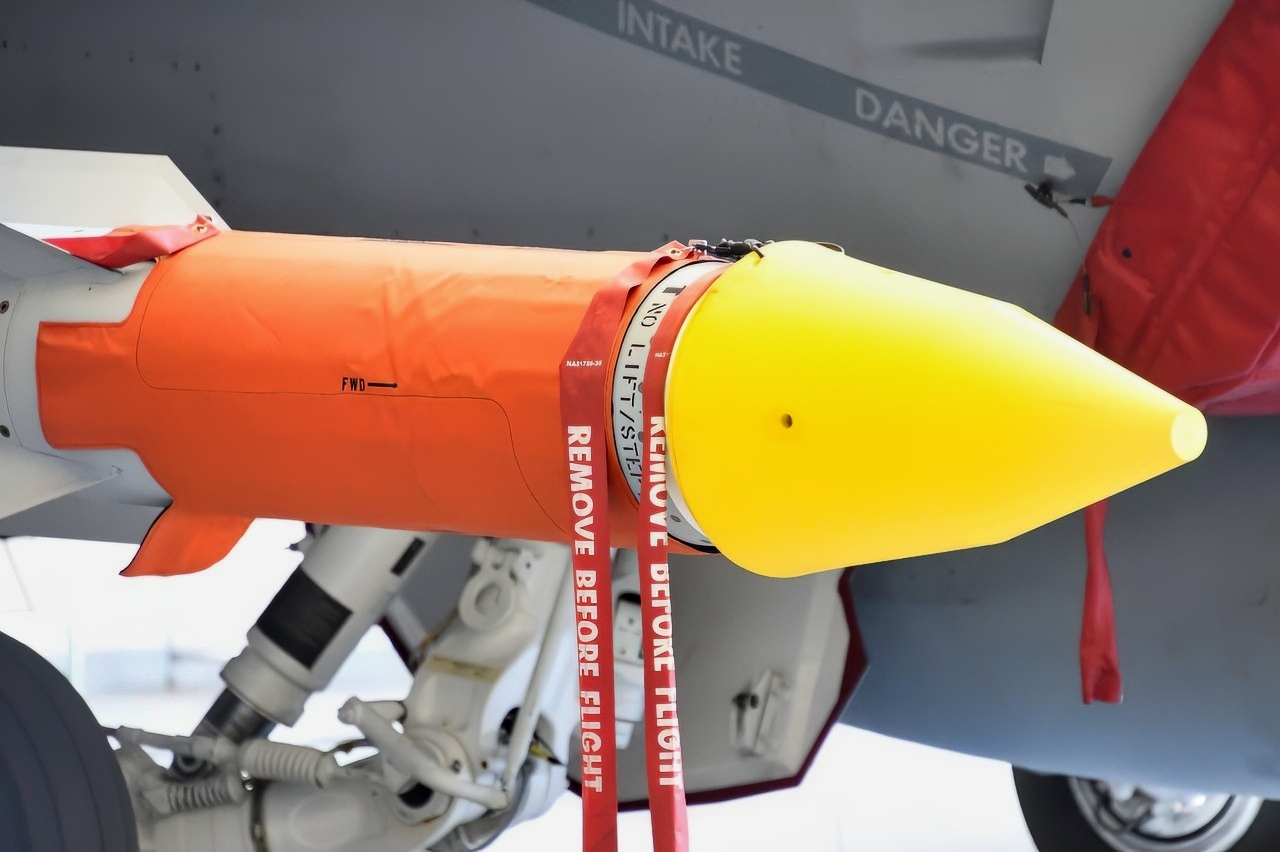
Key Points and Summary – The U.S. is sending Ukraine a new “game-changer” weapon, the Extended Range Attack Munition (ERAM), with 3,350 units included in an $850 million aid package.
-This affordable, air-launched precision munition is designed for mass production and will enhance Ukraine’s strike capabilities.
-However, this move comes as the Pentagon simultaneously restricts Kyiv from using other long-range systems, like the Army’s ATACMS missile, for deep strikes inside Russia.
-This previously unrevealed review process highlights a complex U.S. strategy of arming Ukraine while carefully managing escalation to keep peace talks with Russia viable.
ERAM Is Coming to Ukraine: What We Know
WARSAW, POLAND – Requested by the US Air Force (USAF) for Ukraine since last year, the Trump administration approved the delivery of 3,350 Extended Range Attack Munitions (ERAMs) to Kyiv. The air-to-ground munition was announced as part of a package with other items, as part of an $850 million aid delivery.
This military aid is “mostly funded by European nations.” It is supposed to arrive in the country within “six weeks,” according to a The Wall Street Journal exclusive story from August 23, 2025.
The story was released as the administration’s Special Envoy for Ukraine, Lt. Gen. Keith Kellogg, US Army (ret.), was in the capital, Kyiv, for the August 24 commemoration of Ukraine’s Independence Day.
The ERAM package was reported as part of a story about the Pentagon continuing to prohibit Ukraine from conducting long-range strikes inside Russia using the US Army’s ATACMS (Army Tactical Missile System).
The ERAM is described as an “air-launched tactical, scalable, cheap air-to-ground weapon that was sought by the USAF Life-Cycle Management Center (AFLCMC) last year for Ukraine.” However, little information has been released to date about the weapon, and it has only recently completed its initial production numbers of units.
Reports from industry sources and technical personnel in Kyiv are that the Ukrainian Air Force’s (PSU) F-16s, Mirage 2000s, as well as their Russian-design MiG-29s, Su-25s, and Su-27s will be able to deliver the weapon. This new armament will add another air-to-ground precision munition to supplement the Safran AASM Hammer and GBU-39 SDB, which are already being used in combat by Ukrainian fighter aircraft.
No Long-Range Strikes Anymore
The WSJ story also reveals that the Pentagon has been vetoing long-range strikes on Russian territory using the ATACMS, a surface-to-surface system with a range of 300 km, and is fired from the M142 HIMARS (High-Mobility Artillery Rocket System) launcher.
The WSJ reports that there is now a previously unrevealed “review mechanism” that restricts how Ukrainian forces may employ the weapon systems they have been provided by the US. That process was initiated by the Pentagon’s Undersecretary of Defense for Policy [OUSD (P)] Elbridge Colby, who has tried to cut the flow of weapons to Ukraine in the past.
Colby’s office is not shutting down weapons deliveries, but it now restricts Ukraine’s long-range strike requests not only for US-made weapons, but also for European systems, such as the air-launched MBDA Storm Shadow and SCALP EG missiles.
Previously, these European systems had been used to target areas inside Russia itself.
His review process is curtailing their use inside of Russia, even though they are not US-made weapons. Still, this restriction is being justified by the fact that these weapons “rely on American intelligence and components” in order to reach their targets.
This follows the Pentagon and White House efforts to “woo the Kremlin into beginning peace talks.”
The approval process was revealed by a Pentagon official speaking on condition of anonymity. The official pointed out to the WSJ that these restrictions are in direct contrast with Trump’s recent comments that Ukraine should “play offense.”
The ERAM Weapon
Another official who spoke to the US daily said that the new ERAM munition “will be key to enhancing Ukraine’s capabilities and should be an affordable weapon type adapted for mass production.”
The weapon is supposedly designed around a commercial-off-the-shelf (COTS) modular, open architecture and will deliver “affordable long-range effects.”
The ERAM’s minimum requirements, according to documents seen that were the basis for the weapon’s design requirement and procurement, specify a 500 lb (227 kg) class weapon, “capable of blast, fragmentation and limited penetration effects and with variable fuze options.”
The original Request for Information (RFI) for the system called for a range of at least 463 km and a speed of at least Mach 0.6.
One of the more critical and specific requirements is that the weapon have the ability to operate in a GPS-degraded environment and achieve a Circular Error of Probability (CEP) of 10 meters or less, which would also be capable of functioning in GPS-degraded conditions.
More critically, given the ammunition consumption rates in this conflict, the weapon should be mass producible for up to 1,000 units per year and deliverable within 24 months after contract signing.
The cost is also expected to be low, in the range of US $60,000 per round.
“The ERAM is an effective response and will be less expensive and more accurate than the glide bombs that have been used by the Russians,” said one Ukraine industry representative that spoke to National Security Journal. “This weapon could end up being a real game-changer.”
About the Author: Reuben F. Johnson
Reuben F. Johnson has thirty-six years of experience analyzing and reporting on foreign weapons systems, defense technologies, and international arms export policy. Johnson is the Director of Research at the Casimir Pulaski Foundation. He is also a survivor of the Russian invasion of Ukraine in February 2022. He worked for years in the American defense industry as a foreign technology analyst and later as a consultant for the US Department of Defense, the Departments of the Navy and Air Force, and the governments of the United Kingdom and Australia. In 2022-2023, he won two awards in a row for his defense reporting. He holds a bachelor’s degree from DePauw University and a master’s degree from Miami University in Ohio, specializing in Soviet and Russian studies. He lives in Warsaw.
More Military
The F-22 Raptor Is Beyond Stealth
Canada’s Slow-Motion Tank Crisis Is Just Getting Started
Montana-Class: The 70,000-ton Battleship the Navy Almost Built


