

Key Points and Summary – New satellite imagery (Aug/Sept 2025) reveals China has moved its two 6th-generation stealth fighter prototypes, the “three-engine” J-36 and the “lambda-wing” J-XDS (or J-50), to the remote Lop Nur test site—”China’s Area 51.”
-The base is undergoing a “massive” upgrade, including a 16,400+ ft runway and new hangars, “consolidating” all 6th-gen testing in one “extremely isolated” location.

J-36 Fighter X Screenshot Image.
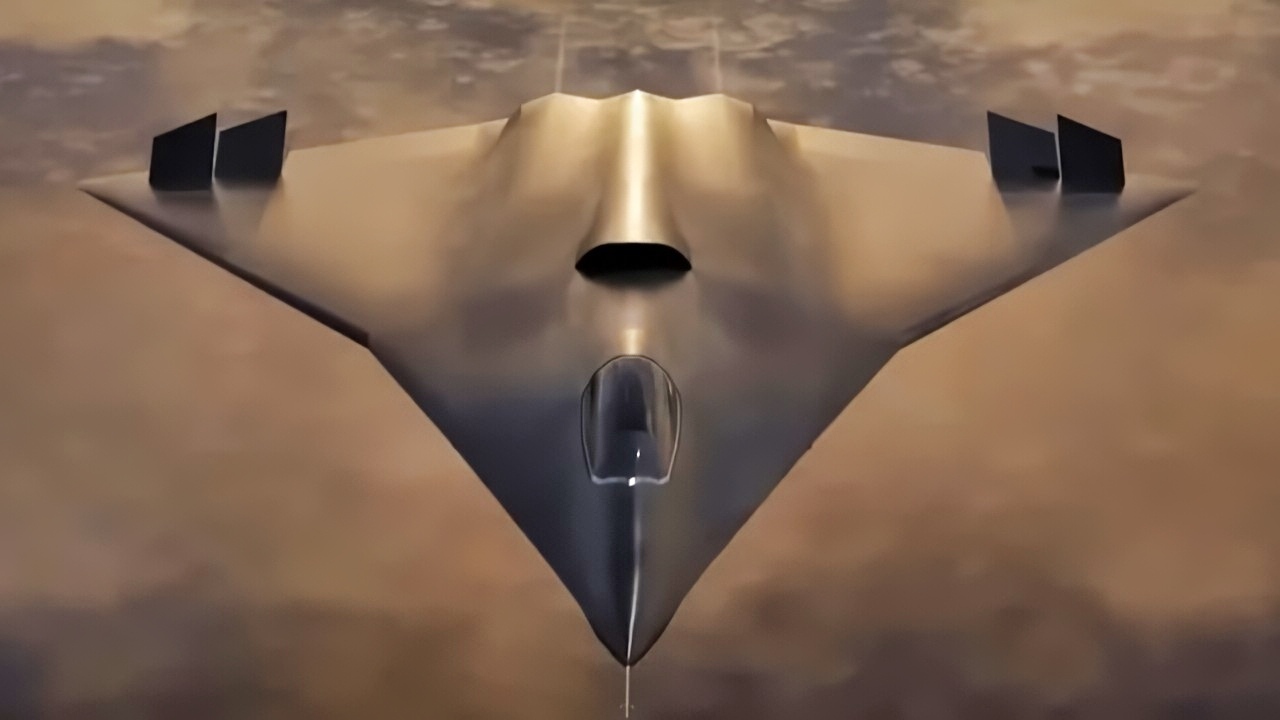
J-36 Fighter YouTube Screenshot/Artist Rendering.
-This “parallel development” and “impressive” manufacturing pace suggests a “shortened timeline” for China’s 6th-gen program, “pressuring” the U.S. to “accelerate” its own NGAD program.
J-36 and J-XDS: We Just Got Photos From China’s Area 51
Satellite imagery from August and September 2025 has revealed that the People’s Liberation Army Air Force (PLAAF) has relocated two of its next-generation stealth fighter prototypes – the Chengdu J-36 and Shenyang J-XDS – to a remote test facility near the Lop Nur nuclear test site in Xinjiang province.
The base features a runway over 16,400 ft long—one of the longest in the world—and multiple new hangars and support buildings currently under construction.
The changes are notable because they indicate that the base, which was previously primarily used for space-plane and reusable launch vehicle trials, is now being repurposed for large-scale flight testing of new advanced combat aircraft.
The news suggests that China is consolidating its sixth-generation fighter testing at a single, secure location designed to support long-range flight operations and classified maintenance work.
China’s Most Advanced Aircraft
The fifth-generation Chengdu J-20, which entered service in 2017, was the first to give the PLAAF stealth fighter capabilities officially.
Building on that platform, China’s broader aviation industry – led by the Chengdu Aircraft Corporation (CAC) and Shenyang Aircraft Corporation (SAC) – has been pursuing at least two sixth-generation designs.
The J-36, produced by Chengdu, is a large tailless aircraft that uses a modified delta platform and, according to open-source imagery, a three-engine configuration.
The size and layout of the aircraft strongly suggest that the fighter is a multirole platform capable of acting as a command node for unmanned systems, as well as delivering long-range precision strikes. It’s also a clear signal that China is catching up to the United States in terms of modern, next-generation stealth technology.
The J-XDS (often referred to as the J-50), meanwhile, is a twin-engine design from Shenyang that features a “lambda” or cranked-kite wing similar to concepts seen in American and European sixth-generation programs. The aircraft looks smaller and optimized for air superiority roles.
Both aircraft, however, share a common feature: they follow a global trend toward tailless stealth configurations that significantly reduce radar signatures across all aspects.
Comparable efforts include the U.S. Air Force’s Next Generation Air Dominance (NGAD) program and the UK-Japan-Italy Global Combat Air Program (GCAP) design.
What We Just Saw
Commercial imagery obtained via Planet Labs from August 27, 2025, shows a J-36 parked on the central apron – the ramp of an airport where aircraft are parked – at Lop Nur.
A second image from September 13 shows the J-XDS on the same airfield, near some newly built hangars. The runway length is significant—it’s over three miles—allowing for heavy takeoffs at high altitude. The runway also supports aircraft that require long acceleration for stealth or payload testing.

J-36 Fighter from China. Image Credit: Creative Commons.
Additionally, satellite images taken between May and November 2025 appear to show major upgrades at Lop Nur. Three new fighter-sized hangars have been built on the western edge of the runway, alongside a much larger main hangar that measures more than 300 feet across. Further work includes expanded fuel storage areas, new utility buildings, and resurfaced taxiways that connect the main apron to the runway.
Earlier imagery from 2020 showed the same site used for a reusable spaceplane landing.
The addition of multiple enclosed shelters and maintenance since then, however, now confirms that the base is being prepared for continuous flight-test operations rather than just short-term experimental efforts.
In short, China is ramping up its efforts on next-generation aircraft and shows no sign of slowing down. And it all starts with these two prototypes.
By locating both the J-36 and J-50 at a single base, the People’s Liberation Army Air Force can centralize its testing and do so under tight scrutiny.
Lop Nur, after all, is extremely isolated. It is hundreds of miles away from any major population centers and carries little to no risk of photography or signal collection by foreign agencies. The facility is also massive, and its scale allows radar cross-section measurements under very controlled conditions.
The presence of both designs suggests that Beijing is running two parallel development tracks, comparing the platforms for aerodynamic efficiency, systems integration, and sensor performance before committing to a production model.
And with China’s impressive infrastructure and manufacturing capabilities, there’s simply no telling how quickly this could unfold or how rapidly China could field these aircraft once they’re ready. Beijing may well opt to field both, and do so in numbers that the United States could struggle to match even with its upcoming NGAD design.
What we’ve seen so far, however, mirrors how the U.S. Air Force has tested prototypes under the Advanced Tactical Fighter program that produced the F-22.
Suppose China continues down this path and expands Lop Nur’s test operations at this pace. In that case, the United States must assume a shortened timeline for Chinese sixth-generation development—and respond by accelerating NGAD readiness, production, and pilot integration now.
About the Author:
Jack Buckby is a British author, counter-extremism researcher, and journalist based in New York. Reporting on the U.K., Europe, and the U.S., he works to analyze and understand left-wing and right-wing radicalization, and reports on Western governments’ approaches to the pressing issues of today. His books and research papers explore these themes and propose pragmatic solutions to our increasingly polarized society. His latest book is The Truth Teller: RFK Jr. and the Case for a Post-Partisan Presidency.
More Military
China Might Have a Way to ‘Swarm’ U.S. Navy Aircraft Carriers
India Leases Russia’s ‘Stealth’ Nuclear Attack Submarines
The Mach 3 SR-71 Blackbird Deserves A Better Fate Than This
The F-14 Tomcat Fighter Was ‘Notoriously Difficult and Costly to Keep Operational’


