

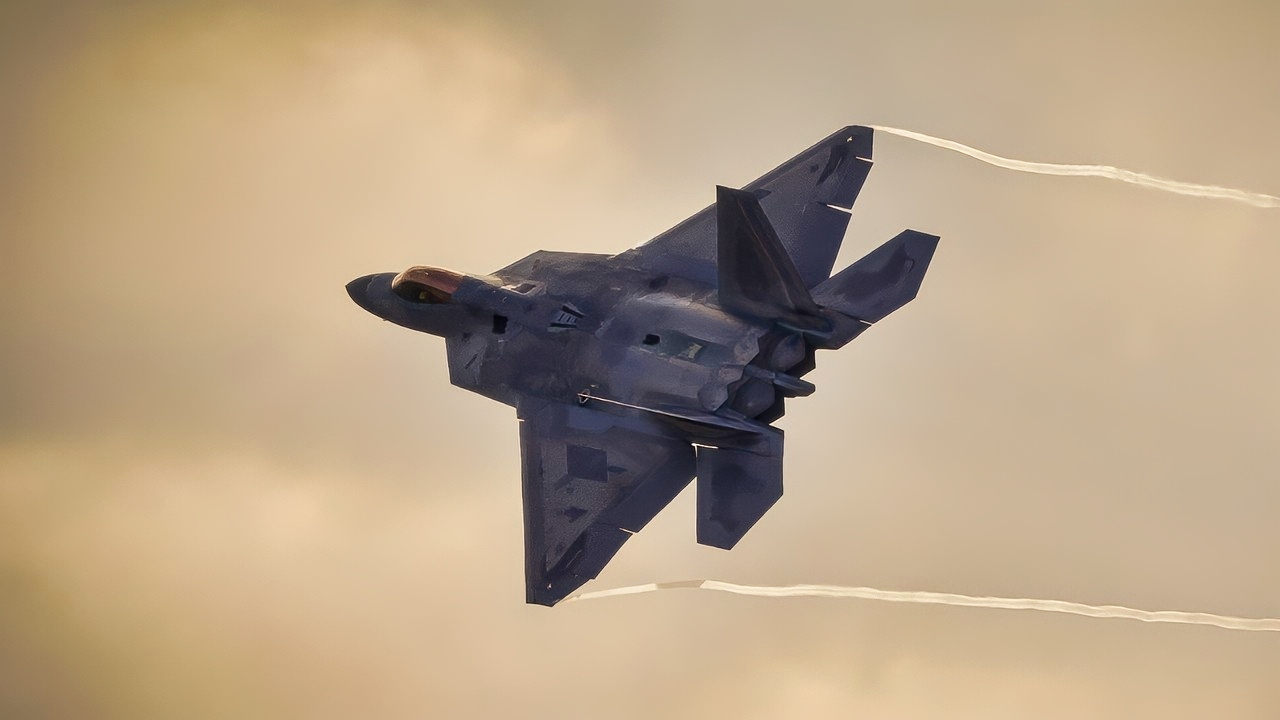
Key Points and Summary – China’s shadowy J-36, first spotted in 2024, remains largely unverified, but its tailless diamond planform, possible tri-jet power, recessed exhausts and side-by-side cockpit hint at a long-range strike role.
-By contrast, the F-22 Raptor is a proven air-dominance fighter with supercruise, thrust-vectoring and mature sensor fusion.

J-36 Fighter from China. Image Credit: Creative Commons.
-On paper, a stealthy, fast J-36 with PL-15/PL-17-class missiles could enjoy a beyond-visual-range edge—if its sensors, networking and weapons match the hype.
-Inside visual range, the F-22’s agility and combat pedigree likely prevail. With so few facts, this matchup is a thought experiment, not prediction—but it shows how concepts and roles could clash. Today.
J-36 vs. F-22: A Fight for the Future?
The J-36 is a mysterious aircraft. First spotted in 2024, its specs and capabilities are virtually unknown by anyone besides the designers. Aside from a few images at various angles, analysts have virtually nothing to go on in assessing its capabilities.
However, its design suggests a great deal about its role and function, giving us a small glimpse into what the J-36 is capable of achieving. But how does this new aircraft fare against the best of America’s fighters like the F-22?
This is more of a thought experiment than an objective analysis, as verifiable information about the J-36 is virtually non-existent at this point.
The F-22 Meets the Next Generation
The F-22 Raptor was designed primarily for air dominance. It features a twin-engine configuration, trapezoidal wings, and a conventional tail.
Its airframe is optimized for stealth with radar-absorbing materials, internal weapons bays, and angular surfaces that reduce its radar cross-section. The aircraft is relatively compact, measuring approximately 62 feet in length and 44.5 feet in wingspan.
Its design emphasizes agility, stealth, and speed, making it one of the most formidable fighters in the world.
In contrast, the J-36 is a much newer design, featuring a tailless, diamond-shaped double-delta configuration. It is larger than the F-22, measuring approximately 22.5 meters in length and 24 meters in wingspan.
Based on visual information, the aircraft uses a tri-jet configuration, which is unusual for modern fighters but may provide redundancy and additional thrust for advanced systems. The J-36’s design incorporates recessed exhausts, flush-mounted sensors, and serrated panel edges to enhance its stealth profile. It utilizes a side-by-side cockpit, which may indicate its role as a strike aircraft rather than a dedicated fighter.
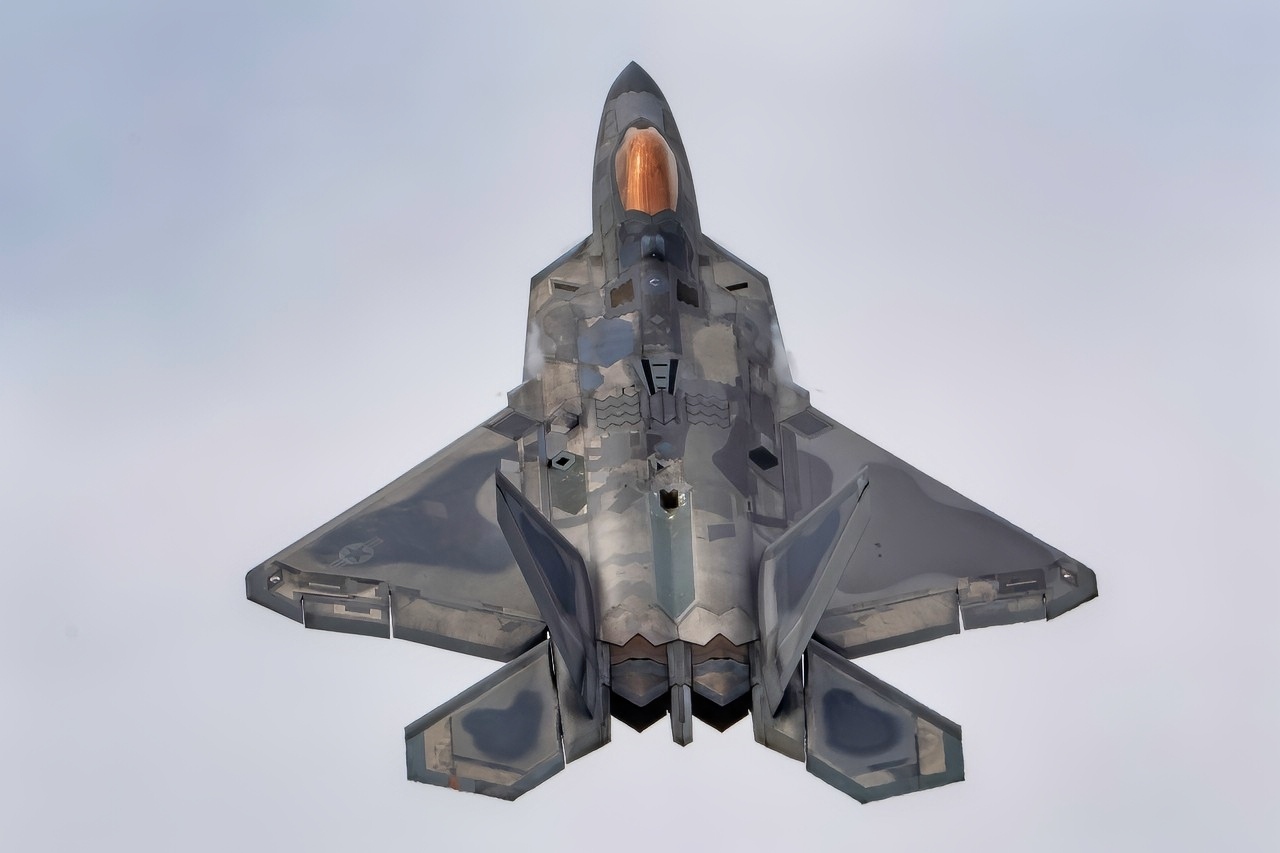
U.S. Air Force Maj. Josh Gunderson, F-22 Demo Team commander, performs the Raptor slide during the Geneseo Airshow July 10, 2021, Geneseo, N.Y. During the maneuver the aircraft actually slides down and backwards under control before Gunderson adjusts the aircrafts position and powers out of the maneuver. (U.S. Air Force photo by Staff Sgt. Don Hudson)
Engine Performance and Avionics
In terms of propulsion, the F-22 is powered by two Pratt & Whitney F119-PW-100 engines, each producing around 35,000 pounds of thrust. This allows the aircraft to supercruise at speeds exceeding Mach 1.5.
Its top speed exceeds Mach 2, and its thrust vectoring nozzles provide exceptional maneuverability. The engine layout of the J-36 is entirely unknown, but it is believed to use either WS-15 or WS-10C engines in a trijet configuration.
If it achieves its projected performance, it could reach speeds of Mach 2.5 and supercruise at higher speeds than the F-22. This would give it a significant advantage in terms of speed and energy management during combat.
Avionics and sensor fusion are critical components of modern air combat. The F-22 is equipped with the AN/APG-77 AESA radar, which provides long-range detection and tracking of multiple targets. It also features advanced electronic warfare systems, secure data links, and a high degree of sensor fusion, which provides pilots with superior situational awareness. Currently, there is no publicly available data on the J-36’s avionics.
Analysts and experts suspect that the aircraft will feature an advanced AESA radar, IRST capabilities, comprehensive passive electronic surveillance arrays, and highly sophisticated EW suites.
This would, in theory, enable the aircraft to receive a comprehensive picture of the battlefield and work in tandem with other manned or unmanned platforms.
Stealth Capabilities and Armament
When it comes to weapons, the F-22 carries a mix of air-to-air and air-to-ground munitions in its internal bays. Its standard air superiority loadout includes six AIM-120 AMRAAMs and two AIM-9 Sidewinders. For ground attack missions, it can carry two 1,000-pound JDAMs along with two AMRAAMs.
It also has an internal 20mm cannon for close-range engagements. The J-36 is reportedly equipped with three weapons bays and has a larger payload capacity overall than the F-22. This provides further evidence to support the theory that the aircraft is more suited for strike operations than for regular fighter duties.
It is expected to carry air-to-air missiles like the PL-15 and PL-17, as well as a variety of air-to-ground munitions like precision bombs or rockets.
Stealth and survivability are areas where both aircraft excel, though in different ways. The F-22 has an extremely low radar cross-section and reduced infrared signature, thanks to its engine placement and materials. Its stealth has been validated in numerous operational scenarios.
The J-36, with its tailless design and recessed features, may offer even lower radar and infrared visibility. However, this is all theoretical, as there is very little to judge the stealth of the aircraft aside from the few images we have. The F-22’s combat survivability is proven, while the J-36’s remains speculative.
Who Wins in 4 Words: We Offer Our Guess
Obviously, evaluating the J-36’s combat performance is a challenging task, given the limited information available.
In a one-on-one combat scenario, the outcome would depend heavily on the range at which the engagement begins. In a beyond-visual-range (BVR) fight, the J-36 would probably have the upper hand if it successfully integrates long-range missiles and advanced sensors. Its speed and stealth might allow it to detect and engage the F-22 before being seen.
However, the F-22’s proven sensor fusion and first-shot capability make it a formidable opponent even in BVR combat. If the F-22 detects the J-36 first, it could launch a preemptive strike and disengage before the Chinese fighter-bomber can respond.
In a within-visual-range (WVR) engagement, the F-22 would likely be victorious. Its agility, thrust vectoring, and combat-tested systems give it a significant advantage in dogfighting. The J-36is likely meant for long-range strike missions and may struggle to match the F-22’s maneuverability in close quarters.
Unless it incorporates revolutionary flight control technologies, it would be at a disadvantage in this type of engagement.
About the Author: Isaac Seitz
Isaac Seitz, a Defense Columnist, graduated from Patrick Henry College’s Strategic Intelligence and National Security program. He has also studied Russian at Middlebury Language Schools and has worked as an intelligence Analyst in the private sector.
More Military
China’s J-20 Stealth Fighter Might Be ‘Better’ Than F-22 and F-35 for 1 Reason
JH-XX: China’s New ‘Diamond’ Stealth Bomber Summed Up in 1 Word
B-52J: The Air Force’s New Bomber Is Coming


Pingback: Is the U.S. F 22 really superior to China’s J 36 – Morning Overview