

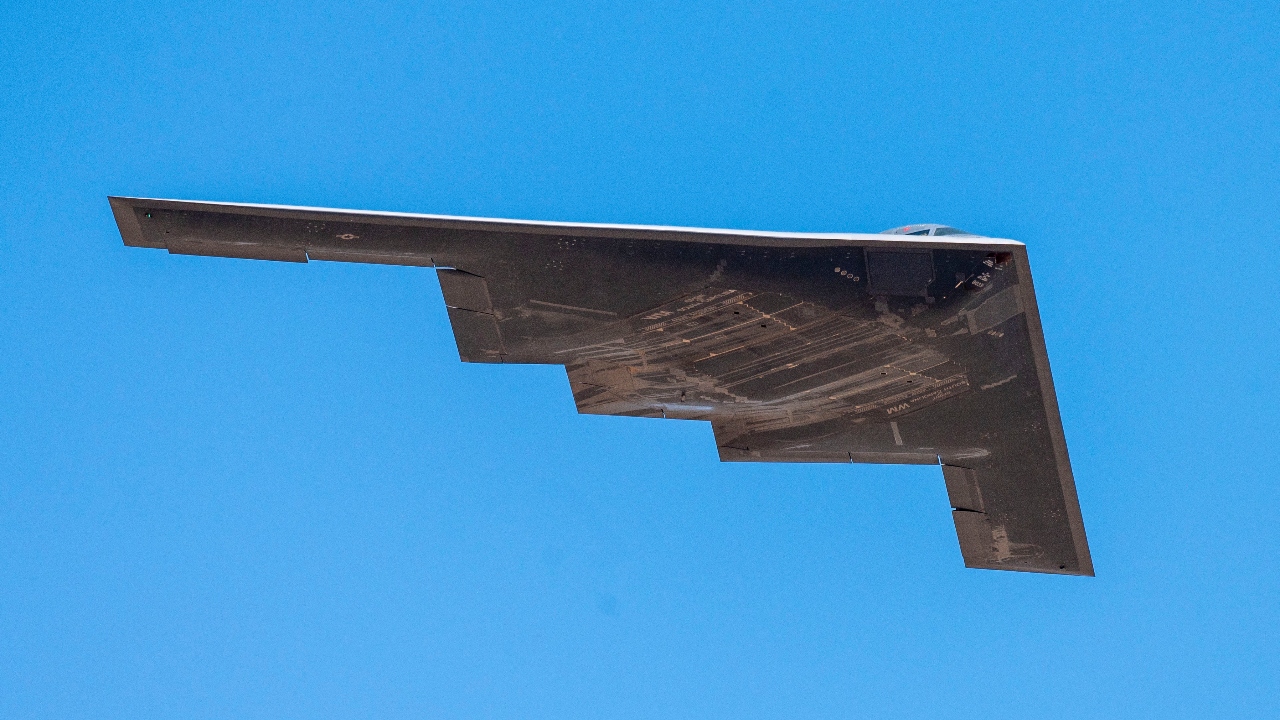
Key Points and Summary – Stealth technology, the cornerstone of US air power in jets like the F-35 and B-21, may one day become obsolete due to the rise of quantum sensing, according to a warning from DARPA senior official Rob McHenry.
-Speaking at a June 25th webinar, McHenry suggested that future quantum radars could theoretically use principles like entanglement to detect any object that emits energy, rendering traditional stealth ineffective.
-While this technology is still largely experimental and faces significant technical hurdles, he argued that the US must get ahead of the curve, as the advent of quantum sensing would represent a radical, game-changing shift in military strategy.
The Quantum Threat to Stealth Is Coming
At a webinar hosted June 25 by the Air and Space Forces Association’s Mitchell Institute for Aerospace Studies, Rob McHenry, a senior official at DARPA, gave his thoughts on the future of stealth technology. He expressed an interesting perspective that stealth technology might one day become obsolete due to the rise of quantum sensing.
“I don’t think we’re going to be able to hide, in an operational sense, in a realistic way,” McHenry said, “due to the sophistication of sensor fusion and track, using AI and other techniques.”
Will Quantum Sensing Make Stealth Obsolete?
Currently, stealth is still the DoD’s top priority, with projects like the B-21 Raider and the F-47 in full swing, it is unlikely that stealth technology will be going anywhere anytime soon.
However, as countries like the U.S. and China invest more in quantum computing, the possibility of quantum radars emerging in the near future grows more likely.
When this happens, McHenry suggests that this will result in a radical change in warfighting strategy.
McHenry suggested that the U.S. should try to get ahead of the curve in the realm of quantum sensing. If quantum radars become a reality in the near future, the U.S. can use them to counter stealth fighters from its adversaries, particularly China, which has been fielding more stealth fighters as of late.
This capability would give the U.S. a huge advantage over any adversary, as anything that emits any sort of energy can be detected by quantum radars.
How Quantum Sensing Works
How does quantum sensing work?
At the heart of it, there are several key principles of quantum mechanics. Superposition allows quantum systems to exist in multiple states simultaneously, enabling them to process and measure information in ways that classical systems cannot.
Entanglement, another cornerstone of quantum theory, links particles in such a way that the state of one instantly influences the state of another, regardless of the distance between them.
This phenomenon can be used to enhance the sensitivity and accuracy of measurements. Quantum coherence, the ability of a quantum system to maintain its state over time, is also crucial, as it allows for stable and precise data collection.
Quantum sensors come in various forms, each tailored to specific types of measurements. Atomic clocks, for instance, are the most accurate timekeeping devices ever created and are essential for technologies like GPS and secure communications.
Quantum gravimeters can detect minute variations in the Earth’s gravitational field, which is useful for geological surveys and underground mapping. Quantum magnetometers are capable of sensing extremely weak magnetic fields, making them ideal for applications such as brain imaging and submarine detection. Additionally, quantum accelerometers and gyroscopes offer precise navigation capabilities without relying on external signals like GPS, which can be jammed or spoofed.
Game Changing for the Defense Industry
In the realm of defense and surveillance, quantum sensing holds particularly transformative potential. One of the most promising applications is in the detection of submarines. Traditional methods rely on sonar, or magnetic anomaly detection, but advanced stealth techniques can evade these.
Quantum magnetometers, however, can detect the faint magnetic signatures of submarines even when they are deeply submerged and shielded. This could significantly enhance anti-submarine warfare capabilities.
The most speculative but intriguing application is quantum radar. Traditional radar systems can be thwarted by stealth technology, which reduces the radar cross-section of an object, making it less detectable. Quantum radar, in theory, could overcome this limitation by using entangled photons to detect objects. Because of the quantum correlations between entangled particles, quantum radar could potentially identify stealth aircraft that would otherwise be invisible to conventional radar systems.
Not Coming Anytime Soon
However, the question remains: will quantum sensing make stealth technology obsolete? The answer is complex and depends on several factors. Quantum radar, for example, is still mainly in the experimental phase. Maintaining entanglement over long distances and in noisy, real-world environments is a significant technical challenge.
Moreover, deploying such systems in operational settings, especially under combat conditions, presents additional hurdles. Even if quantum radar becomes viable, it may serve more as a complement to existing systems rather than a wholesale replacement.
It is also essential to consider the adaptive nature of stealth technology. Just as radar-evading designs evolved in response to traditional detection methods, new forms of stealth may emerge to counter quantum sensing. This could include materials engineered to minimize magnetic or gravitational signatures, or active countermeasures designed to interfere with quantum sensors. The development of such technologies would likely be driven by the same strategic imperatives that led to the creation of stealth aircraft and submarines in the first place.
While widespread quantum radars are probably not coming anytime soon, McHenry’s advice should still be heeded. Countries that invest heavily in quantum technologies, such as the United States, China stand to gain a substantial advantage in surveillance, reconnaissance, and navigation.
Quantum-enhanced early warning systems could detect missile launches or aircraft movements with greater accuracy and speed. Quantum navigation systems could enable operations in GPS-denied environments, enhancing the autonomy and stealth of military assets. Secure quantum communication networks could complement these capabilities by providing unbreakable channels for transmitting sensitive data.
About the Author:
Isaac Seitz, a Defense Columnist, graduated from Patrick Henry College’s Strategic Intelligence and National Security program. He has also studied Russian at Middlebury Language Schools and has worked as an intelligence Analyst in the private sector.
More Fighters
China’s J-20 Stealth Fighter Looks Like a Powerhouse
China’s White Emperor Space Fighter Looks Fake
China’s Aircraft Carriers Have Arrived (Just Not Nuclear Carriers)


German news
June 28, 2025 at 9:54 pm
As countries like the U.S. and China invest heavily in quantum computing, the development of quantum radar technology seems inevitable. Quantum entanglement is a fascinating concept, linking particles instantly over any distance. This article highlights the potential impact of quantum radars on national security. Isaac Seitz’s background in intelligence adds credibility to the discussion. How soon do you think quantum radars will become a reality in military applications? German news in Russian (новости Германии)— quirky, bold, and hypnotically captivating. Like a telegram from a parallel Europe. Care to take a peek?
Pingback: Quantum radar detects stealth planes easily – Morning Overview