

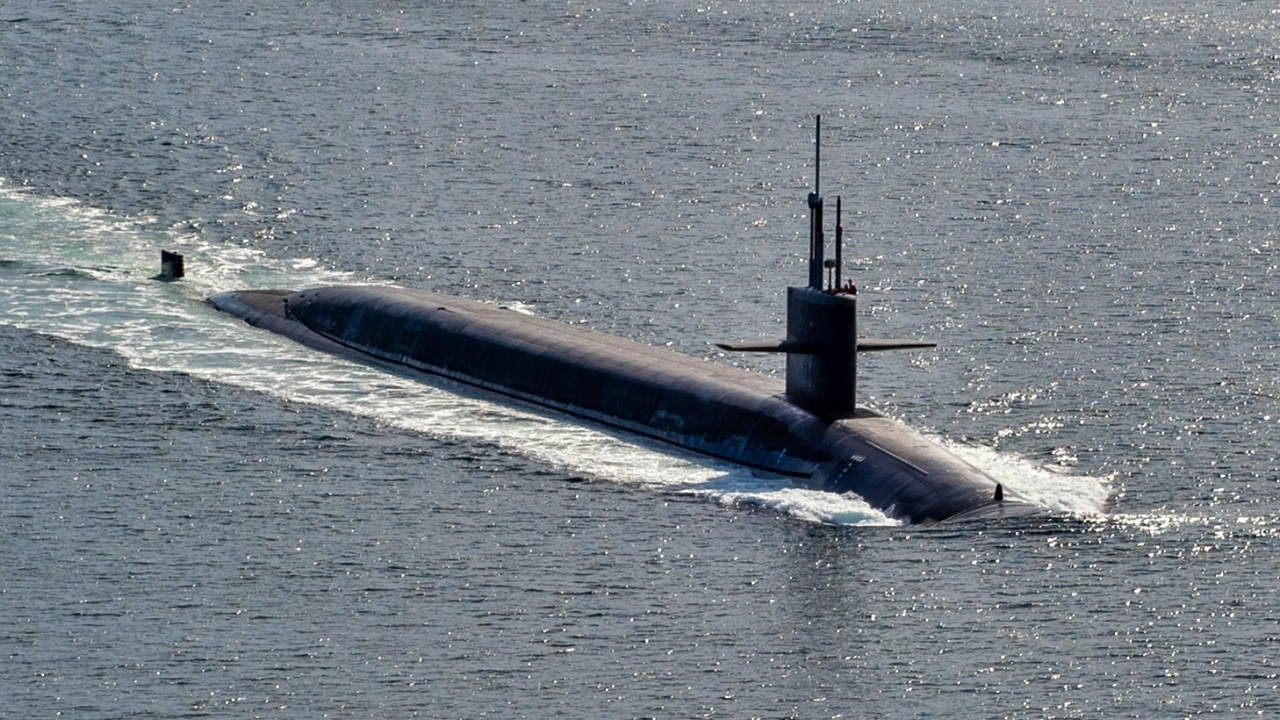
Key Points and Summary – The recent surfacing of the USS Maryland, an Ohio-class ballistic missile submarine, in the Atlantic Ocean, is the latest example of a deliberate US Navy strategy to visibly signal its nuclear deterrent capabilities to adversaries like Russia and China.
-This trend, which has also seen nuclear submarines surface near Norway and Guam, is a calculated show of force in an increasingly contested global environment.
-Accompanied by an E-6B “Doomsday” plane, the Maryland’s public appearance serves as a potent reminder of America’s formidable and far-reaching undersea power, countering similar shows of force by adversaries.
Submarine USS Maryland Surfaces Off Europe: Why The Growing Trend?
The Ohio-class nuclear ballistic missile submarine, the USS Maryland, recently surfaced in the North Atlantic Ocean near Portugal’s Azores islands, the Navy confirmed.
The deployment of the USS Maryland coincided with the deployment of an E-6B Mercury aircraft, capable of communicating with nuclear-armed submarines. The Navy also confirmed to Newsweek the aircraft’s presence in the region.
According to the Navy’s Commander Submarine Force Atlantic, the USS Maryland (SSBN-738) is the 13th of 18 Ohio-class submarines in the United States Navy.
She is the fourth US Navy ship to be named Maryland. Built by the Electric Boat Division of General Dynamics in Groton, Connecticut, Maryland was commissioned on June 13, 1992. She is currently part of the Atlantic Fleet and homeported in Kings Bay, Georgia.
This surfacing is the latest of several recent examples of nuclear submarines that have made their presence clear. Is this a trend, or is it that the US Navy is sending a message to our adversaries?
Nuclear Submarines Do Not Normally Surface During Deployments
Nuclear submarines typically only surface once on deployments, when they are changing out the crews. They can stay submerged for years as long as they have food for their crews.
The only other times that nuclear submarines surface are either planned or in an emergency. Typically, however, the longest they stay submerged is about 120 days.
US Naval Strength Is Flexing Its Muscles
US nuclear submarines are being more visible in certain areas, particularly in the Atlantic and Pacific, as part of a strategy of demonstrating naval strength and deterring potential adversaries. This increased visibility is not necessarily indicative of a change in operational patterns but rather a shift in how the Navy is communicating its presence.
In June 2024, the nuclear-powered submarine USS Tennessee (SSBN 734) surfaced in the Norwegian Sea, accompanied by the USS Normandy (CG 60), a P-8A Poseidon maritime patrol and reconnaissance aircraft, and an E-6B Mercury strategic communications plane.
The E-6B, like the Air Force E-4B “Nightwatch,” the Navy plane is sometimes called the “Doomsday plane,” as it can relay National Command Authority directives to US submarines as part of the “Take Charge and Move Out” mission and fulfill “Looking Glass” obligations, which involves directing nuclear forces if the ground-based options are gone.
The E-6B has a five-mile reel of communications antenna cable, which can unspool out its tail so that it can communicate with submerged Ohio-class nuclear ballistic missile submarines
In early July of 2024, the USS Florida, a conventionally-armed, nuclear-powered submarine, conducted an expeditionary reload of an unknown number of Tomahawk missiles at Naval Base Guam.
The Navy posted several photos of the operation. “This operation highlights the U.S. Navy’s strategic capability to reload vital munitions anywhere in the world,” the caption of the photos reads.
The Navy has planned to introduce rearm-at-sea capabilities for surface warships in case of a conflict with China in the Pacific.
The timing of this deployment and rearming of the Florida was no coincidence. Russia and China were conducting a naval exercise and a joint patrol. “Exercise Joint Sea-2024” in Zhanjiang, a Chinese city located in the southern province of Guangdong that faces the South China Sea.
Strategic Deterrence and Signaling
The US Navy is using the surfacing of nuclear submarines, especially Ohio-class submarines, to signal its capabilities and commitment to allies, particularly in regions like the North Atlantic and around Europe. This is seen as a message to potential adversaries like Russia.
Publicly revealing submarine deployments, even if not a routine operation, can be a strategic move. It allows the Navy to showcase its readiness and presence without disclosing specific operational details.
The increased visibility of US submarines near Norway and other NATO allies reflects enhanced cooperation between the US and its partners in the region. And it is used as a message to our increasingly aggressive adversaries that the US will support our allies.
The choice for a Norwegian deployment and surfacing highlights the broader strategic significance of this region, which is a significant corridor for Russian submarines and other naval vessels heading to the Atlantic, as well as the High North more generally.
Surfacing, However, Is Not a Universal Trend
While the surfacing of some submarines is becoming more visible, it’s important to note that nuclear submarines can remain submerged for extended periods. And that only a very few are surfacing. The US operates 71 submarines worldwide.
The frequency of surfacing depends on various factors, including operational needs, maintenance schedules, and the specific type of submarine. And as we’ve shown above, the sending of a message to our adversaries.
Submarines surface for various other reasons, including entering ports, and transferring personnel, equipment, or supplies. They don’t need to surface for air.
The Russians have also been surfacing their submarines in a show of force. The Norwegian surfacing of the USS Tennessee came just days after a Russian submarine sailed into Havana, Cuba, for a port visit.
Other Russian vessels, such as the Admiral Gorshkov frigate, joined the Kazan during the visit ahead of an air and maritime exercise in the Caribbean.
About the Author:
Steve Balestrieri is a National Security Columnist. He served as a US Army Special Forces NCO and Warrant Officer. In addition to writing on defense, he covers the NFL for PatsFans.com and is a member of the Pro Football Writers of America (PFWA). His work was regularly featured in many military publications.
The Best Tanks on Earth
AbramsX: The Tank the US Army Wants


