

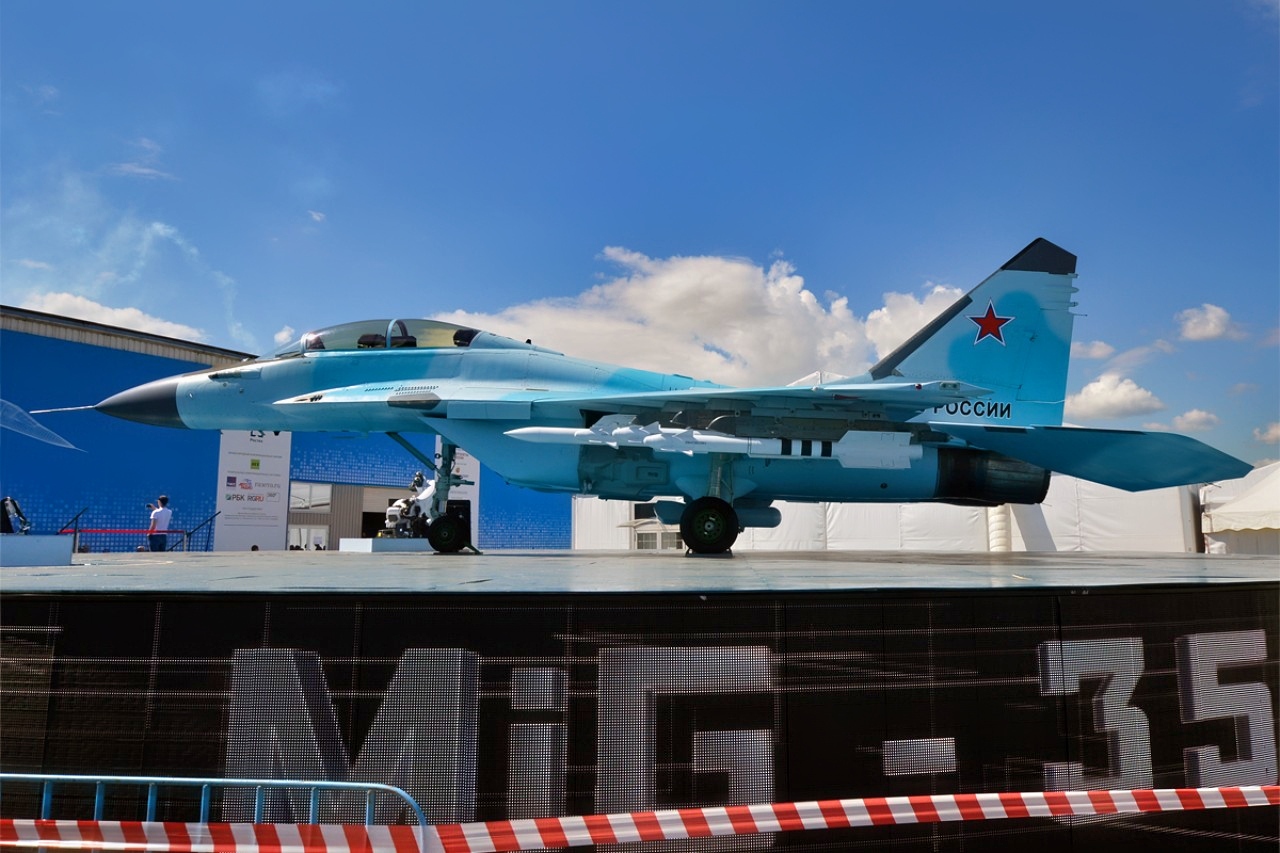
Key Points – Russia is reportedly planning to revive its long-struggling MiG-35 “Fulcrum-F” fighter program by integrating advanced technologies borrowed from its Su-57 fifth-generation jet.
-The ambitious upgrades for the 4++ generation MiG-35 aim to significantly boost its combat potential with new long-range air-to-air missiles (R-77M, izdeliye 810), a modern AESA radar, a new engine derived from the Su-57’s powerplant, a helmet-mounted targeting system, and a sophisticated electronic warfare suite.
-While these changes could make the MiG-35 more effective and attractive for export, significant doubts remain about Russia’s ability to mass-produce the upgraded aircraft on schedule.
Russia Plans On Reviving The MiG-35 To Its True Potential
The Russian MiG-35 was never the aircraft that it was hoped to be when it first appeared in 2017.
Russia touted the MiG-35 Fulcrum-F as a “fifth-generation” fighter jet, but it has fallen short of expectations, with only six units produced out of an initially planned thirty-seven.
It didn’t possess the stealth capabilities to be a fifth-generation fighter, and issues with integrating modern networked warfare pose challenges against advanced adversaries, such as the F-35.
Russia tried to export it but found no takers, due to better available aircraft on the market, and the war in Ukraine. However, the MiG-35 was built to carry a wide range of armaments. With its nine hardpoints, the jet can carry a combination of Kh-31P anti-radar missiles, Kh-31A anti-ship missiles, KAB-500Kr TV guided bombs, and the Kh-29TE missiles. With these capabilities, the Fulcrum-F could be an effective tool in air superiority missions.
In early 2025, however, the future of the MiG-35 is about to change, as the Russian Defense Ministry and the state owned United Aircraft Corporation reportedly plan to facilitate production of the aircraft on a significant scale for the Russian Aerospace Forces.
Such orders have the potential to revive the program, and allow many of the new technologies developed over the past decade, the majority of them for Russia’s new Su-57 fifth generation fighter, to be integrated onto the lighter MiG aircraft, which will enhance its combat potential and making it a far more competitive performer on international markets.
Five of the new features that Military Watch Magazine pointed out that the MiG-35 Fulcrum-F fighter will integrate include but are not limited to:
R-77M Air-to-Air Missiles
Russian fighters have traditionally lacked far behind American, European, and Chinese fighters in the realm of air-to-air missiles.
The R-77 (AA-12A Adder) Russian Air-to-Air Missile is similar to, and in a few respects, identical to, the American AIM-120 AMRAAM missile.
The R-77 missile features an energetic radar seeker and a range of 90-100 kilometers and flies at four times the speed of sound.
The R-77M developed for the Su-57 fighter has the potential to largely bridge the gap in performance, and has a range of approximately 200 kilometers compared to just 110 kilometres for the R-77-1.
The missile is reported to use an AESA radar in its homing head for greater immunity to jamming and a longer target lock on range.
At the same time, its active phased array antenna technology is intended to provide the missile with a fuller and wider angle picture of its target making it far more difficult to evade.
Izdeliye 810 Air-to-Air Missiles:
The izdeliye 810 is a miniaturized derivative of the R-37M very long range air-to-air missile, and reportedly entered service in early 2025 with an engagement range of over 300 kilometers.
The R-37M is the longest-range serial air-to-air missile in the world. It is no longer limited to the MiG-31BM. The Su-35S multirole fighter can also carry the missile, and recent images released by Russian media and Telegram channels confirm its integration on the Su-30SM2 combat aircraft of the Russian Navy’s Naval Aviation
Russian state sources previously reported the MiG-35 to be compatible with the R-37M.
However, the MiG-35 lacks the operational altitude or cruising speed needed to make fully effective use of it.
Integration of the much more compact izdeliye 810 is a perfect fit for the MiG-35. The fighter’s relatively small radar by Russian standards, however, is not considered capable of guiding the missile to targets at its fully range, meaning it will need to be networked with other assets such as MiG-31 interceptors or forward-deployed ground-based systems to provide guidance.
Helmet-Mounted Targeting System:
Last December, Russia unveiled a new helmet-mounted targeting system for the Su-57, which resembles similar systems used by the Chinese J-20 and American F-35 fifth-generation fighters that work by projecting critical information directly onto the pilot’s visor, including flight and targeting data.
The helmet reportedly provides a comprehensive view of the operational environment and pairs with the fighter’s sensors to improve situational awareness significantly.
New Aircraft Engines:
In the 1990s, Russia produced an enhanced variant of the MiG-29’s RD-33 engine, the RD-33M, which significantly reduced fuel consumption, ended black smoke emissions, and increased maximum thrust by nine percent from 81kN to 88.26kN.
But a smaller engine developed based on the Su-57M1 fighter’s AL-51F powerplant could help to significantly reduce operational costs and maintenance needs, while providing a flight performance unrecognizable from that of the original MiG-35.
A modern engine could do much to bridge the performance gap, while major savings on operational costs could help to compensate for the greater cost of producing a more advanced engine.
Electronic Warfare Suite:
As has been the case for many ‘4++ generation’ fighters, MiG-35’s designers may compensate for the fighter’s lack of stealth capabilities by placing a strong emphasis on integrating a powerful electronic warfare suite.
One possibility is that the fighter could integrate a derivative of the Su-57’s Himalayas suite, which is distributed across the stealth fighter, including on the wings, allowing it to better interfere with enemy targeting systems and protect the fighter from missile attacks from all directions.
Russian media reports indicate that the suite’s long range exceeds the effective range of most Western air-to-air missiles. Integrating such an electronic warfare suite, or possibly a suite developed using more advanced technologies developed for the newer Su-57M1 fighter, could significantly improve the MiG-35’s survivability.
Integration of derivatives of the Su-57’s avionics onto another aircraft would be far from unprecedented, with a notable example being the integration of a communications platform closely based on that of the stealth fighter onto modernized Tu-22M3M bombers.
A new feature for the MiG-35 is that it can operate from considerably shorter runways and even unimproved surfaces if need be, similar to Sweden’s Saab JAS-39 Gripen.
A new wingbox section has been reconfigured with lighter alloys, and vents have been replaced. The added space is now filled with more fuel, which now gives the MiG-35 a longer range of up 1,250 miles with no external tanks – about a 50 percent increase over the original MiG-29.
MiG-35 Still in Trouble
While this sounds rosy for the Russian Air Forces (VKS), the reality is that their production is still a thorny issue. A former engineer who worked at the MiG plant told Breaking Defense, “Regardless of how prestigious running the nation’s aerospace sector is, it is probably not worth the unpleasantness to be faced from people at higher levels when these aircraft cannot be built on time – if at all.”
About the Author
Steve Balestrieri is a National Security Columnist. He served as a US Army Special Forces NCO and Warrant Officer. In addition to writing on defense, he covers the NFL for PatsFans.com and is a member of the Pro Football Writers of America (PFWA). His work was regularly featured in many military publications.
More Fighters
Russia’s Su-57 Felon Stealth Fighter Failed


Pingback: Russia Moved Tu-160 Bombers 410 Miles From Alaska - National Security Journal
Pingback: U.S. Air Bases Could be ‘Blown Up’ By $100 Drones - National Security Journal