

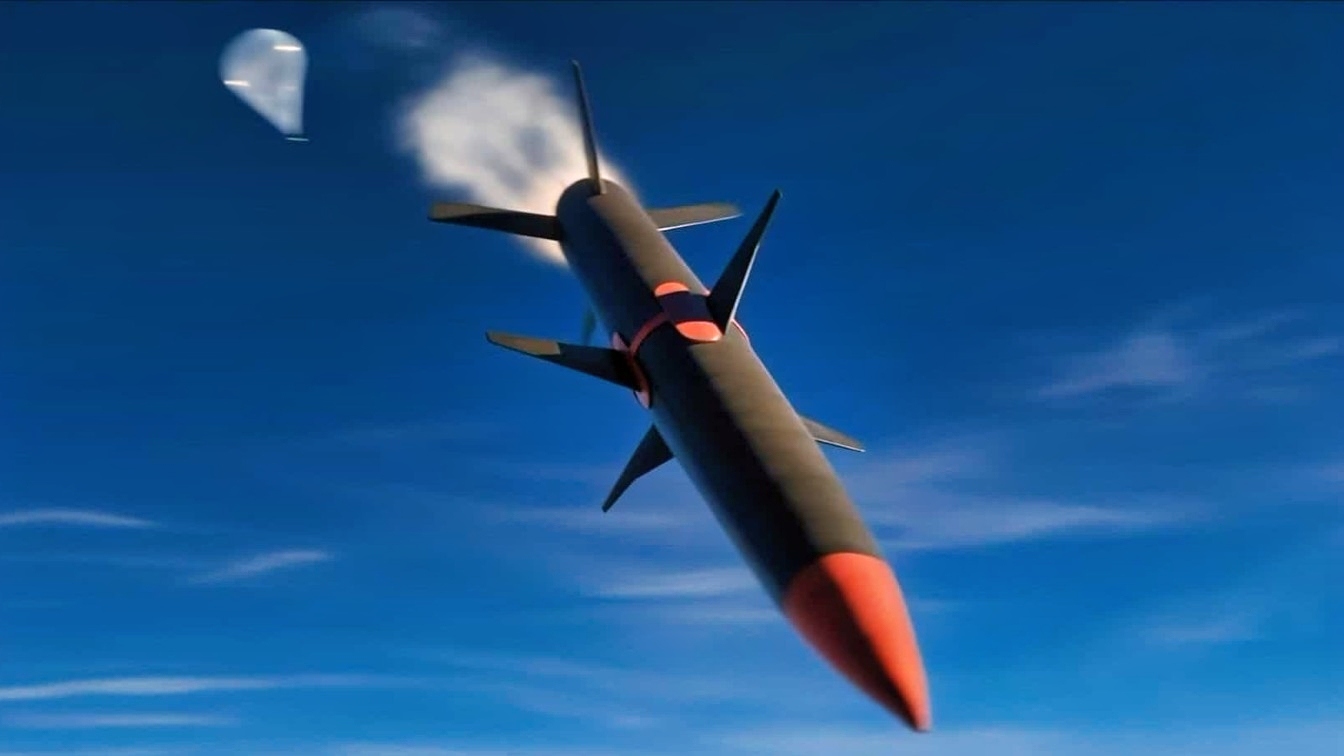
On Saturday Morning (local time), Russia launched one of its largest missile/drone attacks since the beginning of the war, which seems to be a recurring pattern as of late.
The Russians attacked Kyiv with over 40 ballistic missiles, six of which were reportedly Zircon hypersonic missiles, and 120 attack drones.
Putin In a Meeting Creative Commons Photo
According to some sources, only a few missiles were intercepted during the attack, despite Ukraine receiving a small number of PAC-3 missiles from Europe.
Ukraine’s defenses are still weak overall due to shortages in air defenses, and as Moscow increases the intensity of its long-range attacks, there is little for the Ukrainians to do except hope that Russian missiles miss their targets.
One of the Largest Missile Attacks Since the Beginning of the War
The attack began at 1:30 a.m. local time and continued well into the morning as residents of Kyiv were once again subjected to a large-scale missile attack by Moscow. “When the alarm started, we checked that there were ballistics, then went into the corridor. Then it started exploding one missile after another,” one resident said.
She added that the attacks are “very difficult psychologically…It used to be once a week or even more rarely, but now if not every day, then every other day.”
According to official sources, the attacks on Saturday morning killed at least six people, leaving several dozen others wounded.
The Ukrainian Ministry of Defense confirmed the attack, stating that the Russians had used more than 40 missiles and around 120 attack drones, all targeting the City of Kyiv. The Ukrainian Air Force reported that air defenses had “shot down or neutralized 126 targets, including 18 missiles and 108 unmanned aerial vehicles,” during the attack. Some independent analysts, however, believe the total number of interceptions is much lower, as Kyiv faces a crippling shortage of anti-ballistic air defense missiles. Despite small numbers of interceptor deliveries to Ukraine, the country still lacks the capacity to fully defend its airspace against Moscow’s ballistic missiles, leaving many industrial and military sites vulnerable to long-range attacks.
Putin In November of 2020 Creative Commons Photo
Targeting Ukraine’s Industrial Base
The Russian MoD claimed that the targets of the weekend bombardment were “defense industry enterprises and logistics centers” that were involved in the making and assembly of Ukrainian drones and missiles.
According to OSINT information, several defense and industrial centers were hit, including the Merdian Radio Plant, the Kyivkhimvolokno Plastics Factory, the Artem Defense Plant, and many others.
According to Russian sources, these installations were responsible for producing FPV drones, FP-5 Flamingo cruise missiles, and FP-7 ballistic missiles.
While some of these claims cannot be verified, it is more than likely that most, if not all, industrial centers in Ukraine are involved in the country’s defense in one way or another.
The Russians also carried out more attacks against objects in the Odesa region. For the past two weeks, Moscow has been carrying out daily attacks against Ukraine-bound cargo ships in the Black Sea, and against port infrastructure and other sites in the region.
According to Russian sources, these sites are also involved in the production and assembly of mid-to-long-range drones which have been used to attack ships in the Sea of Azov.
These attacks are an unfortunate but ultimately predictable response to Ukraine’s recent campaign against shipping in the Sea of Azov.
Since Ukraine is already facing a shortage of air defense missiles, the country cannot defend its capital and other populated cities like Odesa at the same time.
Escalating the War in Ukraine
The recent attacks against Ukraine have showcased a valuable principle: any escalation in Ukraine is met with equal or greater force.
The Russians first opened Pandora’s box when they started their long-range campaign against energy infrastructure across the country.
When Kyiv finally developed adequate long-range strike capabilities, it responded by striking Russian fuel refineries and other defense-related sites.
Ukraine launched its 40-day blitz to “influence the aggressor state” to end the war. Rather than forcing the Russians to capitulate, this operation seems to have had the opposite effect.
Russian attacks are growing in their scale and frequency, aimed at decapitating the country’s already struggling industrial base.
A similar phenomenon can be seen in the Black Sea/Sea of Azov.
Ukraine launched a large campaign to target shipping vessels in the Sea of Azov to disrupt maritime trade into Russia’s southern ports.
It appears, however, that Kyiv was not expecting Moscow to respond in kind. For two weeks, shipping in the Black Sea has been indiscriminately targeted, and port infrastructure in Odesa and Mykolaiv has been relentlessly targeted.
It should be noted that in the last few days, Ukrainian attacks against ships in the Sea of Azov have diminished.
As said earlier, Ukraine lacks the air defenses necessary to protect its capital and Odesa at the same time, and thus, Russian attacks against Odesa have gone largely unabated.
Moscow’s Attempt to Reestablish Deterrence
The Kremlin is partially to blame for its own predicament.
Whether due to military incompetence or some misguided sense of self-righteousness, Russia has failed to establish meaningful deterrence and prevent Ukraine and the West from launching long-range attacks against Russian territory.
Russia likewise failed to destroy Ukraine’s industrial base despite four years of fighting, which have allowed Ukraine to invest heavily in its medium-to-long-range strike capabilities.
From a purely military perspective, these strikes are long overdue and should have been launched much earlier in the war.
As devastating as these strikes have been, they are unlikely to deal a deathblow to Ukraine.
Ukraine’s industrial base is highly asymmetric and heavily distributed across warehouses and underground facilities. While higher-end munitions like FP-5 and FP-7 missiles might be affected, Kyiv will still be able to produce FPV drones in large numbers, allowing the AFU to hold back the Russian advance.
If these strikes continue, Ukraine’s position will worsen, and its long-range campaign will be hindered, but the country itself is unlikely to capitulate in the face of these attacks. The same logic, unfortunately, applies to Moscow as well.
About the Author: Isaac Seitz
Isaac Seitz, a Defense Columnist, graduated from Patrick Henry College’s Strategic Intelligence and National Security program. He has also studied Russian at Middlebury Language Schools and has worked as an intelligence Analyst in the private sector.


