

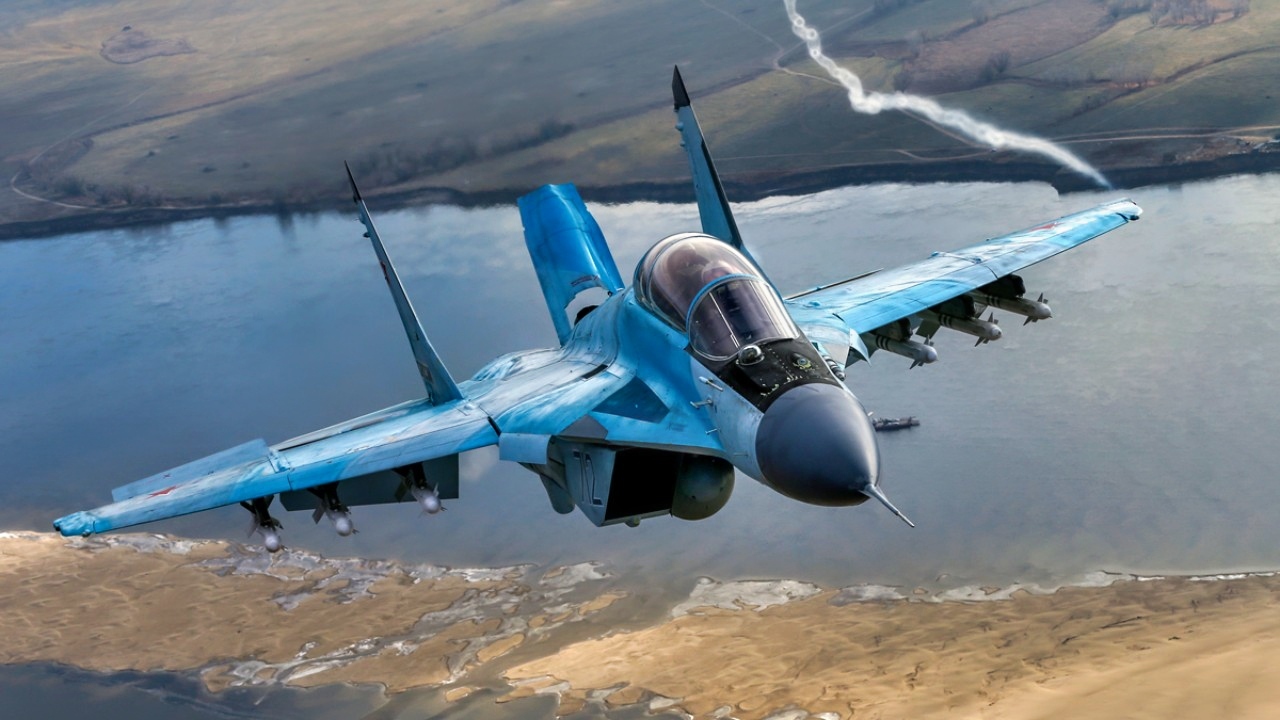
Key Points – Russia has reportedly assigned its advanced MiG-35 fighter jets, a 4++ generation aircraft derived from the MiG-29, to the “humdrum mission” of defending Moscow against escalating Ukrainian drone attacks.
-This deployment is seen as a sign of potential desperation and an admission that Russia’s conventional surface-to-air missile systems, like the S-400 and Pantsir-S1, are insufficient or overwhelmed by the sheer number of drones.
-Using a capable air superiority fighter for such rear-echelon anti-drone duties represents a significant underutilization of the platform and highlights the changing dynamics of air warfare in the Ukraine conflict.
Highly Valued Russian MiG-35 Fighter Has New Humdrum Mission
The aerial war against Ukraine has spawned some unpredictable scenarios. A fighter jet that Russia considers one of the best in its fleet, the MiG-35, is now policing the air around Moscow, looking to defend the capital against Ukrainian drones.
This is not what Vladimir Putin foresaw with his air force. Russian airplanes were supposed to have created air dominance early in the conflict. Still, now many excellent warplanes are executing mundane anti-drone missions rather than taking the fight to the enemy.
Few Envisioned Such an Outcome
The war, which has devolved into a drone fight that has de-emphasized the role of manned fighter jets, has seen few examples of dogfighting.
The Russian airplanes that were supposed to teach the Ukrainians lessons on defeating enemy jets, like the Su-57 and MiG-35, have mainly been a no-show in the war.
Conventional Air Defenses Not That Effective Against Drones
While protecting Moscow is important, it shows that the Russians are not able to use their existing surface-to-air missile systems to counter the use of Ukrainian drones.
Now, the MiG-35 is being taken from the frontlines and placed in the rear for what is boring duty for some of the best pilots in the air force.
Assigning counter-drone duty to the MiG-35 is a disappointing outcome for such an experienced and proven fighter jet.
One would think that conventional air defenses against unmanned craft would be enough to protect Moscow. This shows that Russian generals are still trying to evaluate the MiG-35 and attempting to find the right mission set for the warbird.
This must be seen as a letdown for the air force that had such high hopes to defeat the Ukrainians in the air.
Is the MiG-35 Really a Fourth Generation Plus-Plus Warbird?
The MiG-35 can be considered a close cousin of the old Soviet-era MiG-29 fighter. The MiG-35 is best compared to the upgraded and modernized American F-16 and is considered a fourth-generation-plus fighter.
The MiG-35 has two Klimov RD-33MK turbofan engines that push out a respectable MACH 2.25 speed. Its combat range is around 620 miles.
It has a reduced radar cross section and is considered a much better radar evader than the MiG-29, although it is not nearly as stealthy as the F-22 and F-35.
“The MiG-35’s standout feature is its Phazotron Zhuk-A active electronically scanned array radar, capable of tracking up to 30 targets simultaneously at ranges exceeding 120 miles. However, some reports indicate that cost-cutting measures have led to the omission of this radar in certain airframes, potentially limiting its effectiveness,” according BulgarianMilitary.com.
The MiG-35 can deploy air-to-air missiles such as the R-77 and R-73 and even take out surface vessels with the Kh-31 anti-ship missile. For the counter-drone mission, the MiG-35 uses its 30mm GSh-30-1 cannon.
Latest Drone Attacks Are Extensive
Russia needs every asset it can free up to defend against Ukrainian unmanned aerial systems. Take, for example, an attack in March where the Ukrainians sent 337 drones toward Russia, with 91 targeted at Moscow. Seventy-four were shot down over the capital. This was the largest drone attack of the war.
One would think that the vaunted S-400 and Pantsir-S1 air defenders would do the trick, but the sheer numbers of the drones necessitated another solution, and that’s why MiG-35s were scrambled.
This is not a good development. The MiG-35 is an air superiority jet for one-on-one combat with some of the best airplanes in the world. The Russians have tipped their hand and have admitted that air defenses around the capital are insufficient. It also shows that the air combat roles that Putin’s generals had expected are not playing out in the war.
New Disappointing Era for Human-Crewed Fighter Jets
These struggles represent a larger problem with the Russian air force and raise questions about the future of aerial warfare. What is the role of the manned fighter jet in 21st-century warfare? We are waiting for a decisive aerial battle over the skies of Ukraine, and we have yet to see it.
Russian aircraft are more commonly used for launching cruise missiles and glide bombs from within Russian airspace. Ukrainian jets are flying to protect Kyiv as well. Air policing was supposed to be accomplished by conventional interceptor missiles, and using a group of MiG-35s would have been considered an unlikely mission for such an advanced airplane.
The MiG-35 must be seen as a failure in the war. It has been assigned rear duty without much frontline combat. Russia must be wondering how the MiG-35 became such an afterthought. The airplane could still be used for missile attacks against Ukraine, but this is not the same as dominating the Ukrainian airplanes to achieve air supremacy.
We’ll see if the MiG-35 can still make a difference in the war or if generals are going to keep it as a rear echelon drone defender. This has been a stunning fall for the airplane that was supposed to make the Ukrainians pay for fighting back. Look for Ukraine to keep launching deep-strike drones to stretch the Russian air defenses thin and keep fighter jets like the MiG-35 tied up with a mission that few foresaw.
The drone war is sure to continue, and Russia is more likely to use its fighter jets to protect the capital in what has to be seen as a humdrum mission for pilots who wanted to seek glory by shooting down enemy fighter jets, not drones.
About the Author: Dr. Brent M. Eastwood
Brent M. Eastwood, PhD is the author of Don’t Turn Your Back On the World: a Conservative Foreign Policy and Humans, Machines, and Data: Future Trends in Warfare plus two other books. Brent was the founder and CEO of a tech firm that predicted world events using artificial intelligence. He served as a legislative fellow for U.S. Senator Tim Scott and advised the senator on defense and foreign policy issues. He has taught at American University, George Washington University, and George Mason University. Brent is a former U.S. Army Infantry officer. He can be followed on X @BMEastwood.
Fighter Jet Fails


