

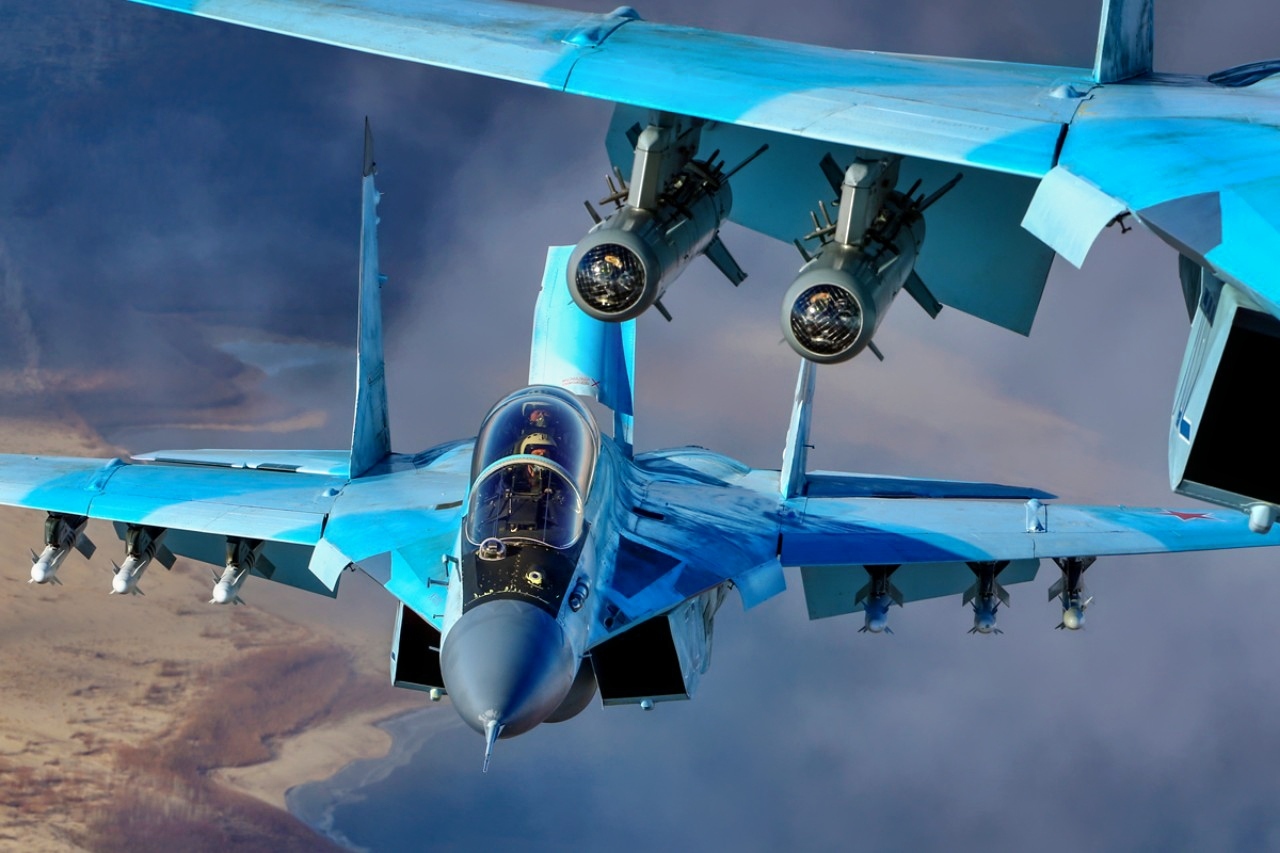
Key Points and Summary on the MiG-35 Fighter – The Russian MiG-35 “Fulcrum-F,” intended as an advanced 4.5-generation upgrade to the MiG-29, has been a significant failure for Moscow’s defense industry.
-Plagued by technical deficiencies, including the lack of a modern AESA radar and thrust-vectoring engines, the program has suffered from extreme production delays, with only 14 aircraft built since 2016.
-The MiG-35 has failed to secure a single export contract, losing bids to more capable Western and even other Russian fighters.
-Its only notable use has been for domestic air defense over Moscow, a far cry from its intended multirole combat duties.
The MiG-35 Fighter Failure
For whatever reason, the number 35 is very popular among manufacturers of fighter jets. In the United States, you have the Lockheed Martin F-35 Lightning II fifth-generation stealth fighter. In the People’s Republic of China, you have the Shenyang J-35 fifth-generation fighter.
And in the Russian Federation, you have the Sukhoi Su-35 “Super Flanker” and the Mikoyan MiG-35 “Fulcrum-F”, both of which are 4.5-generation fighters.
To some pundits, the Su-35 is Moscow’s best fighter, or at the very least, the Russians’ best non-stealth fighter. You won’t hear or read any such compliments bestowed upon the MiG-35, though. If anything, some might cynically remark that the “F” serves as the troubled warbird’s academic letter grade.
MiG-35 “Fulcrum-F” Initial History (and Differences from MiG-29 “Fulcrum”)
The original version of the Fulcrum, the fourth-generation MiG-29, made its maiden flight on Oct. 6, 1977, and went operational with the Soviet Air Forces in August 1983. It was exported to more than 30 countries, including nations outside of the Warsaw Pact.
In theory, the MiG-29 was supposed to be on equal footing with the U.S. F-15 Eagle and F-16 Fighting Falcon. In practice, Saddam Hussein’s Iraqi Air Force’s and Slobodan Milosevic’s Serbian Air Force’s Fulcrum drivers were totally outclassed by their F-15 and F-16 adversaries in aerial combat during 1991’s Operation Desert Storm and 1999’s Operation Allied Force, respectively.
As for the post-Cold War MiG-35, it made its maiden flight in 2007 but didn’t enter into official service with the Russian Aerospace Forces until June 2019. As to how it differed from the MiG-29, War Wings Daily elaborates that “the new aircraft featured substantial upgrades, including a redesigned airframe, enhanced engines, and state-of-the-art avionics.
“The primary goals were to improve range, survivability, and multi-role flexibility while reducing operating costs. This effort aligned with Russia’s broader military modernization strategy, which emphasized developing affordable platforms that could also attract international customers.”
Fulcrum-F Technical Specs and Vital Stats
Crew: 1 or 2
Fuselage Length: 17.3 meters (56 feet 9 inches)
Wingspan: 12 meters (39 feet 4 inches)
Height: 4.7 meters (15 feet 5 inches)
Empty Weight: 11,000 kilograms (24,251 pounds)
Max Takeoff Weight: 24,500 kilograms (54,013 pounds)
Powerplant: 2 x Klimov RD-33MK afterburning turbofan engines, each generating 19,800 pound-force (88.2 kilonewtons)
Ferry Range: In excess of 2,000 kilometers (1,243 miles) with external fuel tanks
Combat Range: 1,000 kilometers (620 miles)
Max Airspeed: Mach 2.25 (1,490 mph)
Service Ceiling: 17,500 meters (57,400 feet)
Armament:
Guns: GSh-30-1 30mm cannon.
Hardpoints: 9 hardpoints with a carrying capacity of up to 6,500 kilograms’ (14,330 pounds) worth of ordnance, including:
Kh-31A anti-ship guided missile
Kh-29TE and Kh-29L air-to-surface missiles
KAB-500Kr TV-guided bomb and KAB-500L laser-guided bomb
The Russian Air Force initially announced in 2013 that it would order 37 MiG-35s and intended to have them in service by the mid-2020s. However, a mere 14 Fulcrum-F airframes have been built thus far – a rate of one per year from 2016 to 2024.
Operational History, i.e. Why Is It Such a Mess?
Part of the reason so few have been produced is the competition for production from fighters such as Sukhoi’s Su-30 and the aforementioned Su-35. (Though Mikoyan and Sukhoi are separate divisions, they both fall under Moscow’s United Air Corporation conglomerate.)
There are also technical deficiencies lurking beneath the impressive cosmetic exterior. As noted by Global Defense Corp, some of these shortcomings include a lack of thrust vectoring; no active electronically scanned array radar; and faulty RD-33 engines that tend to gush smoke.
The lone silver lining for the warplane is that in May 2025, the Russian Ministry of Defense “deployed MiG-35 fighter jets to patrol the skies around Moscow, responding to a growing wave of Ukrainian drone incursions targeting the capital region.”
Future For the Fulcrum-Fs
In short, the future for this airframe is not bright. The MiG-35 has already failed to secure Foreign Military Sales bids with India, Argentina, Bangladesh, and Malaysia. There is still an outside possibility that the Vietnamese People’s Air Force will purchase the plane to replace its aging MiG-21 “Fishbed” and Su-22 “Fitter” fleets, but given the MiG-35’s track record thus far, that prospect looks slim at best.
About the Author: Christian D. Orr, Defense Expert
Christian D. Orr is a Senior Defense Editor. He is a former Air Force Security Forces officer, Federal law enforcement officer, and private military contractor (with assignments worked in Iraq, the United Arab Emirates, Kosovo, Japan, Germany, and the Pentagon). Chris holds a B.A. in International Relations from the University of Southern California (USC) and an M.A. in Intelligence Studies (concentration in Terrorism Studies) from American Military University (AMU).
More Military
The U.S. Navy’s Submarine Crisis Is Real


