

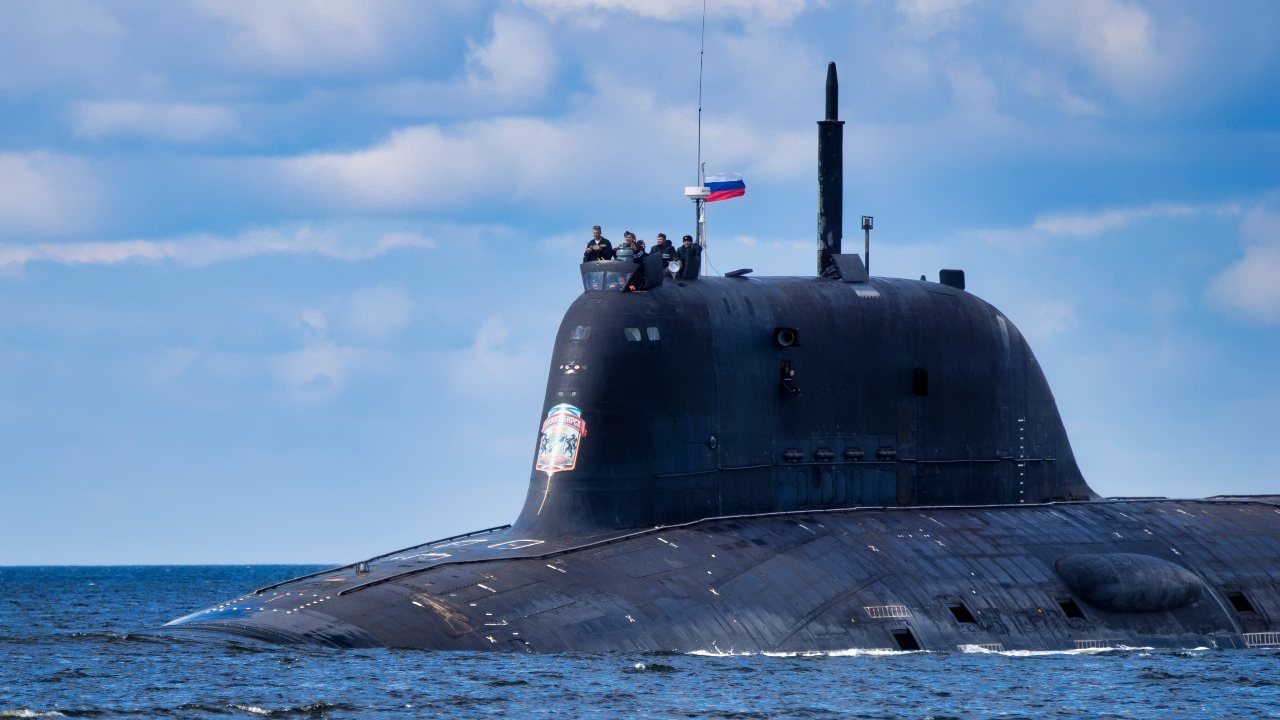
Key Points and Summary: Russia’s latest nuclear submarine, Arkhangelsk, is the fourth vessel in the advanced Yasen-M class. Though smaller than the original Yasen-class, the Yasen-M is no less formidable, capable of firing long-range cruise missiles like Kalibr, Oniks, and hypersonic Tsirkon.
-This firepower, combined with its quiet operation, allows it to threaten targets without even leaving Russian waters.
-While questions remain about its older torpedo technology, its multi-role design marks a strategic shift for Moscow: long-range strike over traditional “sea lane” interdiction.
-NATO must adapt, as these submarines may not need to cross the GIUK gap to pose a significant maritime and land-based threat.
Yasen-Class Revamp: How the Arkhangelsk Could Upend Naval Warfare
Russia’s latest submarine, the Yasen-M-class Arkhangelsk, entered service with the Russian Navy in late December of last year.
It’s just the fourth Yasen-M submarine built. Both the Yasen-class and the modified Yasen-M nuclear submarines are some of the newest, most advanced submarines in the Russian or Chinese navies, said to rival the quietest American submarines.
Thanks to an updated nuclear reactor design, the newer, modified Yasen-M class is somewhat smaller than the original Yasen submarines. However, it is no less capable — in fact, they may actually be more versatile despite their smaller size.
Russian shipyards can build the smaller submarines somewhat faster thanks in part to their smaller size, and could be a way to reduce costs without compromising the quality of the build.
As a platform, the Yasen-class is a particularly potent submarine, thanks not just to their onboard sensor suite nor their extremely quiet operation but also to their long-range strike capability, an ability afforded by their advanced Kalibr and Oniks cruise missiles, as well as the hypersonic Tsirkon missiles. These weapons, along with their torpedo armament, allow the submarine to conduct anti-submarine, anti-ship, and land-attack missions.
The class may also represent a step change in Russian submarine doctrine. Rather than trying to get into the Atlantic Ocean to hold ships there at risk, Russia may instead be pursuing a different strategy. By leveraging very fast hypersonic missiles with exceptionally long range, Russia can hold many European capital cities and other important civilian and military targets at risk without leaving the North Sea or its other territorial waters close to the Russian mainland, making the Yasen a very formidable asset.
Torpedos from the Soviet Era
One of the class’ potential shortcomings could be its torpedos. Izvestia, a Russian state-owned newspaper, raised questions about the Yasen-M’s torpedos.
“There are also certain questions about the torpedo armament – it is from the Soviet era – and they will have to be resolved. The new torpedoes have not yet been fully tested – there is work to do, something to improve,” the newspaper said. “Potentially, this is a very important acquisition,” it added.
One of the worst submarine disasters in Soviet or Russian history — the sinking of the Kursk submarine in 2000 — likely happened because one of the submarine’s torpedos exploded, killing all crew members.
Changing Strategies
The newest Yasin-M submarines are indicative of a change in how Russia employs its submarines and, indeed, what those submarine’s missions will be. A report from the Royal United Services Institute explains.
“From a planning standpoint, the most notable feature of [the new Yasins are a] capacity to launch a range of anti-ship and land attack missiles, including the hypersonic 3M22 Zircon. The shift from SSNs like the Akula, which are primarily optimised for a hunter-killer role, towards a concept closer to nuclear guided missile submarines (SSGNs), is likely indicative of a shift in the way that Russian submarines will contribute to future campaigns.”
Furthermore, “long-range strike missions appear to be superseding sea lines of communication (SLOC) interdiction as a primary task. This will likely necessitate a change in how NATO manages the anti-submarine warfare (ASW) challenge in the High North, given that a strategy of barrier defence at the GIUK (Greenland–Iceland–UK) gap may actually do little to impact Russian submarines, which may have little need to traverse this barrier in order to achieve their operational ends.”
About the Author: Caleb Larson
Caleb Larson is an American multiformat journalist based in Berlin, Germany. His work covers the intersection of conflict and society, focusing on American foreign policy and European security. He has reported from Germany, Russia, and the United States. Most recently, he covered the war in Ukraine, reporting extensively on the war’s shifting battle lines from Donbas and writing on the war’s civilian and humanitarian toll. Previously, he worked as a Defense Reporter for POLITICO Europe. You can follow his latest work on X.


Pingback: Russia 'Lost' a Titanium Submarine Armed with 2 'Nuclear Tipped' Torpedoes - National Security Journal
Pingback: U.S. Navy Nuclear Attack Submarine Smashed Into an 'Underwater Mountain' - National Security Journal