


Key Points and Summary – Russia is relaunching the Su-57 export push with glossy imagery of its internal bays ahead of the Dubai Airshow 2025.
-A leaked trove and official hints point to Algeria as the first Su-57E customer, with deliveries touted for 2025, while Iran and Ethiopia are floated as prospects.
-The pitch: a cheaper “fifth-gen” with internal weapons and super-maneuverability.
-The problem: tiny production runs, sanctions-choked supply chains, immature avionics and engines, and stealth well behind the F-22/F-35.
-With only around 20 in Russian service and after-sales doubts, the Felon’s visibility is rising—but its viability remains uncertain beyond a headline-friendly one-off sale today.
Russia Is Trying to Sell the Su-57 Again: Will It Work This Time?
Russia is attempting to generate interest in its Su-57 fighter aircraft, releasing new promotional material that showcases the jet’s internal weapons bays and air-to-air missiles ahead of the Dubai Airshow 2025, in an effort to sell the aircraft.
It’s Back! With the 2025 Dubai Airshow approaching (November 17-21), Russia has released promotional images of the Su-57, showing its internal features, including its weapon bays.
This return to the export scene is part of an effort to boost foreign orders for an aircraft that remains in low production. The Kremlin, via United Aircraft Corporation and Rostec, wants to position the Su-57 as a credible alternative on the international market.
Defenceblog.com posted that a newly leaked document allegedly from Russian state defense manufacturer Rostec appears to outline detailed pricing, delivery schedules, and export plans for advanced Sukhoi fighter jets destined for several foreign clients—including Iran, Algeria, and Ethiopia.
This information was posted online in October by a hacker site called Black Mirror, which claimed to have hacked over 300 documents from Rostec’s website.

Su-57 Felon Stealth Fighter from Russia. Image: Creative Commons.

Su-57 Felon Fighter Russian Ministry of Defense Photo
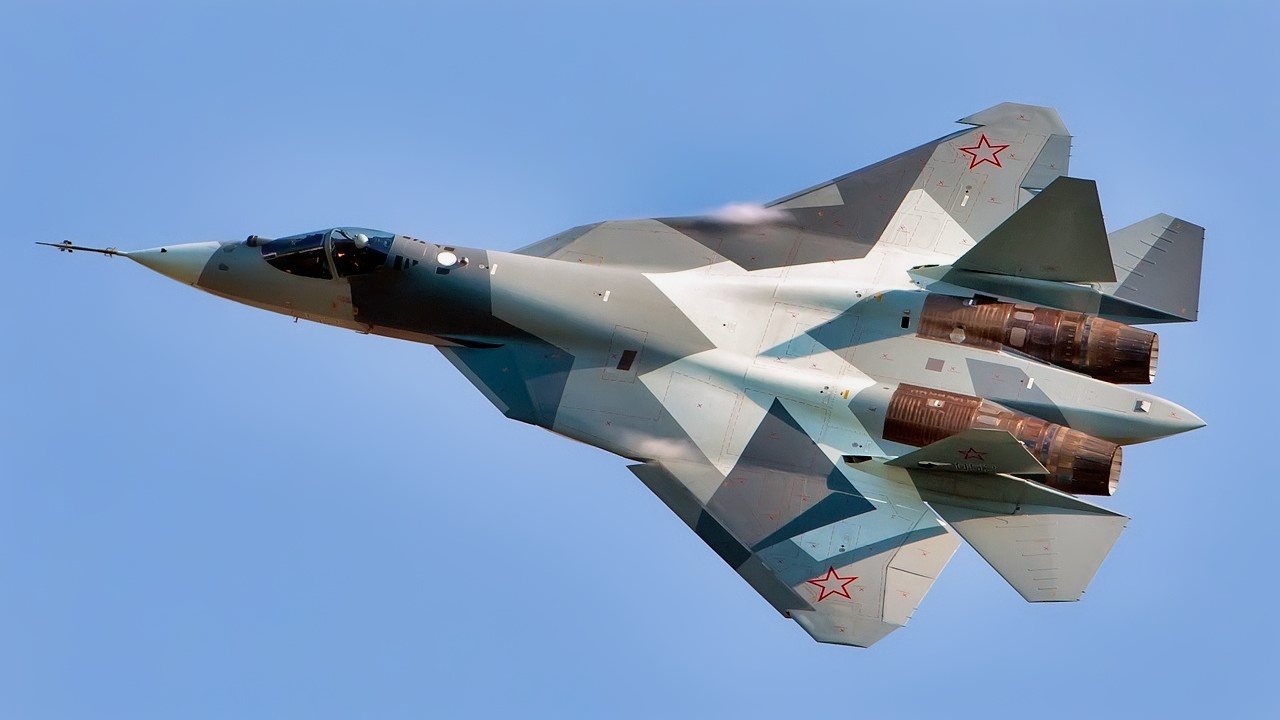
Russia PAK-FA or Su-57 Felon. Image Credit: Creative Commons.
However, the operational reality of the fighter, its technical limitations, production delays, and lack of effective exports raise questions about the relevance of this relaunch.
The First Export Goes To: Algeria
Russia’s much vaunted Su-57 Felon finally has a foreign buyer. Algeria, which has long been rumored to be interested in the Felon, has opted to buy the Russian 5th-generation fighter.
In doing so, Algeria becomes the first nation other than Russia to operate the Su-57. Algeria, in an arms race with Morocco, has purchased six Su-57E models (an export model), with pilots being trained in Russia. The six units are to be delivered sometime in 2025.
Algeria is also rumored to be purchasing eight more Felons for a total of 14. Iran and Ethiopia are also reportedly on the short list of potential buyers for Su-35s and Su-34s.
Morocco has also undertaken a modernization campaign that included the acquisition of F-16C/D Fighting Falcon Block 72 fighters from the United States in 2019. The Kingdom may possibly soon field F-35 Lightning IIs from the US.
While the Russian Federal Service for Military-Technical Cooperation (FSVTS) did not disclose the identity of the purchasing country during the MILEX 2025 defense exhibition in Minsk, multiple independent sources, including Algerian state television and statements from Russian officials, confirm that Algeria is the first export client.
Russian state-owned defense firm Rosoboronexport CEO Alexander Mikheev’s comment at the Aero India 2025 exhibition: “The first foreign customer of the promising fifth-generation multirole fighter Su-57E will begin operating this aircraft, which will be supplied by Rosoboronexport, in 2025.”
Algeria has been a purchaser of Russian military equipment since the 1960s.
“The Su-57 is the world’s sole fifth-generation fighter that has proven its ability to efficiently counter Western-made air defense systems in a real combat environment. The fighter can employ a wide range of high-precision guided weapons and features a low radar signature,” TASS reported.
India withdrew from the FGFA joint development project in 2018, citing insufficient stealth performance and dissatisfaction with Russian radar and avionics.
No Match For the F-22 or the F-35
Designed to compete with Western jets like the F-22 Raptor and F-35 Lightning II, the Su-57 is no match for either of these American air platforms. Furthermore, Russia’s industrial base is far from ready to mass-produce the stealth jet at the desired levels. To date, Russia has only 20 operational Felons in its air fleet.
The Su-57 combines stealth, advanced avionics, and supermaneuverability, reflecting an amended, hybrid philosophy rooted in traditional Russian combat doctrine that prioritizes supermaneuverability, through thrust vectoring, particularly at low speeds, but updated for the challenges of modern aerial warfare in an era increasingly defined by stealthy aircraft.
The Su-57 Felon’s stealth features include faced surfaces that redirect radar out and away from the jet, internal weapon bays, and radar-absorbent materials, with particular emphasis on reducing the jet’s radar cross-section from the frontal aspect, in part by burying the jet’s two engines within the airframe.
However, its stealth properties fall far below those of Western stealth aircraft, as Russia is still in the early stages of developing stealth aircraft. The Su-57 aims to position itself between US and Western aircraft, offering the stealth capabilities and internal weapon bays of a new-generation fighter, while providing a more accessible price and favorable technology transfer conditions.
However, production delays, a lack of extensive operational experience, and dependence on problematic Russian industrial chains may limit its appeal.
Development of the Su-57
The development of the Su-57 began in the early 2000s under the PAK FA (Prospective Aviation Complex of Frontline Aviation) program, which aimed to create a next-generation fighter to replace the aging Soviet-era aircraft fleet.
The prototype, designated the T-50, made its maiden flight on January 29, 2010. Over the next decade, the aircraft underwent extensive testing and refinement, with several prototypes being built and flown.
The Felon faced numerous challenges during its development, including technical issues, budget constraints, and international sanctions. Despite these hurdles, the Russian government remained committed to the project.
In 2019, the first production model of the Su-57 was delivered to the Russian Aerospace Forces, marking a significant milestone in the program. In 2022, 12 aircraft were delivered to the VKS, with an additional 20 reportedly scheduled for delivery in 2024; however, it is unlikely that many, if any, were actually delivered.
The export model of the Felon is powered by two Saturn Izdeliye 30 engines, which provide a top speed of Mach 1.09 (838 mph) and a range of approximately 1,250 kilometers (776 miles) with a combat radius.
The Su-57 can carry a wide range of air-to-air, air-to-ground, and anti-ship missiles and precision-guided bombs. Its internal weapons bays can house up to four R-77 or R-74 air-to-air missiles, while additional hardpoints on the wings allow for the carriage of larger munitions. The aircraft also has a 30mm GSh-30-1 cannon for close-range engagements.
In addition to its advanced arsenal, the Su-57 is versatile and can perform several missions, including air superiority, ground attack, reconnaissance, and electronic warfare. Its advanced avionics and sensor suite enable it to operate in contested environments and rapidly engage aerial and ground-based threats.
The Algerian contract will not be extensive, and at present, there are no other offers on the table to track. Russian manufacturing is hurting due to the Western sanctions. However, Russia will continue this program and hopes it can entice other foreign countries to invest in its troubled program.
Sanctions Limit Upgrades, And Western Weapons Integration
The sanctions on Russia have limited the Su-57’s ability to attract customers, and the supply chain issues that have restricted production to just a handful of airframes for the Russian military will deter potential buyers.
The after-sales support chain, parts availability, pilot training, and maintenance are all key factors that international customers consider. Russia must compete with US, Western European, and Chinese aircraft manufacturers, who, frankly, offer better aircraft than the Su-57.
There are three countries currently that claim to have produced 5th Generation stealth fighters: the United States ( the Lockheed Martin F-22 Raptor and F-35 Lightning II), the People’s Republic of China (the Chengdu J-20 Mighty Dragon and Shenyang J-35), and Russia (the Sukhoi Su-57 (NATO reporting name Felon). Meanwhile, India is working on its Advanced Medium Combat Aircraft (AMCA), but it isn’t expected to be fully operational until 2035.
The Sukhoi Su-57 is widely regarded by many experts as the least effective stealth fighter, particularly in comparison to its American and Chinese counterparts, such as the F-22 Raptor and J-20, due to its significantly inferior stealth capabilities, limited production, and issues with technology and workmanship.
5th Gen-Stealth? Radar Cross-Section Is Enormous
While it offers improvements over previous Russian aircraft, its radar cross-section is significantly larger than that of other fifth-generation fighters, and delays, budget issues, and reliance on older engines have plagued its development.
The F-35 has a frontal radar cross-section of 0.0001 m², thanks to its advanced fiber-matte radar absorbent material. In comparison, the SU-57 has a radar cross-section ranging from 0.1 to 1 m². This means the Su-57 has a 1,000 times larger radar cross-section than an F-35, which is more akin to a fourth-generation fighter.
That may be an exaggeration. Alex Hollings says the Felon’s radar signature is more likely to be 20 to 30 times that of an F-22 Raptor, which is still a massive difference in stealth.
The Su-57 is unlikely to generate significant foreign sales for Russia, despite its appearance at the Dubai Air Show.
About the Author: Steve Balestrieri
Steve Balestrieri is a National Security Columnist. He served as a US Army Special Forces NCO and Warrant Officer. In addition to writing on defense, he covers the NFL for PatsFans.com and is a member of the Pro Football Writers of America (PFWA). His work was regularly featured in many military publications.


