


Key Points and Summary – The Soviet Victor III-class submarine was a strategic shock to the U.S. Navy in the late 1970s.
-While previous Soviet subs were notoriously loud, the Victor III was terrifyingly quiet, a “black hole” that erased America’s acoustic advantage.
-This quantum leap was not Soviet ingenuity alone; it was fueled by secrets stolen by the John Walker spy ring.
-The new design, featuring advanced quieting and towed sonar arrays, turned the underwater Cold War into a dangerous duel between near-equals, proving that espionage could instantly close a technological gap and reshape the global balance of power.
What Made the Victor III-Class Submarine So Powerful: U.S. Navy DNA?
Since I was a kid putting away books in a summer job at the Providence Public Library back in my home state of Rhode Island, thumbing through Janes Fighting Ships and other naval books, I have been fascinated with Soviet and now Russian nuclear attack submarines.
And, even at 46, that obsession continues.
History tells the story: For the better part of three decades, the Cold War beneath the waves was a game of cat and mouse played by two starkly different philosophies.
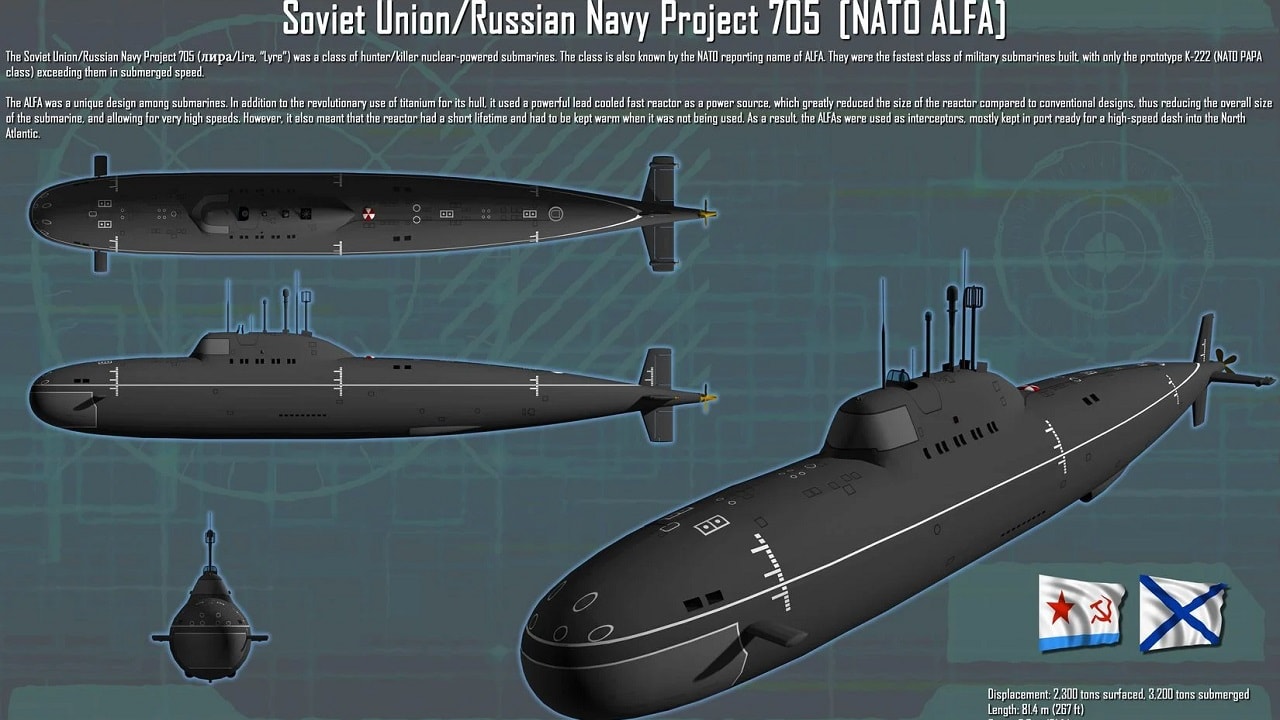
Alfa-Class Submarine. Image Credit: Creative Commons.
The United States Navy, with its technological prowess and immense budget, built submarines that were the undisputed masters of stealth. Our boats were ghosts, paragons of acoustic silencing that could glide through the deep ocean, confident that they were the hunters and never the hunted. On the other side, the Soviet Union built submarines that were brute-force instruments of power—fast, deep-diving, heavily armed, and notoriously, almost comically, loud. A Soviet submarine was a charging bear in a forest of whispers; you always heard it coming.
This acoustic advantage was the bedrock of American naval strategy. It was our ace in the hole, the invisible shield that allowed our carrier battle groups to roam the seas and our ballistic missile submarines to disappear into the depths, secure in their invulnerability. We knew we were quieter, and in the dark, silent world of undersea warfare, the quietest boat always wins.
Then, in the late 1970s, everything changed. American sonar operators, listening to the familiar cacophony of the Soviet Northern Fleet, began to detect something new. It was a Soviet attack submarine, but it was different. It was faster than its predecessors, more agile, and most terrifyingly, it was quiet.
The familiar clatter of machinery and the loud thrash of propellers were gone, replaced by a much softer, more elusive acoustic signature. This new predator was the Project 671RTM, known to NATO as the Victor III-class. It was a quantum leap in Soviet submarine design, a boat that had suddenly and inexplicably closed a technology gap that we believed would take decades to bridge.
The appearance of the Victor III sent a jolt of pure fear through the Pentagon and the U.S. intelligence community. It was more than just a technological surprise; it was a strategic nightmare. But the most chilling part of the story would not be revealed until years later.
This sudden Soviet mastery of silence was not entirely their own. It had been bought, paid for, and delivered by an American traitor. The story of the Victor III is not just one of brilliant Russian engineering; it is a dark tale of espionage, betrayal, and how stolen secrets from the heart of the U.S. Navy helped create one of the most formidable undersea adversaries we ever faced.
The Noisy Predecessors and the American Edge
To truly grasp the shock of the Victor III, you have to understand the submarines that came before it. The Soviet Victor I and Victor II classes of the late 1960s and early 1970s were impressive machines in their own right.
They were the workhorses of the Soviet attack submarine fleet, designed to sprint out into the Atlantic to intercept NATO convoys and hunt American ballistic missile submarines. They were fast, able to outrun most surface ships, and could dive deeper than their American counterparts, giving them a theoretical edge in evading torpedoes.
But they had a fatal flaw: they were incredibly noisy. And in the world of anti-submarine warfare (ASW), noise is death. The internal machinery of these boats was bolted directly to the hull, sending vibrations radiating out into the water for miles. Their propellers were crudely manufactured, creating a loud, churning sound known as cavitation that was like a dinner bell for American sonar operators.
An American Los Angeles-class submarine, lying in wait, could often hear a Victor-class boat coming from a hundred miles away. Our advanced SOSUS (Sound Surveillance System) network of underwater hydrophones laid across the Atlantic could track their every move. The game was rigged. We held all the cards, and the core of our advantage was our mastery of submarine quieting.

NAVAL BASE GUAM (Dec. 11, 2024) – The Los Angeles-class fast-attack submarine USS Annapolis (SSN 760) transits Apra Harbor, Naval Base Guam, Dec. 11, 2024. Assigned to Commander, Submarine Squadron 15, based at Polaris Point, Naval Base Guam, Annapolis is one of five forward-deployed fast-attack submarines. Renowned for their unparalleled speed, endurance, stealth, and mobility, fast-attack submarines are the backbone of the Navy’s submarine force. Regarded as apex predators of the sea, Guam’s fast-attack submarines serve at the tip of the spear, helping to reaffirm the submarine force’s forward-deployed presence in support of a free and open Indo-Pacific. (U.S. Navy photo by Lt. James Caliva)
This wasn’t just a matter of better parts; it was a fundamentally different design philosophy. The U.S. Navy had poured immense resources into understanding the science of underwater acoustics. We developed techniques to isolate machinery on “rafts”—massive internal platforms suspended on rubber mounts that absorbed vibrations. We pioneered complex computer-aided design for propellers, milling them to precise, complex curves that minimized cavitation. We analyzed every pump, every pipe, every piece of equipment to dampen its acoustic signature. These weren’t just trade secrets; they were the crown jewels of American naval technology. And we believed they were secure.
The Betrayal That Silenced a Fleet
The story of how those secrets were lost begins not in a Moscow design bureau, but in a nondescript office in Norfolk, Virginia, with a U.S. Navy Warrant Officer named John Walker. Walker, a communications specialist with access to a vast array of classified material, was in deep financial trouble.
In 1967, he walked into the Soviet embassy in Washington D.C. and offered to sell America’s secrets to the KGB. For the next 18 years, Walker and a small ring of co-conspirators, including his brother and his son, methodically funneled a torrent of top-secret documents to their Soviet handlers. It was arguably the most damaging espionage case in U.S. history.
The Walker spy ring provided the Soviets with a treasure trove of intelligence, including the codes for our secure communications systems. But the most devastating information they handed over related to our anti-submarine warfare and submarine quieting programs.
The Soviets didn’t just get technical manuals; they got the very keys to our submarine kingdom. They learned about the locations and capabilities of our SOSUS listening network. They received detailed reports on our ASW tactics. And most critically, they gained a deep understanding of how we made our submarines so quiet.
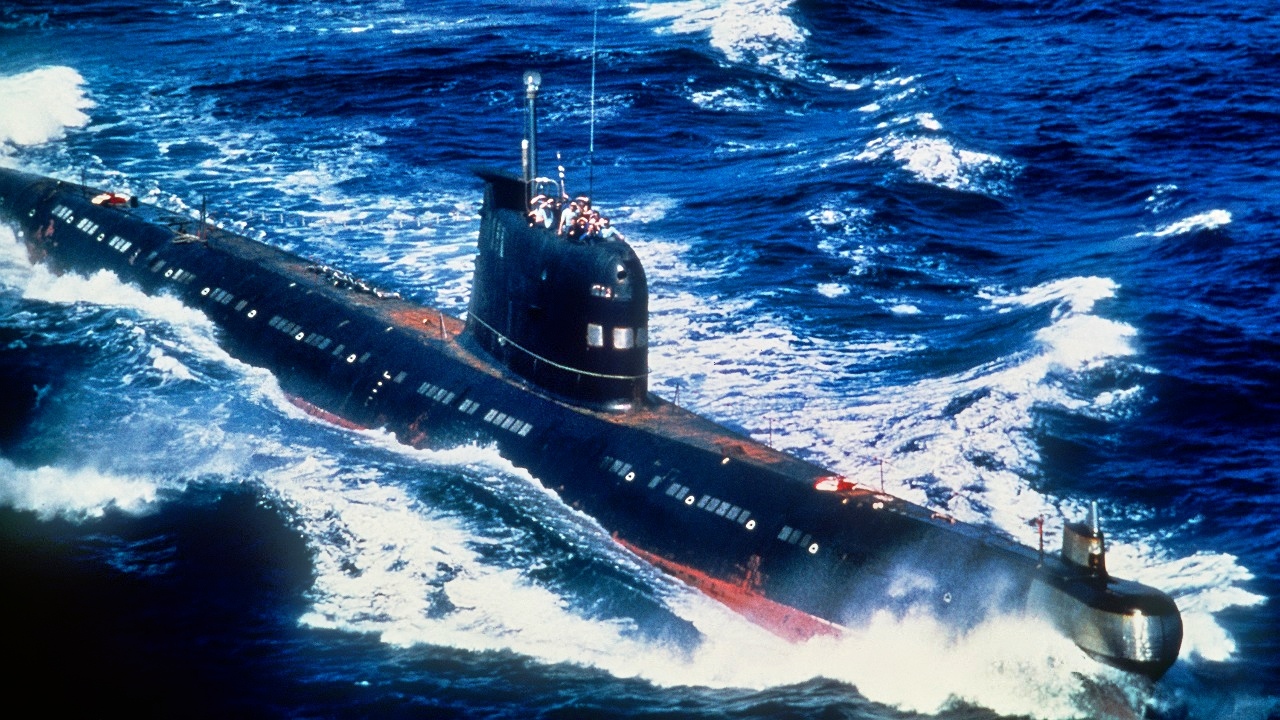
Foxtrot-Class Submarine. Image Credit: Creative Commons.
Armed with this stolen knowledge, Soviet engineers at the Rubin and Malakhit design bureaus could now reverse-engineer America’s acoustic advantage. They finally understood the intricate principles of machinery rafting. They learned about our advanced propeller milling technology, which allowed for the creation of far more efficient and quieter screws. They could now analyze their own submarine designs through the lens of what their primary adversary was listening for. It was as if they had been given the answer key to the most difficult test in the world. The Victor III was the first major beneficiary of this catastrophic intelligence windfall.
Anatomy of a Stolen Shark
When the first Victor III, the K-524, slid into the water in 1977, it was immediately apparent that this was a different breed of animal. While it shared the same basic hull form as its predecessors, it incorporated several revolutionary changes, many of which were directly influenced by the secrets stolen by John Walker.
The most significant leap was in its internal quieting. For the first time in a major Soviet submarine class, the primary machinery was mounted on a large, two-stage sound-isolating raft system. This was a direct application of the American design philosophy, and it dramatically reduced the amount of vibration transmitted into the hull. The difference was audible—or rather, it wasn’t. The loudest sources of noise on the earlier boats had been effectively muffled.
The other game-changing improvement was its propeller. Instead of the older, cruder designs, the Victor III was fitted with a pair of tandem, four-bladed propellers that were far more acoustically efficient. Later boats in the class would be retrofitted with a single, large, skewed seven-bladed propeller, a design made possible by the advanced milling technologies the Soviets had learned about through Walker. This new screw was a night-and-day improvement, drastically reducing cavitation noise at tactical speeds.
Visually, the Victor III was distinguished by a large, peculiar pod on its top vertical tailfin. This distinctive feature housed a deployable towed sonar array. This was another major innovation for the Soviets.
A towed array is a long cable with a series of hydrophones that a submarine can trail hundreds of meters behind it. This allows it to listen for enemy contacts far away from the noise of its own hull and machinery, giving it a much greater detection range. It was a capability that had given American submarines a significant advantage, and now, the Soviets had it too.
The result was a submarine that, while still not as quiet as a brand-new American Los Angeles-class boat, had narrowed the gap to a terrifying degree. The hundred-mile detection advantage the U.S. Navy had enjoyed was gone. Now, the detection ranges were much shorter, much more uncertain. The Victor III was a predator that could finally hunt with a measure of stealth.

Los Angeles-Class. Image Credit: Creative Commons.
The Duel in the Deep: A Frightening New Equation
The arrival of the Victor III fundamentally changed the nature of the undersea Cold War. The cat-and-mouse game became a far more dangerous duel between near equals. An American Los Angeles-class submarine was still the apex predator. Its reactor was quieter than the Victor III’s, and its sonar systems were more advanced. But the Victor III was faster and could dive deeper, giving its commander more options to escape an attack.
More importantly, the acoustic gap had shrunk so much that encounters became a matter of skill, nerve, and luck. An American sub commander could no longer be entirely certain that he had detected a Soviet boat before it had detected him. There were numerous, now-declassified reports from the 1980s of harrowing encounters in the North Atlantic, where U.S. and Victor III submarines would suddenly find themselves in dangerously close proximity, each realizing at the same moment that they were no longer the only hunter in the area.
This new reality had profound strategic consequences. It meant that the protective screen around American carrier battle groups was now more permeable. A Victor III, with its improved quietness and high speed, had a much better chance of slipping through to get within torpedo range of a carrier.
It also meant that our own ballistic missile submarines, our ultimate nuclear deterrent, were theoretically more vulnerable. The Victor III had become a credible threat, a weapon that forced the U.S. Navy to rethink its tactics and accelerate its own technological development.
The pressure created by this Soviet shark directly led to the U.S. pouring billions into the development of its successor to the Los Angeles-class—the Seawolf-class submarine, a boat designed with the express purpose of restoring America’s overwhelming acoustic dominance.
A Legacy of Betrayal and a Lesson for a New Era
The Victor III-class submarines served through the end of the Cold War and into the Russian Navy, though their numbers have dwindled over the years due to age and Russia’s post-Soviet budget crises. A few may still be in service, but they are relics of a bygone era. Their true legacy, however, is not in their service record, but in the brutal lesson they taught the West.

Akula-Class. Image Credit: Creative Commons.
They were a stark and powerful reminder that no technological advantage is permanent. They proved that a determined adversary, through a combination of their own ingenuity and our own security failures, can close a seemingly insurmountable gap with shocking speed.
The story of the Victor III is inextricably linked to the story of John Walker’s treason. It is a cautionary tale written in the silent depths of the ocean, a reminder that the most dangerous weapon is not always a missile or a torpedo, but a secret given to the enemy. It demonstrated that the invisible war of acoustics could be won or lost not just in a shipyard, but in a quiet act of betrayal a world away.
About the Author: Harry J. Kazianis
Harry J. Kazianis (@Grecianformula) is Editor-In-Chief and President of National Security Journal. He was the former Senior Director of National Security Affairs at the Center for the National Interest (CFTNI), a foreign policy think tank founded by Richard Nixon based in Washington, DC. Harry has over a decade of experience in think tanks and national security publishing. His ideas have been published in the NY Times, The Washington Post, The Wall Street Journal, CNN, and many other outlets worldwide. He has held positions at CSIS, the Heritage Foundation, the University of Nottingham, and several other institutions related to national security research and studies. He is the former Executive Editor of the National Interest and the Diplomat. He holds a Master’s degree focusing on international affairs from Harvard University.
More Military
The F-22 Raptor Stealth Fighter Still Haunts the U.S. Air Force
The U.S. Navy’s Big Nuclear Attack Submarine Mistake Still Stings
China’s J-20 Mighty Dragon vs. F-22 Raptor Stealth Fighter Summed Up in 4 Words
Why Is a U.S. Navy Aircraft Carrier Still Damaged 8 Months After a Collision?


