

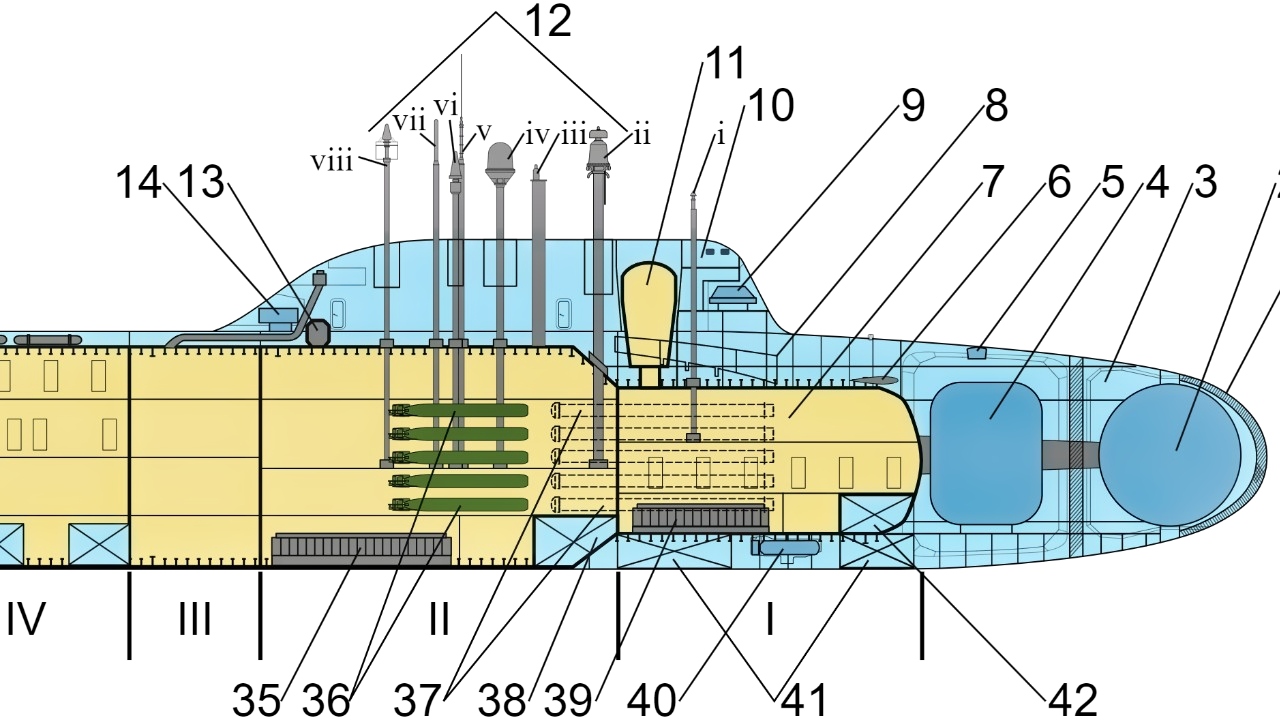
Russia’s Yasen-Class Submarine, Explained: You better believe Russian submarines can venture across the Atlantic and dock in Havana, Cuba close to American shores. The Russian navy accomplished this feat by sending one of its most modern attack subs to the Caribbean in June. This was a real stick in the eye to the U.S. military and likely had the Navy in fits. Vladimir Putin is showing the world that he can deploy vessels of a Blue Water navy anywhere, anytime.
Let’s take a closer look at the submarine that pulled off the Cuba deployment.
Meet the Yasen-Class from Russia
The Project 885M Yasen-class Kazan nuclear-powered cruise missile submarine is a gem of a boat that the United States has been concerned about for years.
The Kazan and its sister subs of the Yasen-class consist of fast attack capabilities with an impressive range.
Putin is using it to send a message to America that he will not stand by idly as the Pentagon continues to supply the Ukrainians with modern land warfare weaponry.
The Kazan was joined by three other vessels on its voyage to Cuba. The missile frigate Admiral Gorshkov, an oil tanker, and a salvage tug made the journey, so the Americans tracked the flotilla the whole time. The Kazan was not believed to carry nuclear missiles.
Background of the Yasen-class
Russia began work on the Yasen-class during the Cold War, and the first type became operational in 2013 with the commissioning of the Severodvinsk. The Kazan is actually part of the updated Yasen-M class. It can carry modern weapons such as the Oniks and Kalibr cruise missiles and, some day, the new hypersonic Zircon missiles.
New Offensive Concept for the Cruise Missile Boats
The deployment to Cuba is a wholesale change for the Yasen-class as these boats were meant to protect sea lines of communication for Russian ships. They are indeed fast attack subs but not known to lead their own flotilla in the manner that they exhibited in June. This shows that commanders of Putin’s navy have bigger plans for the Yasen-class, and they are not concerned with causing another Cuban Missile Crisis.
Yes, They Have Done It Before
The Yasen-class boats have made some patrols off the eastern shores of the United States, but the surfacing in Cuba is notable for its audacity and public relations boost for the Russian navy. This shows that Russia could someday fire land-attack cruise missiles at American targets on the East Coast.
Has the Yasen-class Reached Parity with American Subs?
One American general believes the Yasen-class is “on par” with similar subs in the U.S. fleet. Air Force Gen. Glen VanHerck, the former chief of U.S. Northern Command said that “the Russian subs are holding the United States at risk in some of their patrol areas.”
Russian shipbuilders were careful with the Kazan, taking a slow and steady pace with an eight-year production period. Moscow lacked money after the Cold War and tightened the budget for new submarines.
NATO Should Be Worried
Russia usually specializes in traditional “hunter-killer” subs. Now, the Yasen-class can be used for shore attack missions with the ability to come close to North America. This also means NATO navies will have to face the fact that the Yasen class will not just serve to interdict shipping in sea lanes but will also threaten northern European coastlines.
New Reactor and Sonar
The Kazan has a fourth-generation KTP-6 monoblock reactor, quieter than the previous boats before the Yasen-M upgrade. This noise cancellation will give the Kazan even more ability to evade enemy efforts to detect it.
The Kazan also has improved sonar with the conformal array system, which is more powerful than other earlier Yasen-Class boats. This system is similar to the best sonars in advanced NATO subs.
About the Author: Dr. Brent M. Eastwood
Brent M. Eastwood, PhD, is the author of Don’t Turn Your Back On the World: a Conservative Foreign Policy and Humans, Machines, and Data: Future Trends in Warfare, plus two other books. Brent was the founder and CEO of a tech firm that predicted world events using artificial intelligence. He served as a legislative fellow for U.S. Senator Tim Scott and advised the senator on defense and foreign policy issues. He has taught at American University, George Washington University, and George Mason University. Brent is a former U.S. Army Infantry officer. He can be followed on X @BMEastwood.


