

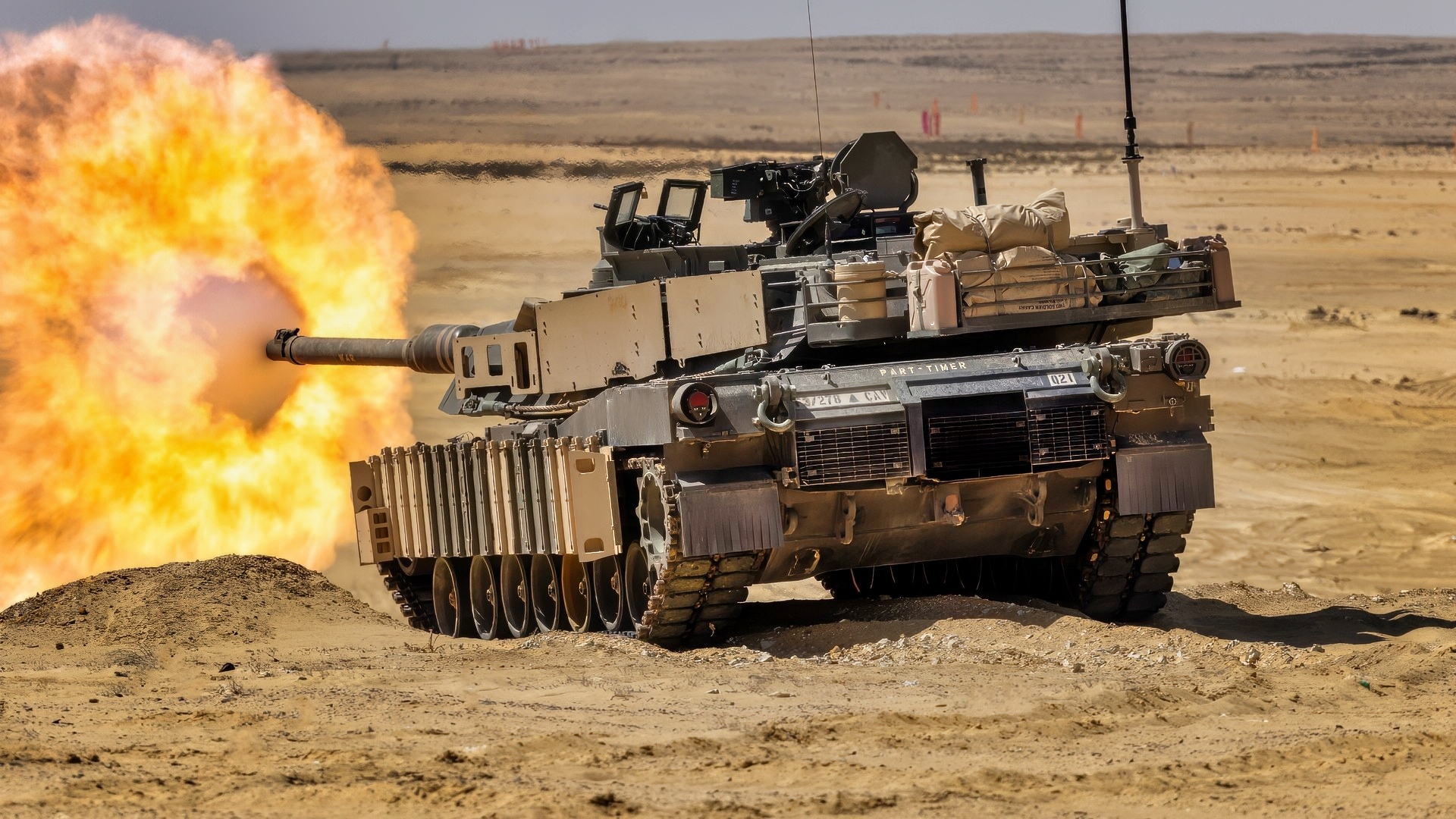
Summary and Key Points: National security expert Steve Balestrieri evaluates the M1 Abrams and its M256 120mm smoothbore cannon, specifically the use of Depleted Uranium (DU) ammunition.
-Known as the “Silver Bullet,” rounds like the M829A4 utilize Armor-Piercing, Fin-Stabilized, Discarding Sabot (APFSDS-T) technology to defeat third-generation Explosive Reactive Armor (ERA).

An M1A1 Abrams tank from 1st Tank Battalion, 3rd Marines, maneuvers before a live fire assault at Shoalwater Bay Training Area, Queensland, Australia, on May 25, 2001 for Exercise Tandem Thrust 2001. Tandem Thrust is a combined military training exercise involving more than 18,000 U.S., Australian, and Canadian personnel who are training in crisis action planning and execution of contingency response operations. (DoD photo by Sgt. Bob O’Donahoo, Australian Army. (Released))

Soldiers with the Ohio National Guard’s 1st Combined Arms Battalion – 145th Armor Regiment conduct live fire training with the M1A2 SEPv3 Abrams Main Battle Tank at the Camp Ripley Training Center near Little Falls, Minnesota, on July 28th, 2025 (Minnesota National Guard Photo by Mr. Tony Housey).

A U.S. Army M1A3 Abrams tank fires a round during a live fire training exercise at Smardan Training Area, Romania, April 19, 2017. The combined exercise had U.S. and Romanian armored crewmen taking commands from a Romanian commander to prove the cohesion between units in support of Operation Atlantic Resolve, a NATO mission involving the U.S. and its European Allies and partners in a combined effort to promote regional stability and deter aggression in Europe. (U.S. Army photo by Army Pvt. Nicholas Vidro)
-This report analyzes DU’s unique properties, including its 19g/cm³ density, self-sharpening impact, and pyrophoric ignition.
-Balestrieri explores the IAEA and UNSCEAR findings on chemical toxicity versus military necessity, concluding that DU remains indispensable for defeating near-peer armor in 2026.
Steve Balestrieri on Modern Armor: Why the U.S. Army Refuses to Abandon the 120mm DU Round
The M1 Abrams remains the king of the battlefield, and its main gun, a 120mm smoothbore that fires depleted uranium rounds, is the biggest tank killer. The rounds made from uranium, the densest, heaviest element on Earth, will defeat any known armor with ease.
The M1 Abrams’ Depleted Uranium (DU) rounds, notably the M829 series (A1-A4), are high-density, armor-piercing sabot projectiles (kinetic energy penetrators) designed to destroy heavy enemy armor.
Their “self-sharpening” ability upon impact makes them superior to tungsten. Primarily, this ammunition, often referred to as the “Silver Bullet,” is used to achieve maximum penetration against modern tanks like T-72s and T-80s.
DU Rounds Give The Abrams Incredible Firepower:
The SEPv3’s main gun is the M256 120mm smoothbore cannon. It can fire M829A4 advanced kinetic-energy and advanced multi-purpose rounds via an ammunition data link.
This round is an Armor-Piercing, Fin-Stabilized, Discarding Sabot – Tracer (APFSDS-T) cartridge, consisting of a depleted uranium long-rod penetrator with a three-petal composite sabot.
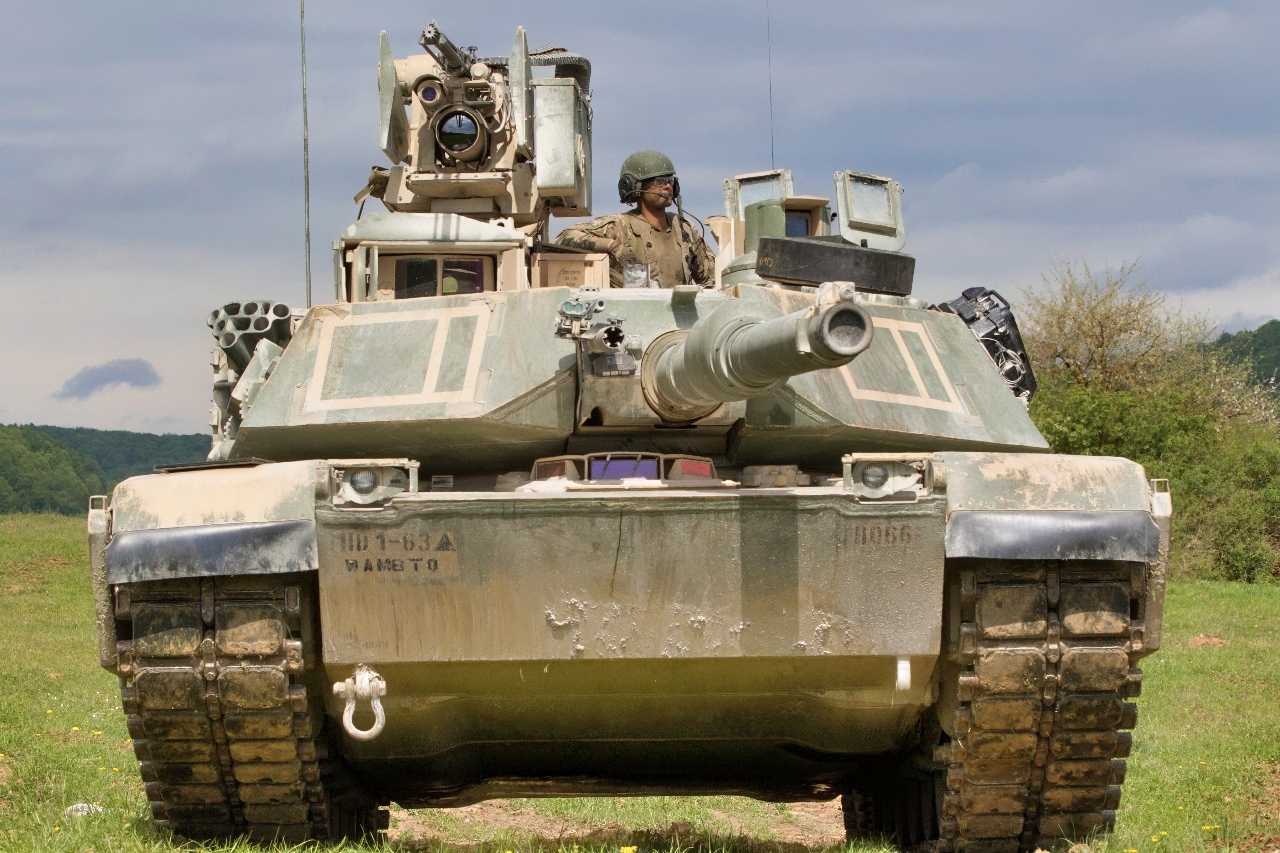
An M1A2 Abrams tank from 1st Battalion, 63rd Armor Regiment, “Dragons,” 1st Infantry Division, Fort Riley, Kansas, pulls during Combined Resolve X at the Hohenfels Training Area, Germany, May 1, 2018. Exercise Combined Resolve X is a U.S. Army Europe exercise series held twice a year in southeastern Germany. The goal of Combined Resolve is to prepare forces in Europe to work together to promote stability and security in the region. (U.S. Army photo by Spc. Andrew McNeil / 22nd Mobile Public Affairs)

A U.S. Army tank crew assigned to 2nd Battalion, 5th Cavalry Regiment, 1st Armored Brigade Combat Team, 1st Cavalry Division, maneuvers an M1A2 Abrams tank at a railhead in preparation to transport it to Hohenfels, Germany during a railhead operation, Corbu, Romania, October 24, 2018. The Battalion has deployed to Europe in support of Atlantic Resolve, an enduring training exercise between NATO and U.S. Forces. (U.S. Army National Guard photo by Sgt. Jamar Marcel Pugh, 382nd Public Affairs Detachment/ 1st ABCT, 1st CD/Released)

U.S. Soldiers assigned to the 2nd Armored Brigade Combat Team, 1st Cavalry Division supporting the 4th Infantry Division maneuver an M1A2 Abrams tank and M2 Bradley Fighting Vehicle past a simulated opposing force’s Leopard 2A6 tank during exercise Arrow 23 in Niinisalo, Finland, May 5, 2023. Exercise Arrow is an annual, multinational exercise involving armed forces from the U.S., U.K., Latvia, Lithuania and Estonia, who train with the Finnish Defense Forces in high-intensity, force-on-force engagements and live-fire exercises to increase military readiness and promote interoperability among partner nations. (U.S. Army National Guard photo by Sgt. John Schoebel)
These rounds will defeat third-generation explosive reactive armor (ERA) at extended ranges. ERA is designed for maximum penetration against heavily armored targets and has an effective range of 4,000 meters.
The Depleted Uranium Round, The Silver Bullet:
The M829A1 DU round, known as the “Silver Bullet,” made their appearance for the first time against Iraqi T-72s during the 1991 Persian Gulf War. They cut through the Soviet-made armor with ease.
The latest in the series, the M829E4 (or A4), continues this legacy with enhanced capabilities to penetrate modern tank armors and defeat active protection systems.
M1 Abrams depleted uranium (DU) rounds are highly effective armor-piercing projectiles, with advantages in density, self-sharpening properties, and pyrophoric ignition, making them superior to tungsten rounds.
However, their use raises concerns about potential health and environmental risks, as they create radioactive and toxic dust upon impact, which critics argue may outweigh the military benefits.
Performance and Effectiveness:
Superior penetration of any known armor. DU rounds are significantly denser than steel, allowing them to retain more kinetic energy and penetrate thick armor more effectively than other rounds.
The M829A1 DU round has a flat, laser-like trajectory out to 3,600 meters, meaning it does not incur ballistic drop due to gravity over a distance of two miles. That is incredible power generated by the gun and the round. It will penetrate 570mm of armor at a range of two thousand meters.
The 120mm DU round was a huge improvement over the standard tungsten antiarmor round for the M60 tank, the M735, which could penetrate 350 millimeters, or 13.7 inches, of steel rolled homogeneous armor (RHA).
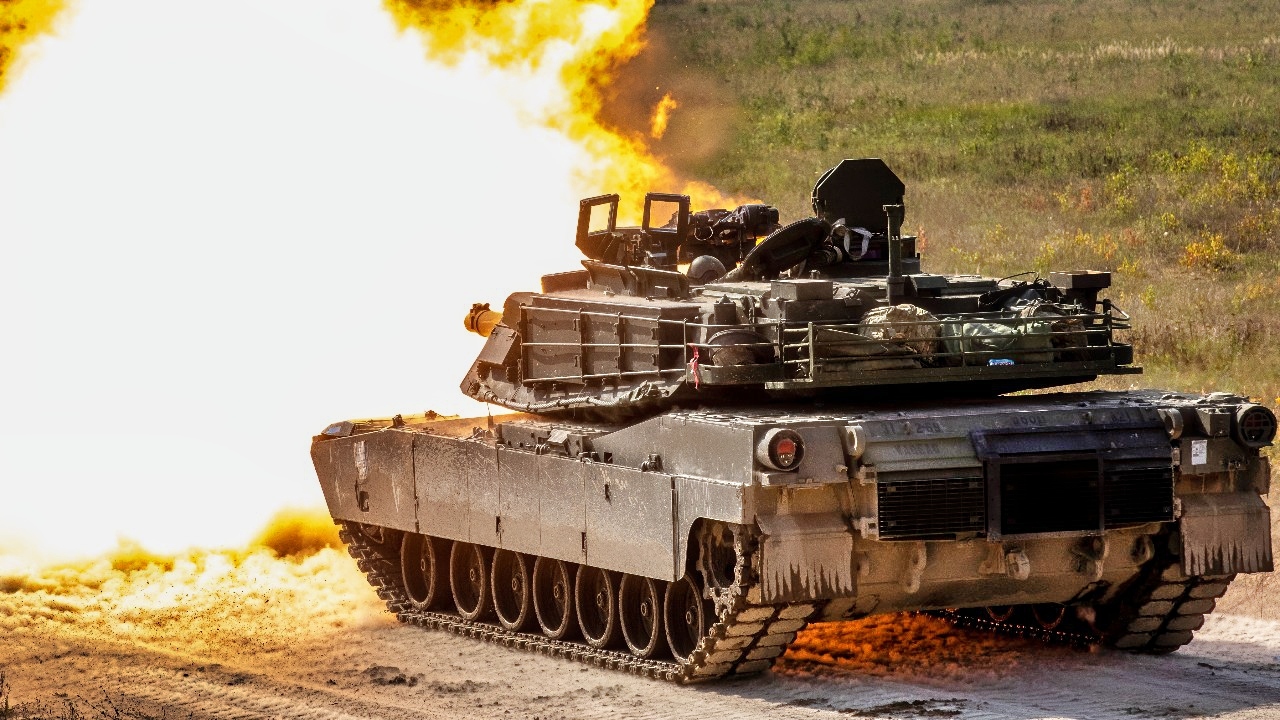
U.S. Army tank crews with Alpha “Animal” Company and Bravo “Barbarian” Company, 2nd Battalion, 69th Armor Regiment, 2nd Armored Brigade Combat Team, supporting 3rd Infantry Division, fire rounds from M1A2 Abrams tanks at Bemowo Piskie Training Area, Poland Sept. 12. The 3rd Infantry Division’s mission in Europe is to engage in multinational training and exercises across the continent, working alongside NATO allies and regional security partners to provide combat-credible forces to V Corps, America’s forward-deployed corps in Europe. (U.S. Army photo by Alex Soliday)
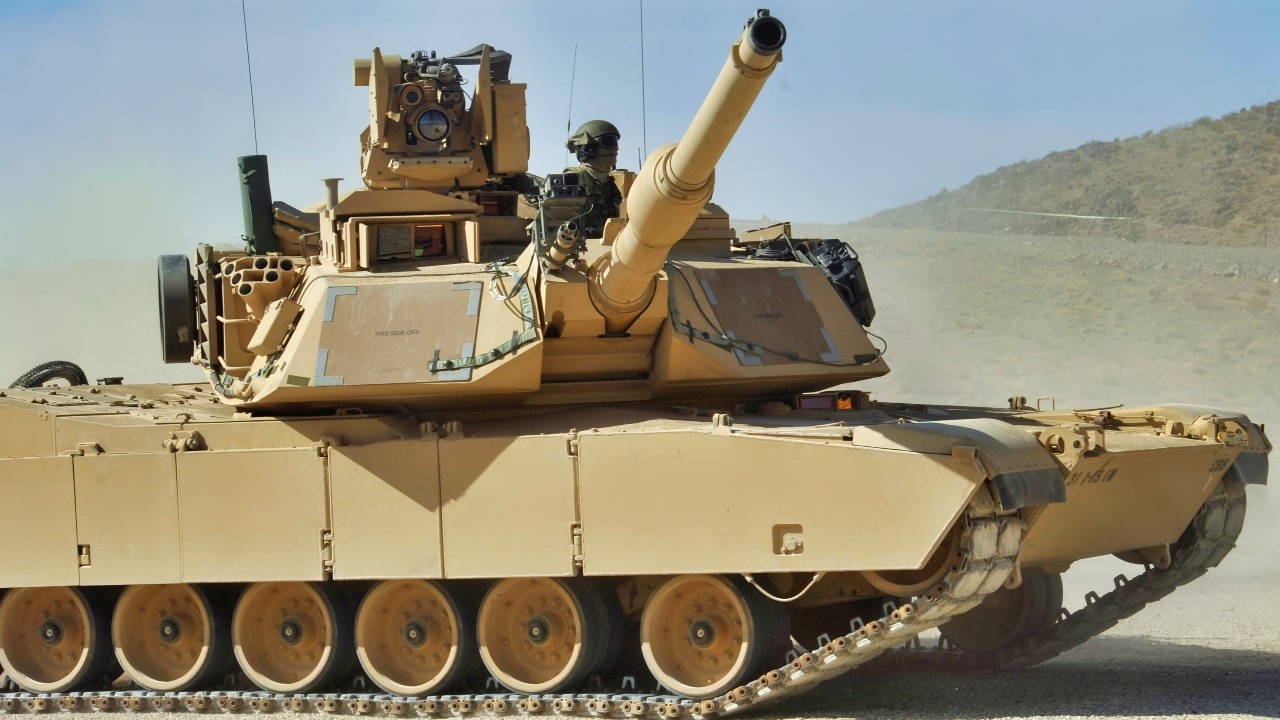
Australia is sending 49 of its retired M1A1 Abrams tanks to Ukraine, a move that bolsters Kyiv’s armored firepower but raises significant questions about survivability on the modern battlefield. While the donation is a welcome gesture, US officials have reportedly expressed private frustration, warning that Ukraine struggles to sustain the complex tanks and highlighting their vulnerability to cheap, top-attack FPV drones. The war in Ukraine has become a “drone war,” where even advanced main battle tanks are at constant risk. The effectiveness of these donated Abrams will ultimately depend on Ukraine’s ability to counter this pervasive threat.
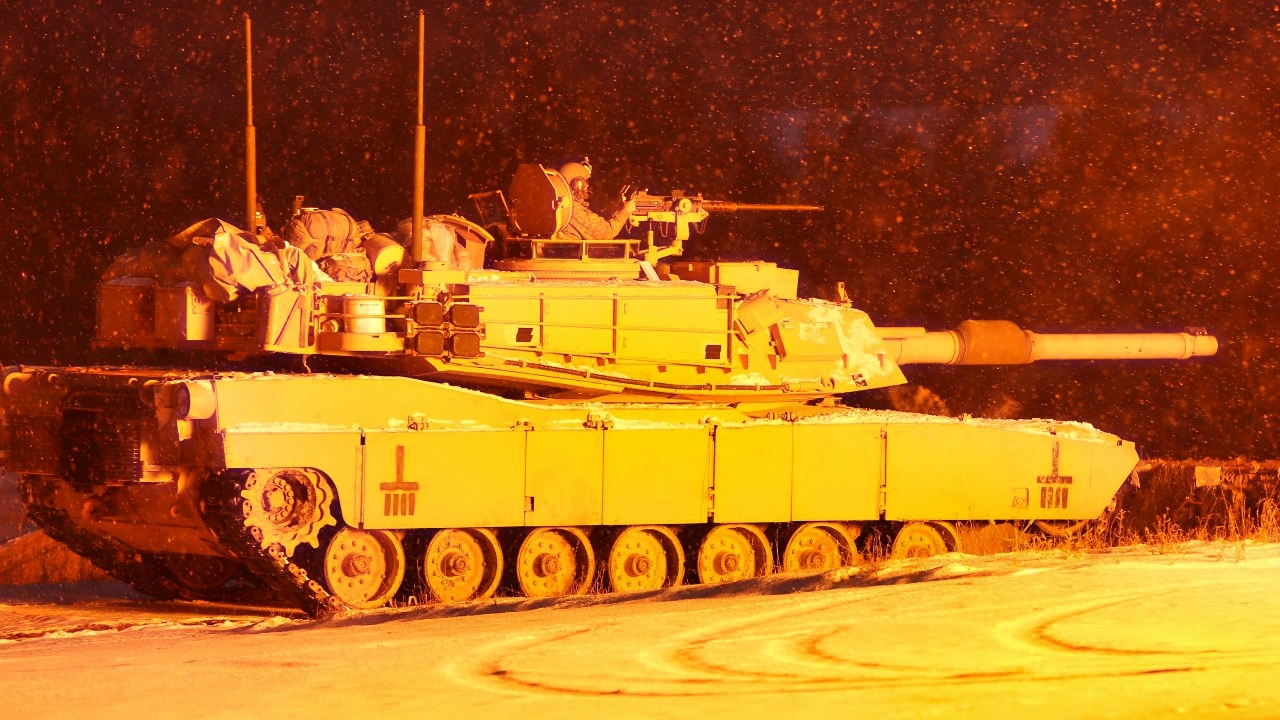
U.S. Soldiers assigned to 1st Squadron, 7th Cavalry Regiment, 1st Armored Brigade Combat Team, sit ready to engage targets in an M1 Abrams Main Battle Tank during Combined Resolve XV live fire exercise at Grafenwoehr Training Area, Germany, Feb. 9, 2021. Combined Resolve XV is a Headquarters Department of the Army directed Multinational exercise designed to build 1st Armored Brigade Combat Team, 1st Cavalry Divisions’s readiness and enhance interoperability with allied forces to fight and win against any adversary. (U.S. Army photo by Sgt. Randis Monroe)

The 1st Battalion, 194th Armor Regiment,1st Brigade Combat Team, 34th Infantry Division, test fire their M1 Abrams Tank at Udairi Range, Kuwait, May 3, 2021. The main cannon of the M1 Abrams Tank shoots a 105mm round. (U.S. Army Photo by Spc. Juan Carlos Izquierdo, U.S. Army Central Public Affairs)
The M833 DU round, however, could penetrate 420 millimeters of RHA positioned at a sixty-degree angle for maximum armor thickness. But it couldn’t match the armor of the newer Soviet T-80 tanks. That’s why the Army went to the 120mm smoothbore cannon.
Upon impact, the DU projectile ignites and sharpens rather than flattening, which aids penetration of thick composite or reactive armor.
Superior density is key to the round. Depleted uranium is denser than tungsten (approximately 19 grams per cubic centimeter), resulting in higher kinetic energy upon impact.
The incendiary effect. The rounds catch fire upon penetrating a target, often leading to the detonation of the enemy tank’s own ammunition or fuel.
The rounds are pyrophoric, meaning they ignite on contact with air, which helps destroy the inside of a tank by creating secondary fires, especially when combined with the ignition of fuel and ammunition.
Accelerated to extremely high speeds by using the sabot round, this allowed a depleted-uranium (DU) round to penetrate through an unprecedented amount of armor. The pyrophoric nature of uranium and steel would cause DU to catch fire upon penetration, resulting in catastrophic damage inside the tank.
DU rounds will easily withstand the shock of reactive armor better than many other metals, increasing the likelihood of defeating an armored target even when the armor is designed to counter threats.
The Environmental Risk Of Depleted Uranium Rounds and M1 Abrams:
The DU rounds pose an environmental risk. Once a DU round hits an armored surface, it creates a fine, radioactive, and chemically toxic dust. Critics are concerned that this dust is harmful to both military personnel and civilians.
Depleted uranium (DU) rounds that miss their targets contaminate the environment by leaving behind fragments and dust that can corrode over time, releasing DU into the soil and groundwater.
This contamination can lead to long-term ingestion through drinking water or food, though studies generally show low levels except in “hot spots” near impact sites. While DU has both chemical and radioactive properties, the primary environmental risk is chemical, with the potential for long-term migration and incorporation into the food chain.
While some argue that the radiological danger is low, others highlight that chemical toxicity is the primary concern, similar to other heavy metals like lead, and that inhaling the dust poses a serious health hazard.
Some experts argue that the potential long-term health and environmental risks of using DU ammunition outweigh the military advantages.
The International Atomic Energy Authority (IAEA) says depleted uranium has “chemical and radioactive toxicity“, but is considerably less radioactive than naturally-occurring uranium.
“The fear is that if depleted uranium shells land on the ground, they may contaminate the soil,” says Dr Marina Miron, from King’s College London. “That is why the US and its Nato allies sparked controversy when they used them in Kosovo.”
In 2016, the UN’s Scientific Committee on the Effects of Atomic Radiation (UNSCEAR) found no significant poisoning was caused by exposure to depleted uranium.
Retired Colonel Hamish de Bretton-Gordon, who previously commanded U.K. and NATO chemical, biological, radiological, and nuclear defense (CBRN) forces, told Newsweek that the “radiation is incredibly low.”
“If you’re in a vehicle that’s hit by a depleted uranium round, the radiation is the least of your worries,” he added.
However, the IAEA warns there could be a risk to individuals who handle fragments of depleted uranium rounds.
The United States, despite the environmental impact of DU rounds, will continue to use them because they can defeat any known armor. At some point, US and Allied armor will replace the 120mm. But as for the DU rounds, those will continue to be used.
About the Author: Steve Balestrieri
Steve Balestrieri is a National Security Columnist. He served as a US Army Special Forces NCO and Warrant Officer. In addition to writing on defense, he covers the NFL for PatsFans.com and is a member of the Pro Football Writers of America (PFWA). His work was regularly featured in many military publications.


xi-xi-xi
March 15, 2026 at 10:48 am
The DU sabot round can still be easily defeated by space armor combined with movable non-rigid steel plates, plus well-sloped turret design.
NOT exactly rocket science.
But can the M1 tank withstand a russian KAB glide bomb.
NOT likely. Future battles fighting against american-made tanks will strictly be fought with glide bombs launched from unmanned drones.
Catapult
March 15, 2026 at 12:16 pm
Tanks are o obsolete. Cheap drones can obliterate them from the air and now this.
GlowWorm
March 15, 2026 at 6:28 pm
They emit lower energy level alpha radiation, which is particulate in nature. This contamination of water can be easily absorbed /stopped with a cheap water filter if you are worried about ingestion that way. A chelation agent can readily help eliminate from the body if you think you ingested. prussian blue works or is it thymolblue ill have to look it up again.
Omega13
March 16, 2026 at 12:45 pm
What part of “depleted” do you not understand? Very little radiation is released from a DU round… just above background.