


Key Points and Summary – The T-80 main battle tank, once a feared Soviet spearhead, has proven to be a “rolling coffin” in Ukraine, with over 1,200 Russian losses documented by Oryx.
-Its failure is attributed to multiple flaws: its powerful 1,000-hp gas turbine engine is a “gas-guzzling” logistical nightmare that requires vulnerable fuel convoys and performs poorly in warm, dusty weather.

T-80 Tank Russian Army. Image Credit: Creative Commons.
-Russian forces failed to use proper combined arms tactics, leaving the tanks exposed to Ukrainian anti-tank teams and drones.
-Now relegated to a “mobile artillery piece” in the rear, the T-80 has been a “humiliating” disappointment.
The T-80 Main Battle Tank Has Been a ‘Rolling Coffin’ in Ukraine and Russia
The Soviet Union had high hopes for its T-80 main battle tank. It was supposed to lead a massive attack against American and NATO troops during the Cold War if the conflict ever became “hot.” Skip forward to the Russian war against Ukraine, and Moscow is surely disappointed about its performance.
It should have been part of a vanguard force that would overwhelm the Ukrainians and take Kyiv in a matter of weeks.
The Ukrainians fought back hard with precision-guided anti-tank missiles and swarming kamikaze drones.
The Russians did not have the correct combined arms tactics that featured dismounted infantry rooting out enemy cells that fired anti-tank weapons and launched deadly unmanned suicide craft. Artillery was also not concentrated in a way that could help the T-80.
What Has Happened During the War?
The tanks became rolling coffins with numerous examples of destruction due to modern anti-tank weapons.
Numerous Russian tankers, thinking they were safe before the war, perished in the hulking beasts due to explosions and fires, leaving nothing but smoking ruins.
Quick Specs on the T-80
The T-80 has a gas-turbine engine that delivers an impressive 1,000 horsepower. This has enabled the tank to operate quickly, with excellent acceleration and maneuverability. It has a powerful 125mm 2A46 smoothbore gun with a modern fire control system that can also fire anti-tank missiles through the tube.
However, the engine had problems and required extensive maintenance, keeping many T-80 tanks out of battle. The Russians did not expect the kind of logistical hurdles that would affect readiness.
Armored spearheads intended to take and hold Ukrainian territory were impossible to execute.
The T-80 shared some of the same features as the earlier Cold War models, such as the T-64 and T-72. Ukraine has attempted to transform the T-80 tanks that it uses, but it has been Russia that has lost the most of these variants.

Tim Murry, a foreign threats compound contractor, drives a T-72 battle tank into position to serve as adversary targets for a joint service exercise, Emerald Flag, at Eglin Air Force Base, Fla., Nov. 30. Emerald Flag is a multi-service exercise aimed to unify information sharing across joint domain platforms. (U.S. Air Force photo/1st Lt Karissa Rodriguez)
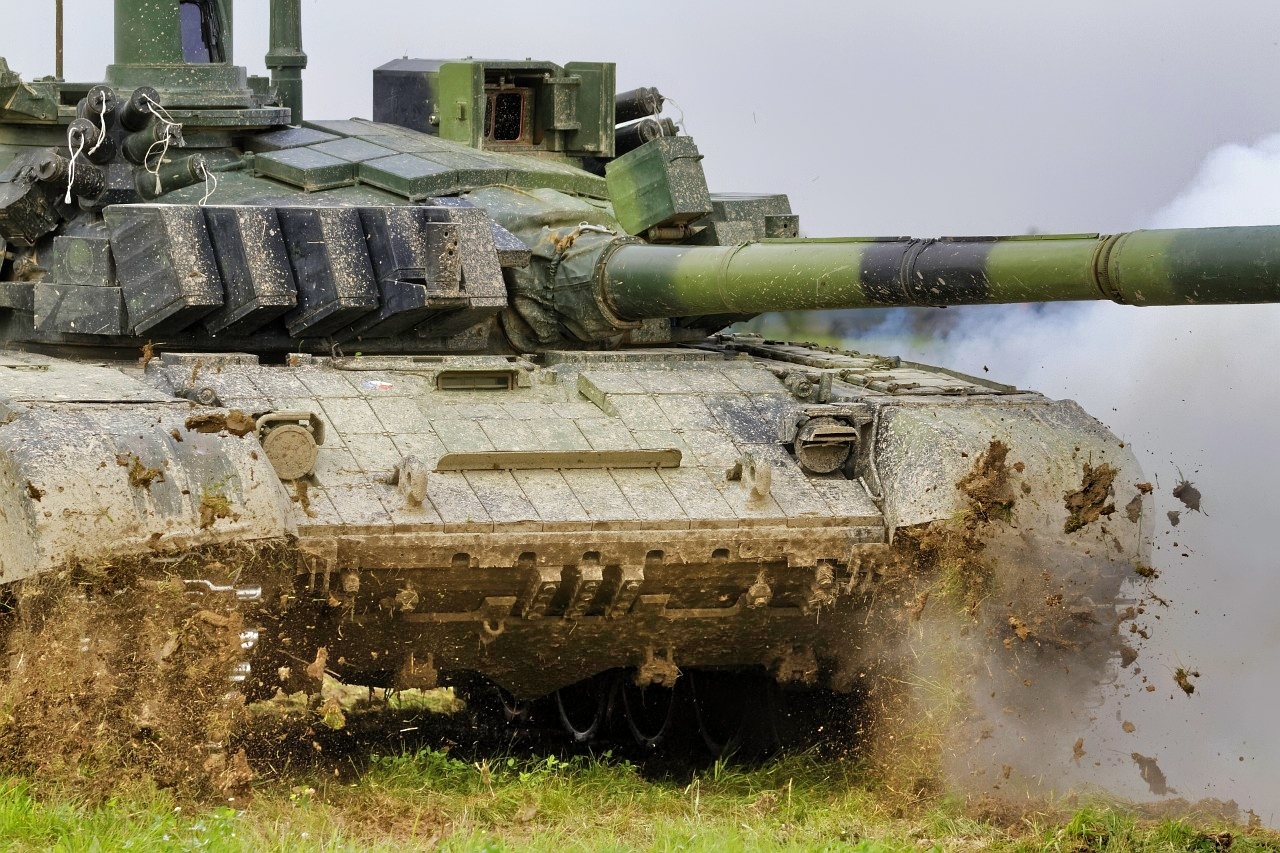
T-72 Tank. Image Credit: Creative Commons.
Grim T-80 Statistics Reveal Heavy Losses for Both Sides
Let’s take a look at the actions of Ukrainian T-80 tanks. The open-source website Oryx, which compiles many combat photos and videos posted on social media, has bad news for friendly forces using T-80 variants.
Eighty Ukrainian T-80s have been destroyed, including the T-80BV and T-80UD.
Russia has several T-80 variants that it has used, and the number of destroyed tanks is frightening. Oryx reckons that the Russians have lost more than 1,200 T-80s.
Engine Problems In Warm Weather
The T-80 was supposed to be much more survivable than that. Tank crews figured that using a gas engine rather than a diesel would be better for warfare. The tanks could start well in cold weather and be refueled easily to withstand harsh weather conditions.
The engine was thought to be more reliable and quieter. While better during the winter months, the power plant struggled on warmer spring and summer days when dust was prevalent. The engine suffered in this type of dry weather.
The T-80 was also not fuel-efficient during the war. The gas sucking engine needed a long logistical trail. Designed to lead armored spearheads deep into enemy territory, the T-80 did not perform as expected, with poor fuel economy and range.
Fuel trucks had to be moved to the frontlines repeatedly, and these were cannon fodder and easy to destroy by the Ukrainians with their powerful artillery and multiple-launch rocket systems.
Superior Speed Has Not Been a Great Advantage
The T-80 should have been much better, leading the way for armored strikes. It can travel at a swift 43 miles per hour on roads. The fire control system has the kind of optics that could identify friend or foe and send prompt firing solutions to the tank’s main gun. This combination of speed and firepower should have made it a stout foe for both sides. The T-80 was also supposed to work well after sundown with better night-vision optics for its targeting system.
Russia upgraded the T-80’s armor to better protect against multiple threats. The composite armor was replaced by new explosive reactive armor called Kontakt-1 and then Kontakt-5.
The T-80 has only three crew members with an auto-loader for the gun. It should have been more survivable, thanks to its lower silhouette and shorter turret. The T-80U variant features improved thermal imaging and enhanced engine performance. But this tank still had problems against Ukraine.
The T-80 was more of a Cold War armored war wagon meant to counter the American M1 Abrams. It was designed for mass tank-on-tank battles; the Americans fought during Operation Desert Storm. Russia thought that it could survive against enemy shells from Abrams tanks, but it did not foresee the use of loitering drones and modern anti-tank missiles. The armor was updated too late, and the Russians took many losses.
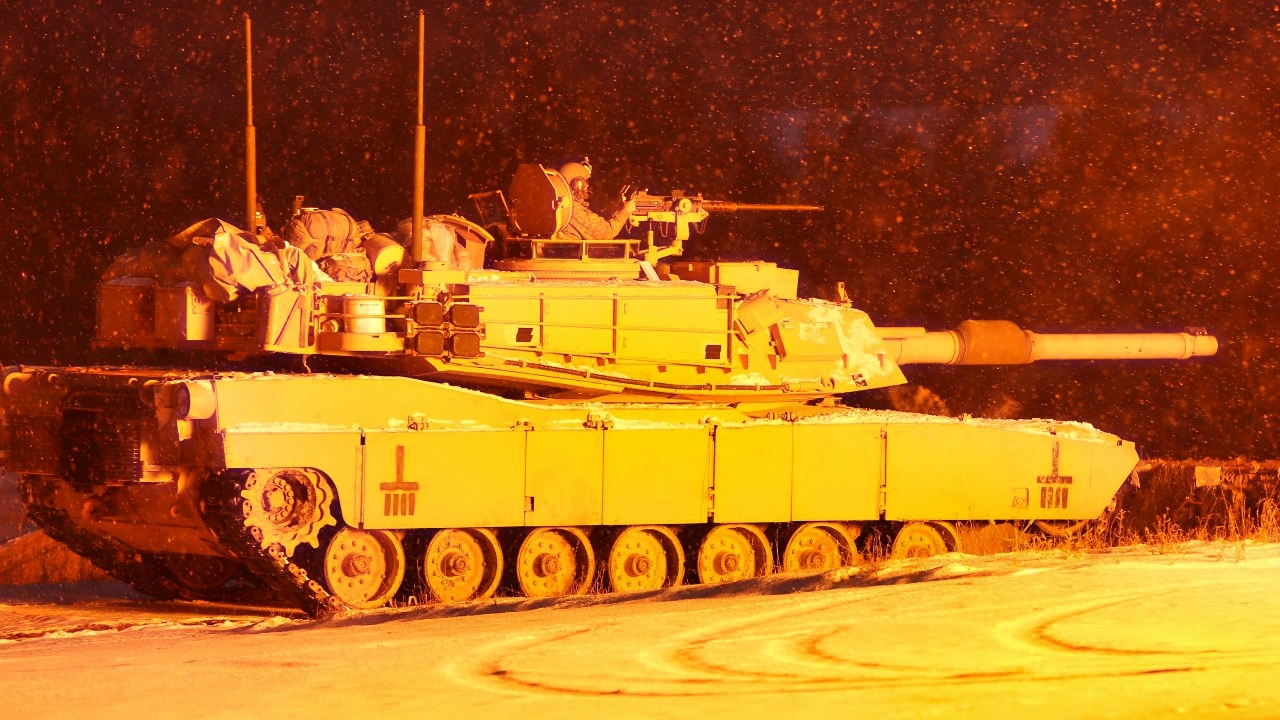
U.S. Soldiers assigned to 1st Squadron, 7th Cavalry Regiment, 1st Armored Brigade Combat Team, sit ready to engage targets in an M1 Abrams Main Battle Tank during Combined Resolve XV live fire exercise at Grafenwoehr Training Area, Germany, Feb. 9, 2021. Combined Resolve XV is a Headquarters Department of the Army directed Multinational exercise designed to build 1st Armored Brigade Combat Team, 1st Cavalry Divisions’s readiness and enhance interoperability with allied forces to fight and win against any adversary. (U.S. Army photo by Sgt. Randis Monroe)
Russian tank personnel followed a too simple doctrine. The T-80 was used with little imagination or creativity. Massive tank battles in which the T-80 could quickly outflank the enemy in combat teams with armored personnel carriers never materialized. Instead, the T-80 was picked apart by Ukrainian hunter-killer teams that snuck close in to the Russian tanks. The vast armored spearheads never lived up to their reputation.
The Russians have shown that the main battle tank has limitations. They did not learn quickly enough that the T-80 would have so much difficulty. Now, Russians often advance with individual soldiers on motorbikes, a far cry from the armored warfare tactics enshrined during the Cold War.
The T-80 has thus been a failure in Ukraine, suffering significant losses by both sides. The gas turbine engine has been a disappointment, and the Russians did not re-equip the tank with better armor until after many losses. The tank is now more of a mobile artillery piece, hanging back in reserve areas and not a decisive factor at the front of the battlefield. The T-80 has been a steel coffin for many soldiers, and don’t expect it to make a difference in the war going forward.
About the Author: Brent M. Eastwood
Brent M. Eastwood, PhD is the author of Don’t Turn Your Back On the World: a Conservative Foreign Policy and Humans, Machines, and Data: Future Trends in Warfare plus two other books. Brent was the founder and CEO of a tech firm that predicted world events using artificial intelligence. He served as a legislative fellow for US Senator Tim Scott and advised the senator on defense and foreign policy issues. He has taught at American University, George Washington University, and George Mason University. Brent is a former US Army Infantry officer. He can be followed on X @BMEastwood.
More Military
The Mach 3 SR-71 Blackbird Spy Plane ‘Broke All the Rules’ Thanks to Titanium
SR-72: The Air Force’s New Hypersonic Bomber?
Russia’s Admiral Kuznetsov Aircraft Carrier Is Now ‘Non-Operational’
New Army M1E3 Tank vs. Russia’s T-14 Armata: Who Wins Summed Up in 2 Words


