
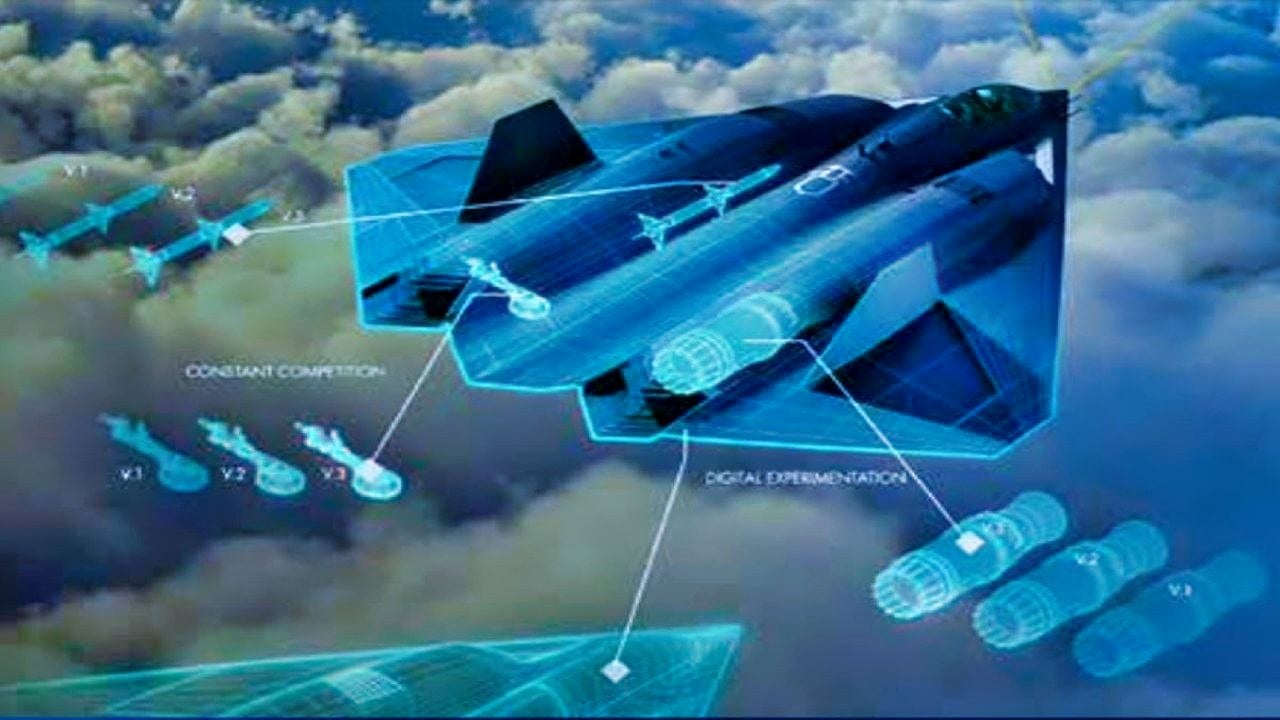
Summary and Key Points: The X-44 MANTA was envisioned as a radical, tailless derivative of the F-22—stripping away vertical and horizontal tails to cut signature and drag while relying on thrust vectoring and advanced flight controls for stability.
-With a stretched delta wing, it promised more internal fuel, added range, and a stealth profile pushed even further than the Raptor’s, with notional performance around Mach 2 and a ceiling near 49,000 feet.
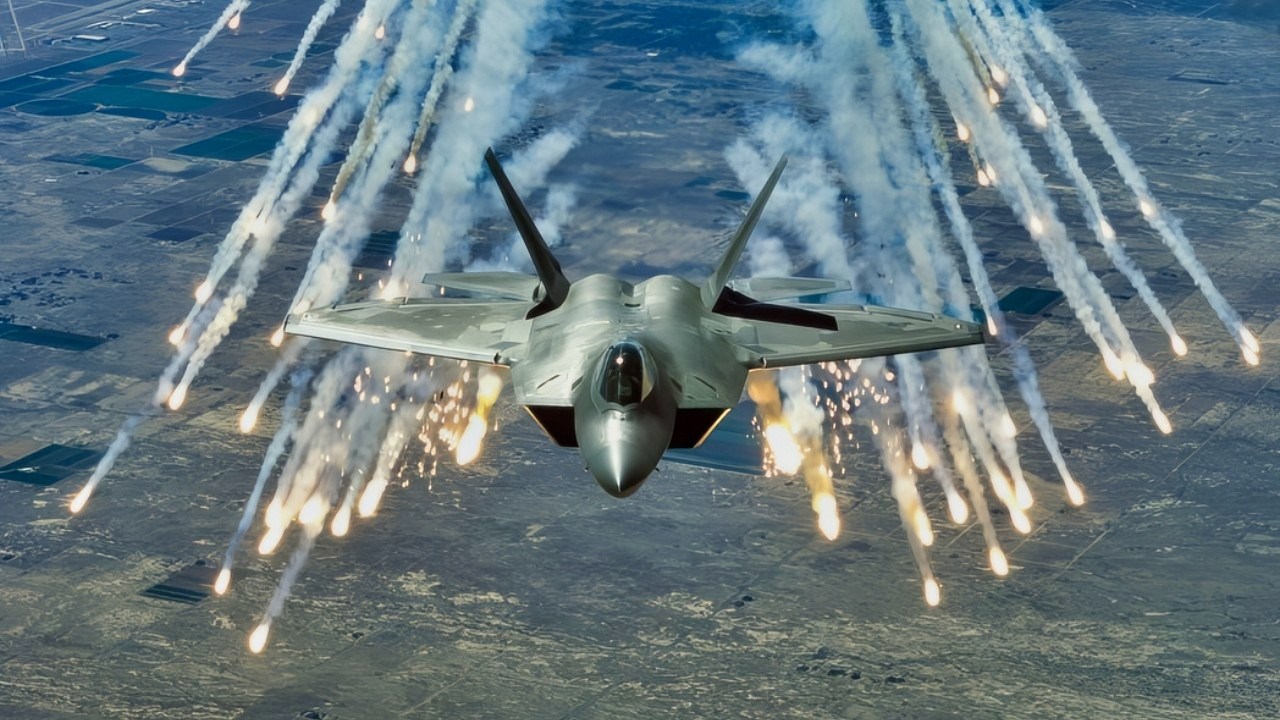
F-22 Raptor Firing Flares. Image Credit: Creative Commons.
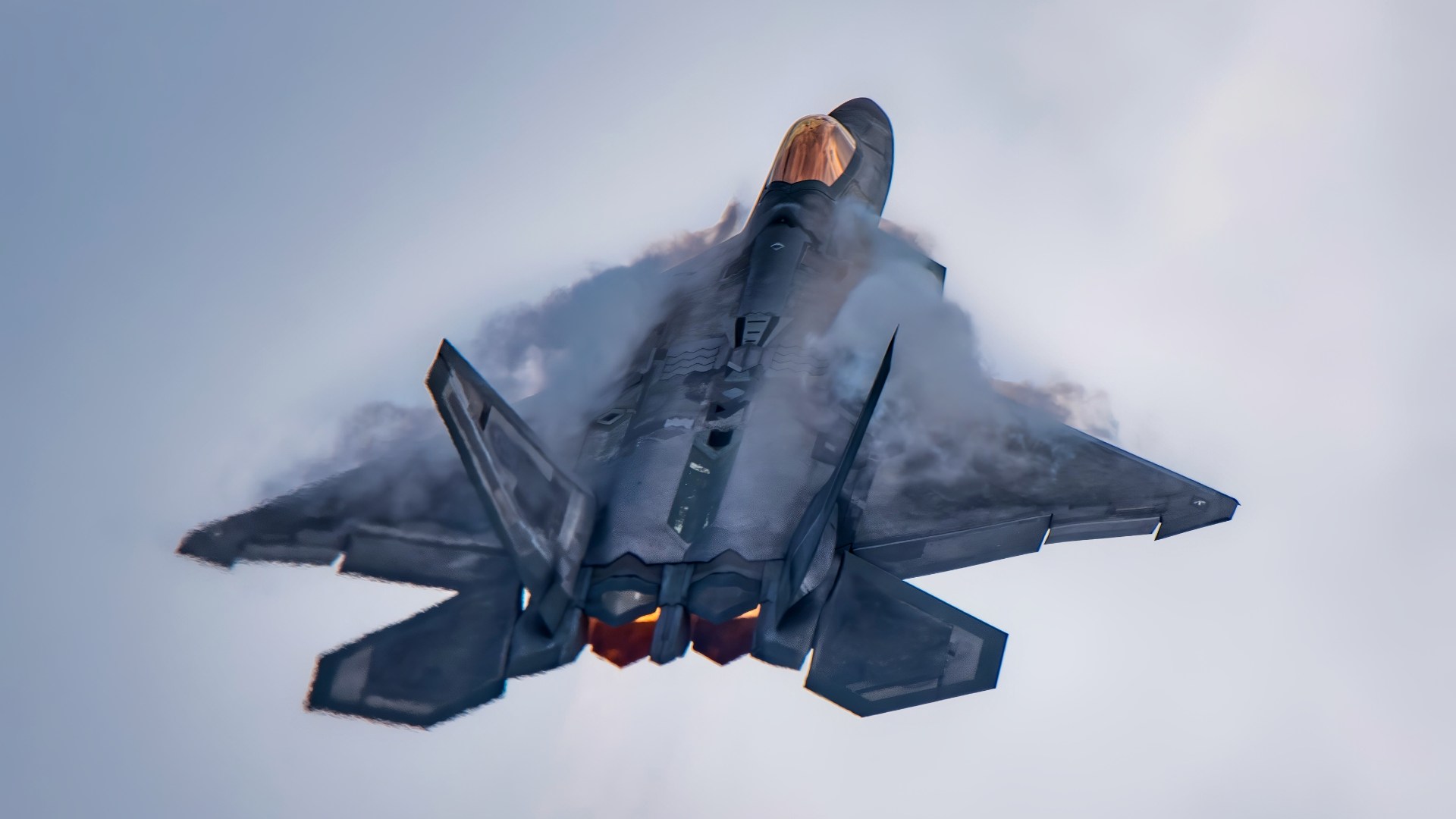
Maj. Paul Lopez, F-22 Raptor Demonstration Team commander, performs during the Chicago Air and Water Show, Aug. 17, 2019. Founded in 2007, the F-22 Demo Team showcases the unique capabilities of the world’s premier fifth-generation fighter aircraft. (U.S. Air Force photo by 2nd Lt. Samuel Eckholm)
-The concept died fast as F-22 costs mounted, the technical risk of fully tailless control looked steep, and post–Cold War budgets—and then shifting priorities—left no room for a high-stakes demonstrator.
X-44 MANTA: The Tail-Less F-22 Concept That Never Flew
In the late 1990s, the U.S. Air Force and NASA entertained an idea for a truly ambitious aircraft: the X-44 MANTA (Multi-Axis No-Tail Aircraft), a radical derivative of the F-22 Raptor designed to eliminate all vertical and horizontal tails and rely entirely on thrust-vectoring to maneuver.
The idea was to take the F-22’s airframe and stealth systems, then push them further in terms of agility, range, and radar-signature reduction.
While the ambitious concept showed promise, the X-44 never left the drawing board. So what happened?
What did the concept reveal about American air-dominance thinking at the time? And what might its cancellation tell us about fighter development priorities today?
What the X-44 MANTA Was Meant to Be
The X-44 MANTA first emerged around 1999 as a collaboration between the Skunk Works division of Lockheed Martin, NASA, and the Air Force.
It was envisioned as a streamlined evolution of the F-22. It featured the same twin-engine layout but employed a tailless delta-wing shape that relied entirely on thrust-vectoring for control.
The goal was to reduce radar cross-section to an extreme degree by eliminating all vertical stabilizers.
The design would reduce drag and general mechanical complexity, while also increasing space for internal fuel storage and weapons. It was a remarkable design that would solve sustainment issues while boosting range and lethality.
The delta wing was also intended to be stretched relative to that of the F-22, which would further increase fuel capability and combat radius. On paper, its performance metrics were impressive. The X-44 was expected to achieve a service ceiling of about 49,000 feet and a range of almost 2,000 miles, while flying at speeds of about Mach 2.

U.S. Air Force Capt. Nick “Laz” Le Tourneau, F-22 Raptor Aerial Demonstration Team commander, performs an aerial maneuver during the Hyundai Air and Sea show at Miami, Florida, May 25, 2025. The F-22 Aerial Demonstration Team highlights cutting-edge airpower, precision, skill, all while reinforcing public confidence in the Air Force’s ability to protect and defend. (U.S. Air Force photo by Staff Sgt. Lauren Cobin)
It wasn’t expected to be a production variant of the F-22, but the X-44 was conceived to build on the Raptor’s air-superiority role. Its advanced stealth and maneuverability might prefigure the sixth-generation aircraft currently being built and under development.
The MANTA was clearly a hybrid idea. It was part F-22 derivative, and partly a technology demonstrator. It was designed to test the viability of a radical tailless combat aircraft that utilized full thrust vectoring and stealth from the get-go; but it simply wasn’t meant to be.
Why It Never Happened
Despite its clear promise, there were multiple factors that killed the X-44 before it ever flew.
Budget and timing were chief among them. At the time, the U.S. defense budget was still coping with the post-Cold War draw-down. The F-22 program itself was facing cost overruns and political opposition, with its final production numbers eventually being capped at 187 aircraft. Introducing an even more advanced derivative of the platform would have required substantial new investment, and a huge amount of effort to convince lawmakers to get on board. That didn’t happen.
Then there’s the matter of technical risks. Removing all tail surfaces and relying solely on thrust vectoring was a fantastical idea. It was possible, but it was risky. While NASA and the Air Force had conducted preliminary feasibility studies, the level of thrust vectoring required, and the flight-control software the feat demanded, were still immature in the 1990s.
Without great software and advanced systems, the tailless design would be highly unstable, particularly at high angles of attack. That made the engineering risk high, which meant the design would only be entertained if the budget allowed. The budget did not allow.
Further, shortly after the concept was floated, the war on terror began, and the Department of Defense’s priorities changed. Focus moved toward counter-insurgency, unmanned systems, and multi-role platforms such as the F-35 Lightning II, rather than ultra-specialized air-superiority jets.
All of that was enough for the MANTA project to be canceled, but that doesn’t mean the project completely died. The design of the X-44 arguably influenced fighter research under the NGAD umbrella, meaning an X-44 demonstrator was never actually necessary.
In many ways, the X-44 will live on as the F-47.

F-47 Fighter from U.S. Air Force. Image Credit USAF.

NGAD. Image Credit. Lockheed Martin.
The funding for the X-44 was completely cut by 2000, and the project permanently shelved. There was no prototype. No test flights. The concept remained just that: a concept.
Nonetheless, the program indicated that such an aircraft was technically feasible. And after decades of additional experience and learning, the Next Generation Air Dominance program is delivering the F-47, which is expected to do much of what the X-44 promised—and then some.
About the Author:
Jack Buckby is a British author, counter-extremism researcher, and journalist based in New York. Reporting on the U.K., Europe, and the U.S., he works to analyze and understand left-wing and right-wing radicalization, and reports on Western governments’ approaches to the pressing issues of today. His books and research papers explore these themes and propose pragmatic solutions to our increasingly polarized society. His latest book is The Truth Teller: RFK Jr. and the Case for a Post-Partisan Presidency.


