


The USS Gerald R. Ford Has Sailed All Over the World And Needs Some Repairs Done
The Gerald R. Ford (CVN-78) is the most technologically advanced supercarrier ever put into service in the United States Navy. It was supposed to be the forerunner of the new Ford-class carriers and usher in a new era of Naval dominance.
In its most recent deployment, Ford is indeed breaking some records, though perhaps not the ones that the Navy wants. With her deployment now exceeding 260 days, Ford has joined the Vietnam-era carriers in terms of deployment time, and she is approaching her breaking point. The crew is exhausted, and the ship’s systems are at their breaking point.

An F/A-18F Super Hornet, attached to the “Blacklions” of Strike Fighter Squadron (VFA) 213 and a F/A-18E Super Hornet, attached to the “Golden Warriors” of Strike Fighter Squadron (VFA) 87 fly over the world’s largest aircraft carrier, USS Gerald R. Ford (CVN 78), the Arleigh Burke-class guided-missile destroyer USS Mahan (DDG 72), April 11, 2025. The Gerald R. Ford Carrier Strike Group is underway in the Atlantic Ocean completing integrated naval warfighting training. Composite Training Unit Exercise (COMPTUEX) is the Joint Force’s most complex integrated training event and prepares naval task forces for sustained high-end Joint and combined combat. Integrated naval training provides America’s civilian leaders and commanders highly-capable forces that deter adversaries, underpin American security and economic prosperity, and reassure Allies and partners. (U.S. Navy photo by Mass Communication Specialist 2nd Class Maxwell Orlosky
A Deployment That Has Continued for Too Long
The deployment began on June 24, 2025, when Ford departed Naval Station Norfolk. It was meant to be a conventional overseas deployment, initially focused on European operations. Global events rapidly intervened.
The carrier was first redirected to the Caribbean, where it supported U.S. operations against Venezuela, and was soon thereafter reassigned to the Eastern Mediterranean and the Red Sea as tensions escalated with Iran. With each redirection, the sailors on board were delayed in their chance to return home. What had once been expected to last roughly six months steadily expanded, with repeated extensions announced after the carrier was already deep into its deployment.
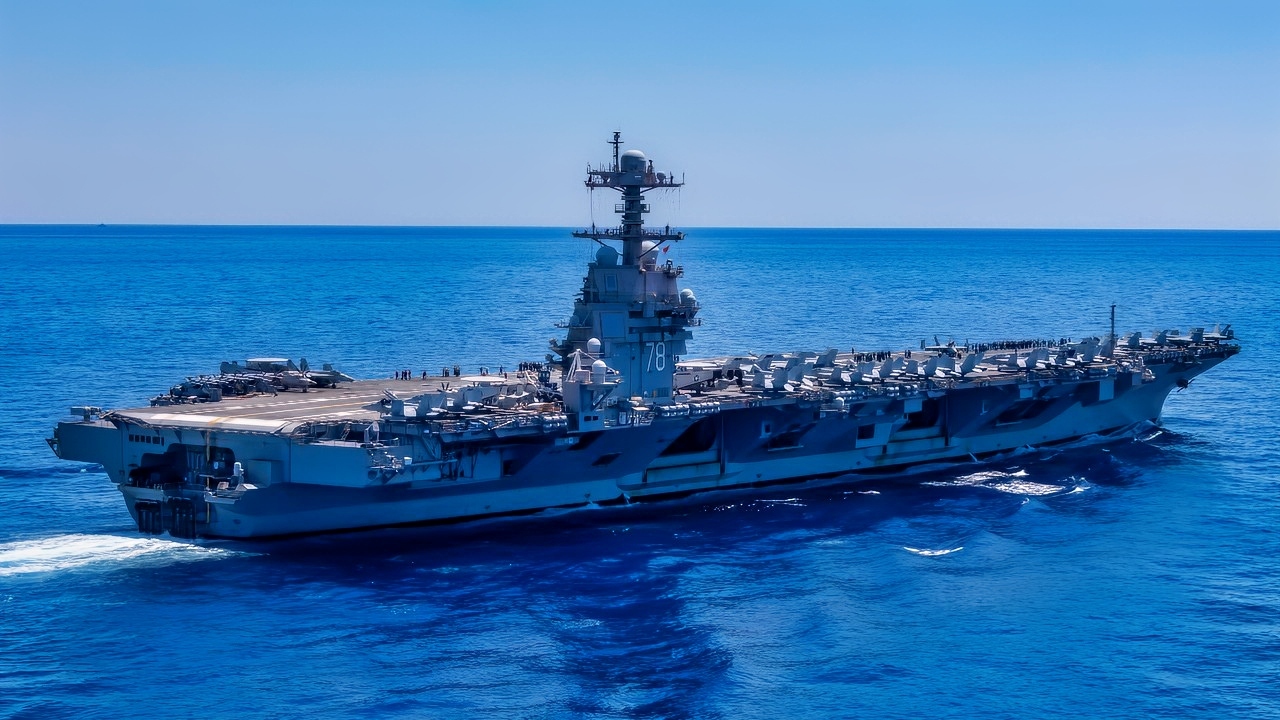
The world’s largest aircraft carrier, USS Gerald R. Ford (CVN 78) transits the Mediterranean Sea, August 1, 2025. Gerald R. Ford, a first-in-class nuclear aircraft carrier and deployed flagship of Carrier Strike Group Twelve, is on a scheduled deployment in the U.S. 6th Fleet area of operations to support the warfighting effectiveness, lethality, and readiness of U.S. Naval Forces Europe-Africa, and defend U.S., Allied, and partner interests in the region. (U.S. Navy photo by Mass Communication Specialist Seaman Brianna Barnett)
By early March 2026, Ford had crossed the 260-day threshold, placing it among the longest aircraft carrier deployments since the Vietnam War. Unlike the long deployments of the pandemic era, which were designed to reduce disease exposure by keeping ships at sea, Ford’s endurance was driven by continuous operational demand. The carrier conducted real-world combat sorties, maintained persistent deterrence patrols, and supported active strike operations without the recuperative pauses that traditionally allow crews and ships to reset.
Crew Morale is Plummeting
Fatigue among the crew understandably skyrocketed. Aircraft carriers are designed to operate for sustained periods under immense pressure, but even this was pushing it. Sailors missed family emergencies, births of their children, and other important life events with little means of keeping up with their loved ones.
Perhaps more damaging than the length itself was the uncertainty that accompanied it. Several times during the deployment, sailors were reportedly informed that a homecoming was imminent, only to learn hours or days later that the carrier had been diverted to another theater. This further eroded the morale of the unfortunate sailors serving on Ford, along with many other factors.

Ford-Class Aircraft Carrier. Image Credit: Creative Commons.
To make matters worse, the quality of life aboard the tired carrier was steadily decreasing. Gerald R. Ford has long struggled with its sanitation systems, and during the extended deployment, those problems intensified. Frequent toilet blockages are admittedly not a new issue on naval vessels. However, with the extended deployment, the already exhausted crew had to contend with even more hardships.
While Naval leadership tried to calm everyone down and assure the public that such issues were being addressed, accounts from sailors suggested that constant use without full maintenance availability was overwhelming the system.
The Onboard Fire: Ford is Reaching Her Breaking Point
The breaking point came on March 12, 2026, when a fire broke out in the ship’s aft laundry facility. According to official reports, the fire was caused by a lint fire, although some skeptical observers speculate it may have been struck by a munition.
The fire reportedly burned on for multiple hours, filling compartments with smoke and forcing the displacement of hundreds of sailors. More than two hundred crew members were treated for smoke inhalation, one sailor had to be medically evacuated, and over one hundred berthing spaces were rendered uninhabitable. To restore basic habitability, the Navy was forced to divert thousands of mattresses and clothing items from another carrier, forcing Ford’s sailors to sleep on improvised beds
Immediately after the fire was reported, the Navy went into full damage-control mode and tried to reassure everyone that the damage was minimal. The carrier was sent to Souda Bay, Crete, for emergency inspections and repairs.
Although the stay was initially supposed to be temporary, defense analysts quickly noted that the visible damage was only part of a much larger problem. Months of deferred maintenance had accumulated across the ship, from auxiliary systems to habitability spaces and high-stress mechanical components tied to flight operations.

The world’s largest aircraft carrier USS Gerald R. Ford (CVN) 78 and the USNS Laramie (T-AO-203) conduct a refueling-at-sea in the Eastern Mediterranean Sea, Oct. 11, 2023. USS Gerald R. Ford is the Navy’s newest and most advanced aircraft carrier, representing a generational leap in the U.S. Navy’s capacity to project power on a global scale. The Gerald R. Ford Carrier Strike Group is currently operating in the Eastern Mediterranean Sea, at direction of the Secretary of Defense. The U.S. maintains forward deployed ready and postured forces to deter aggression and support security and stability around the world.(U.S. Navy photo by Mass Communication Specialist 2nd Class Jackson Adkins)
Out of Action for a Long While
Assessments conducted following the fire led several analysts and defense outlets to estimate that Ford could require between twelve and fourteen months of repair and refurbishment before returning to full operational availability.
This is not only because of the damage from the fire, but also because of the months and months of deferred maintenance, the high number of sorties the ship has undertaken, and the regular maintenance wear that carriers undergo during large deployments. For a first-in-class ship, this is a bad omen for the rest of the Ford-class carrier.
The prospect of putting Ford out of commission for twelve-to-fourteen months is frightening for Naval planners, especially as the U.S. industrial base struggles with shipyard delays and extended overhaul periods.

ATLANTIC OCEAN (Oct. 29, 2019) USS Gerald R. Ford (CVN 78) conducts high-speed turns in the Atlantic Ocean. Ford is at sea conducting sea trials following the in port portion of its 15 month post-shakedown availability. (U.S. Navy photo by Mass Communication Specialist 3rd Class Connor Loessin)
The USS John C. Stennis is currently undergoing its own delayed RCOH, with the USS Harry S. Truman expected to enter into its own haul before Stennis is completed. Now that Ford is in dire need of repairs, the shipbuilding industry is being stretched to the breaking point.
The Navy’s carrier fleet, on the other hand, will have to find a way to cope with the absence of these carriers, most likely by extending carrier deployments, which will ultimately exacerbate the problem.
About the Author: Isaac Seitz
Isaac Seitz, a Defense Columnist, graduated from Patrick Henry College’s Strategic Intelligence and National Security program. He has also studied Russian at Middlebury Language Schools and has worked as an intelligence Analyst in the private sector.


