


Summary and Key Points: Dr. Brent M. Eastwood, a defense analyst and former U.S. Army Infantry officer, evaluates the sustainability of the Aegis Combat System during Operation Epic Fury. Amidst false Iranian claims of striking the USS Abraham Lincoln aircraft carrier, the U.S. Navy has maintained an impenetrable “protective bubble” using SM-2, SM-3, and SM-6 interceptors.
-This 19FortyFive report analyzes the “alarming” expenditure rates cited by Admiral James Kilby, exploring the industrial supply chain issues at MDA and the strategic trade-offs between SM-3 IB and IIA variants as the Navy prepares for a prolonged high-tempo conflict.
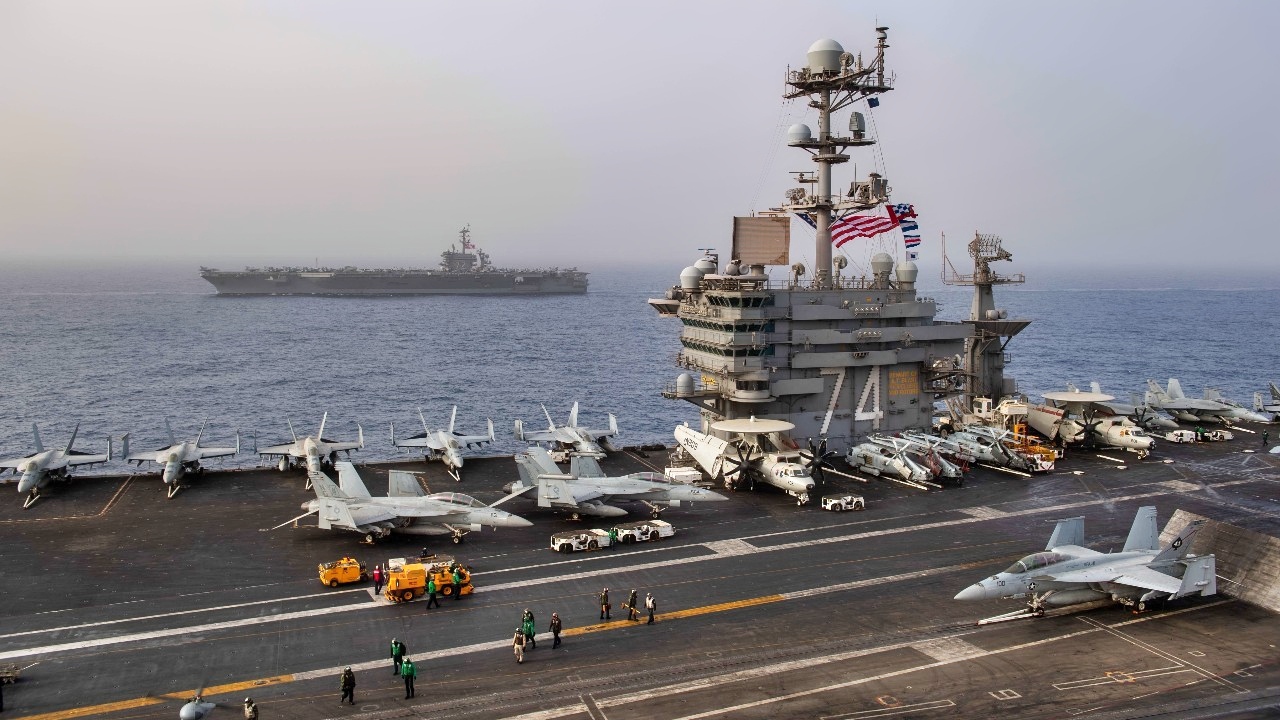
The aircraft carrier USS Abraham Lincoln (CVN 72), back, steams alongside the aircraft carrier USS John C. Stennis (CVN 74) in the Mediterranean Sea, April 24, 2019. The John C. Stennis Carrier Strike Group (CSG) 3 and Abraham Lincoln Carrier Strike Group (CSG) 12 are conducting dual carrier operations, providing opportunity for two strike groups to work together alongside key allies and partners in the U.S. 6th Fleet area of operations. John C. Stennis is underway in the Mediterranean Sea as part of the John C. Stennis Carrier Strike Group (JCSCSG) deployment in support of maritime security cooperation efforts in the U.S. 6th Fleet area of responsibility. (U.S. Navy photo by Mass Communication Specialist 3rd Class Grant G. Grady)
The Interceptor Crisis: Why the U.S. Navy’s Missile Inventory is the True Bottleneck in the Iran Air War
The Iranians have little to brag about. Their propaganda organs have kicked into overtime during Operation Epic Fury because the regime needs any semblance of good news it can trumpet.
Israel and the United States have punished Iran and eliminated the Supreme Leader Ali Khamenei, plus a host of its political and military leaders.
The combined air attacks have created air superiority over Iran. Enemy air defenses have been suppressed. Ballistic missile facilities are smoking ruins, and at least nine Iranian naval vessels have been destroyed.
So, Iranian state-run media has resorted to lies to counteract all the bad news confronting the regime. One outright whopper was the claim that Iran had damaged the USS Abraham Lincoln aircraft carrier with ballistic missiles. The U.S. Central Command shot down that fake news by saying that no missile fired from Iran even came close.
Iran Gets Caught In a Lie
The Iranian Islamic Revolutionary Guard Corps had claimed they hit the Lincoln with four missiles. CENTCOM said this was a lie.
“The Lincoln continues to launch aircraft in support of CENTCOM’s relentless campaign to defend the American people by eliminating threats from the Iranian regime,” the U.S. military command in the region said.
The Iranians bragged that “the land and sea will increasingly become the graveyard of the terrorist aggressors.”
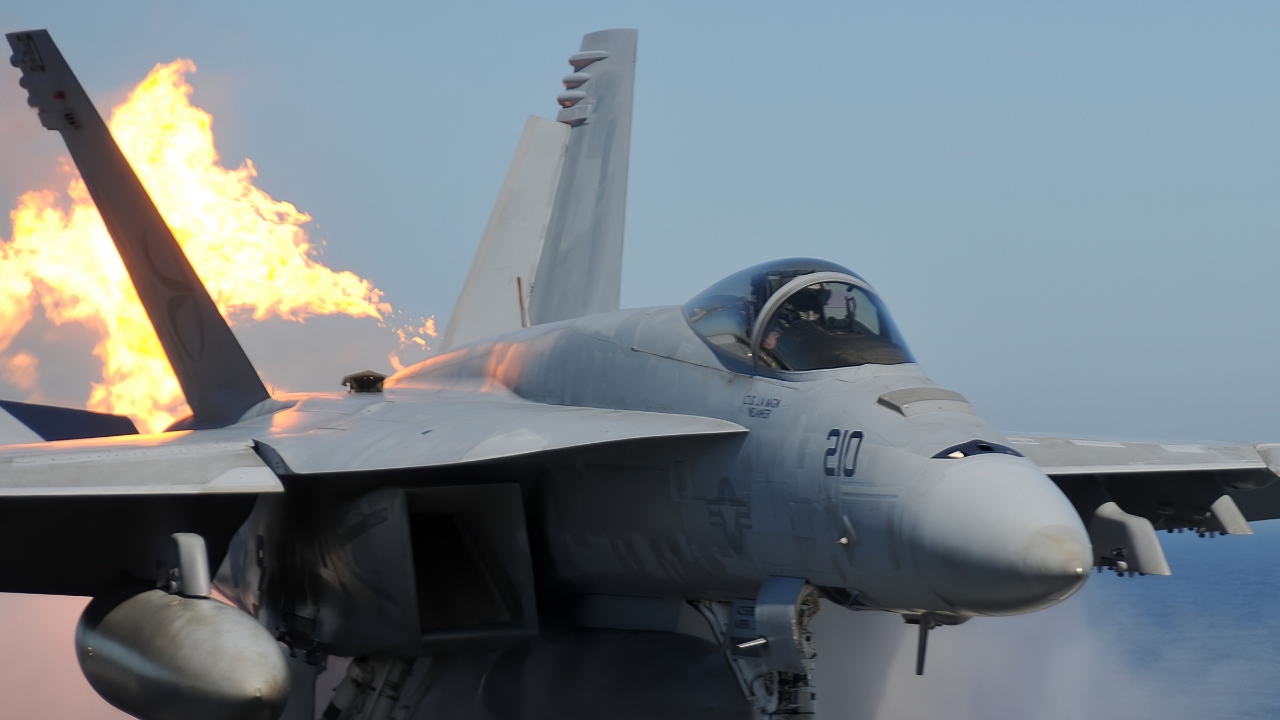
A U.S. Navy F/A-18E Super Hornet aircraft assigned to Strike Fighter Squadron 137 is launched from the flight deck of the aircraft carrier USS Abraham Lincoln (CVN 72) while underway in the Pacific Ocean on Feb.2, 2009.
(DoD photo by Petty Officer 2nd Class James R. Evans, U.S. Navy. (Released))
Anti-missile Duties Are Front and Center
There has been much speculation before the war about whether Iranian ballistic missiles could threaten the Abraham Lincoln and the USS Gerald R. Ford.
So far during Operation Epic Fury, no enemy projectile or drone has pierced the protective bubble over the carrier strike groups that are guarded by airborne early warning airplanes and the Aegis Combat System.
Support ships in carrier strike groups have Aegis on board, and it has been an effective system when facing the Iran-backed Houthis of Yemen, who tried to destroy U.S. carriers and strike group vessels last year.
How Long Can Interceptors Last?
One concern has been the use of American missile interceptors, such as the SM-2, SM-3, and SM-6. These have worked great, but they are not unlimited, expensive, and difficult to build. They also take a substantial amount of time to produce in numbers.
“The biggest problem remains longer-term procurement numbers, a trend continued by the 2026 budget request. Both of the last two budget requests have proposed ending production of the IB variant of the SM-3 in favor of the IIA variant, sacrificing capacity for capability. While this decision might reflect the need for a greater range of the SM-3 IIA to deal with threats in the Indo-Pacific, it has constrained MDA’s ability to replace interceptors used in other theaters,” according to a missile interceptor analysis by think tank CSIS.
They Are Expensive and Could Run Out Fast
SM-3 interceptors can run around $9 million each. The SM-3 has been expended at an “alarming rate” after operations against the Houthis and protecting Israel, U.S. then acting Chief of Naval Operations Admiral James Kilby said in testimony to Congress last year.

Arleigh Burke-class guided-missile destroyer USS Michael Murphy (DDG 112) sails alongside Nimitz-class aircraft carrier USS Abraham Lincoln (CVN 72) on Dec. 8, 2025. USS Abraham Lincoln (CVN 72), flagship of the Abraham Lincoln Carrier Strike Group, is underway conducting routine operations in the U.S. 7th Fleet area of operations, demonstrating the U.S. Navy’s long-term commitment to a free and open Indo-Pacific. (U.S. Navy photo by Mass Communication Specialist 3rd Class Nathaly Cruz)
Finding Out Exact Numbers Is a Difficult for Open Source Analysts
Responsible Statecraft determined in its research that between October 2023 and December 31, 2024, the Navy had 168 SM-2s, 17 SM-3s, and 112 SM-6s.
“[We] estimate that a total of 24 missiles were expended by a total of four different Arleigh Burke destroyers in 2024 to supplement Israel’s ballistic missile defense: let’s say 12 SM-3s and 12 SM-6s,” the news outlet wrote. “We can estimate a grand total of 268 SM-2s, 159 SM-3s, and 280 SM-6s were used in the Middle East from October 2023 through the end of June 2025.”
This Is High Levels of Operational Tempo
That is heavy use for these projectiles. It is not clear just how many interceptors in the Lincoln strike group are on hand, but if the operation against Iran lasts around four weeks as Trump has claimed, then interceptors may have to be replenished on the Abraham Lincoln and perhaps the Gerald R. Ford. This depends on the operational tempo the Navy’s newest supercarrier faces.
To be sure, the Navy knows the exact numbers of its interceptor missiles at all times, and efforts will be underway to replenish these weapons when needed. But it does stand to reason that strike groups must have ample numbers of replacements ready to go. With supply chain and workforce issues in the U.S. defense industrial complex, the entire military is facing difficulties in producing missiles to continue dominating that fight.
“Missile interceptors are a big concern, particularly anti-ballistic interceptors,” said Kelly Grieco, a senior fellow at the Stimson Center. “We are using these interceptors faster than we can make them.”
Watch This Closely; It’s the Key to the War
We will see how long the Iranian operation lasts and how much the Israeli and American air strikes can erode the strength of Iranian missile launchers. Israel and the United States claim they have air superiority, and the two air powers may want to keep the war chugging along until as many Iranian ballistic missile launchers, command and control centers, missile production facilities, and rocket force troops are eliminated. This will be the war’s biggest challenge.

Iran’s missile capabilities. Image Credit: Creative Commons.

Iran Missiles. Image Credit: Creative Commons.
The Navy knows what it is doing and has rehearsed actions in what I call the “Kinetic Missile Fight.” The war with Iran will be watched closely by China, though, and Xi Jinping’s military wants to see how the U.S. Navy holds out with its air defense system and the number of interceptor missiles it goes through. The two carrier strike groups will need to monitor the levels of projectiles that protect the ships and use them parsimoniously until they can be replenished. This will be critical to ensuring American carriers survive.
About the Author: Brent M. Eastwood
Author of now over 3,000 articles on defense issues, Brent M. Eastwood, PhD, is the author of Don’t Turn Your Back On the World: A Conservative Foreign Policy and Humans, Machines, and Data: Future Trends in Warfare, plus two other books. Brent was the founder and CEO of a tech firm that predicted world events using artificial intelligence. He served as a legislative fellow for US Senator Tim Scott, advising the senator on defense and foreign policy issues. He has taught at American University, George Washington University, and George Mason University. Brent is a former US Army Infantry officer. He can be followed on X @BMEastwood.


Stu Erwin
March 3, 2026 at 12:36 pm
The story about the Canadian diesel sub sinking the super carrier was interesting, and all this coverage of the above surface warfare brings me to ask exactly what is the status of the Iranian submarine fleet? In total numbers (25) they are ranked 4th behind the US, China, and Russia and barely ahead of North Korea, Japan and South Korea. None are listed as nuclear. although their own technology is advancing, most use Chinese and/or Russian technology and they operate in relatively shallow coastal waters. Haven’t seen one report mentioning them.
MakAfrasd
March 6, 2026 at 12:03 am
LOL its so funny how you claim “air superiority” even though there are jets being shot down all over Iran. By definition, thats not “air superiority”. Also, crew members on ships reported being hit, but that information is not being released to the public. Keep believing the lies youre told by shit diaper trump and hangover hegseth while more and more americans and innocent people die. Warmonger trash