


The U.S. Navy’s F/A-18 Super Hornet Is No Stealth Fighter, and Iran Could Take It Down
Aerial combat is always risky. Over the skies of Iran, even though the Americans and Israelis have declared air superiority and even air dominance, there have been instances when Iranian air defenses almost enjoyed a win over U.S. pilots. Take the example of the Air Force F-35 nearly destroyed when it was hit by enemy fire and forced into an emergency landing.

An F/A-18F Super Hornet, attached to Strike Fighter Squadron (VFA) 195, taxis on the flight deck of Nimitz-class aircraft carrier USS George Washington (CVN 73) while underway in the Celebes Sea, Nov. 29, 2025. George Washington is the U.S. Navy’s premier forward-deployed aircraft carrier, a long-standing symbol of the United States’ commitment to maintaining a free and open Indo-Pacific region, while operating alongside allies and partners across the U.S. Navy’s largest numbered fleet. (U.S. Navy photo by Mass Communication Specialist 2nd Class Tyler Crowley)
There Was Almost a Shoot-down
The U.S. Navy’s F/18-E/F Super Hornet is not immune to danger either. One Super Hornet had a close call with an Iranian man-portable air defense system (MANPADS). The naval airplane was flying fast and low for a munitions delivery mission during Operation Epic Fury. This is surprising since MANPADS are usually a weapon focused on much slower-moving aircraft such as helicopters and drones.
Do the Americans and Israelis Really Have Total Air Dominance?
This calls into question how much air superiority the United States and Israel have gained. There are still pockets of resistance that have surprised the allies. Video evidence inspected by the War Zone showed that the Super Hornet almost got shot down on March 25 over Chabahar in Iran’s Sistan and Baluchistan province. The weapon was fired near Pakistan.
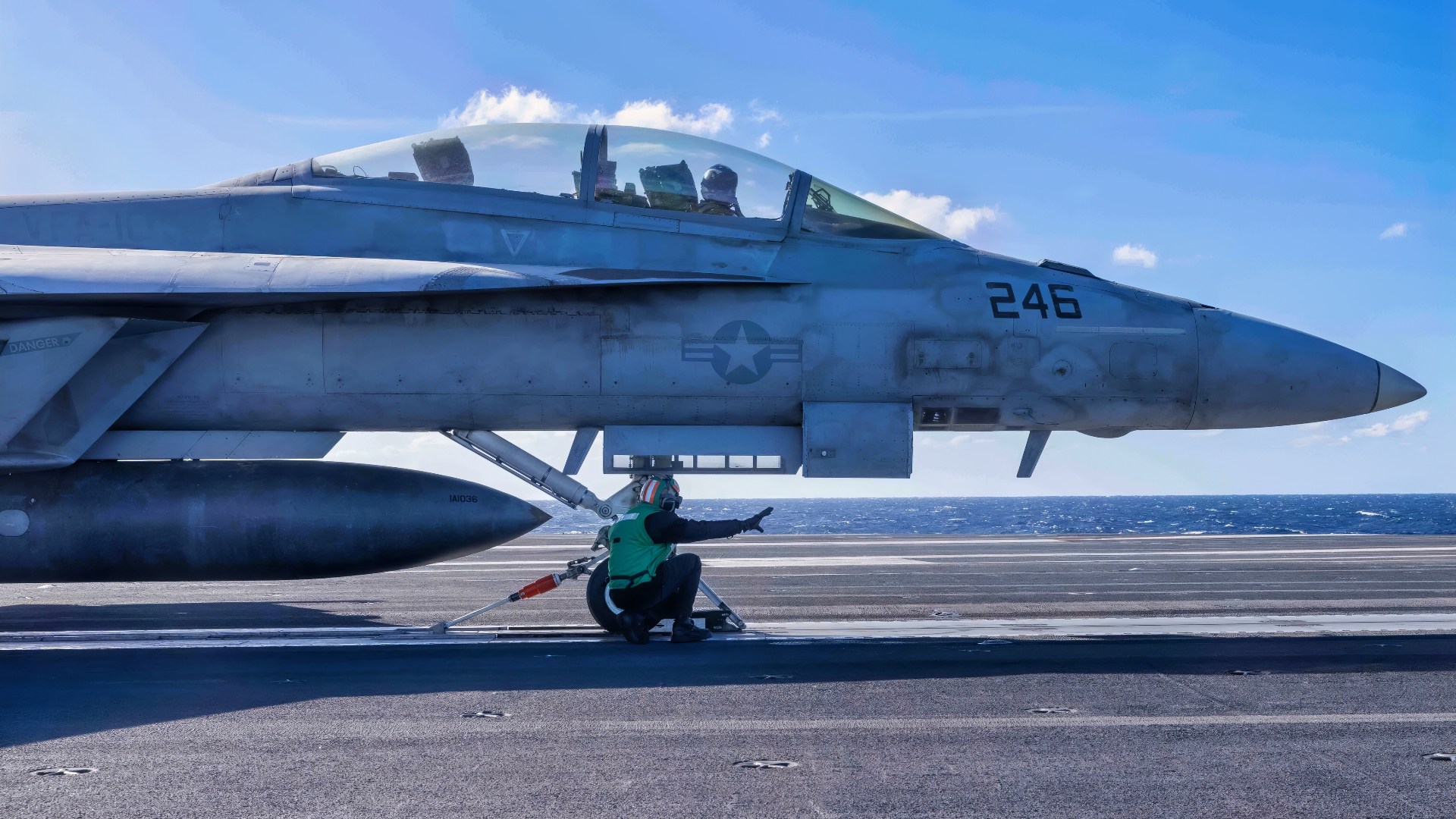
ATLANTIC OCEAN (Nov. 6, 2025) Aviation Boatswain’s Mate (Equipment) 3rd Class Diondre Jean signals the launch of an F/A-18F Super Hornet attached to the “Gladiators” of Strike Fighter Squadron (VFA) 106 on the flight deck aboard the Nimitz-class aircraft carrier USS George H.W. Bush (CVN 77). George H.W. Bush is underway conducting carrier qualifications and routine operations in the Atlantic Ocean. (U.S. Navy photo by Mass Communication Specialist Seaman Apprentice Juan SerratosGuzman)
Let’s Not Get Cocky
Perhaps the F/A-18 E/F was flying too low, and the aviator was too confident about the safety of the sector that he or she was flying in. I’m still surprised that a MANPAD came that close to scoring a hit. These are not the most robust anti-aircraft devices in any arsenal. But give credit to an alert Iranian fighter who was not giving up, despite the air power of Israel and the United States.
One posting on X said, “Video reportedly of a US Navy F/A-18 getting hit by IRGC Air Defense over Chabahar. IRGC Public Relations Office claimed the fighter crashed in the Indian Ocean.”
It is not known whether the Super Hornet was damaged. The Americans just reported that the airplane wasn’t shot down.
Strafing Makes Sense, But It Is Dangerous
The Super Hornet, in this case, was attacking with its M61A1 Vulcan rotary cannons. These are powerful weapons, but they may not be the best option for destroying Iranian targets. Vulcans are definitely cheaper than using air-to-surface missiles or joint direct attack munitions (JDAMS). But what about combat search and rescue (CSAR) efforts for potentially downed pilots? A shoot-down and a captured pilot would be disastrous. CSAR should be in place during every mission. Low strafing runs were widely used in the war against Iraq and Afghanistan, but that was when air dominance was assured, and the enemy had few sophisticated air defenses.
Evaluate Tactics Better
After this very close call, I would recommend suspending the strafing runs until it is safer. The X user OSINT-Technical reported on March 15 that the Navy has been conducting low-altitude flights regularly, and one can hear “bursting” noises on video that would be evidence of the rotary cannon operating.
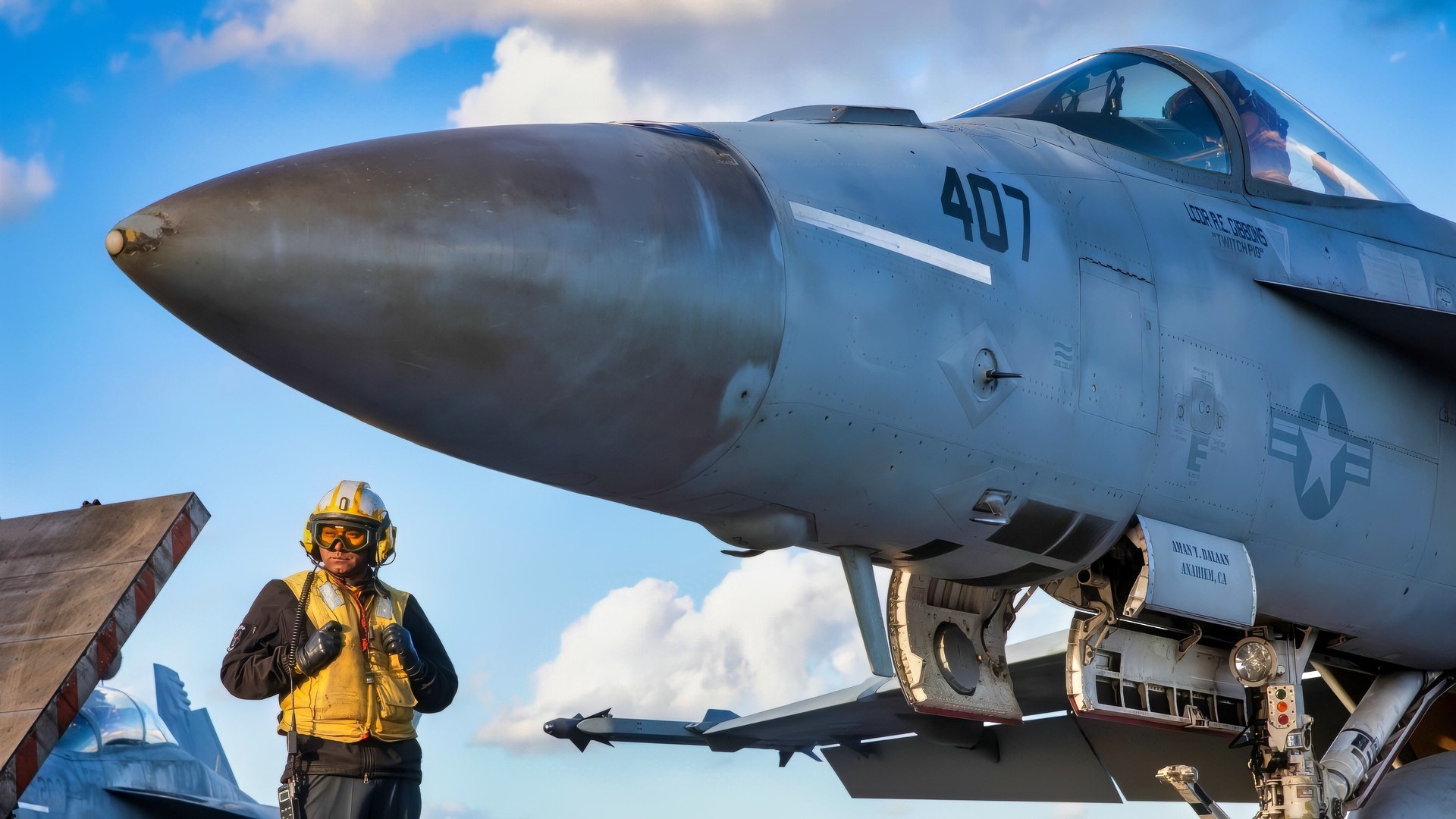
Aviation Boatswain’s Mate (Aircraft Handling) 1st Class Jose Mejiacastro, assigned to Air Department aboard the world’s largest aircraft carrier, USS Gerald R. Ford (CVN 78), prepares to signal to a Carrier Air Wing 8 F/A-18E Super Hornet attached to Strike Fighter Squadron 87 on the flight deck, Sept. 26, 2025. Gerald R. Ford, a first-in-class aircraft carrier and deployed flagship of Carrier Strike Group Twelve, is on a scheduled deployment in the U.S. 6th Fleet area of operations to support the warfighting effectiveness, lethality and readiness of U.S. Naval Forces Europe-Africa, and defend U.S., Allied and partner interests in the region. (U.S. Navy photo by Mass Communication Specialist 2nd Class Mariano Lopez)
MANPADS Should Not Be a Problem
The F/A-18 E/F is not a stealth aircraft, and it probably should not be considered a Day One asset due to its limited radar evasion. But it is fast and maneuverable. Just ask the Navy Blue Angels pilots who fly it. Performance is not the problem—but the near-miss by the MANPAD was alarming.
This Is One Busy Jet
Super Hornets are the backbone of the U.S. Navy’s strike packages. Their flights account for about 70 percent of all sorties in the service.
“Drawing on U.S. Navy fleet structure data and NAVAIR modernization programs, the reason is clear: no other aircraft currently combines cost-efficiency, payload capacity, and multirole flexibility at scale. This analysis breaks down the key factors behind its continued relevance, including its replacement of legacy platforms like the Grumman F-14 Tomcat, its operational dominance, and how upgrade programs are keeping it combat-ready,” according to Simple Flying.
Better and Better for F/A-18 Super Hornet
The Super Hornet has been upgraded over the years, and its AN/APG-79 active electronically scanned array (AESA) radar is top-notch. Its avionics are much better now. I like all the different weapons it can carry for multi-role missions. It can conduct air policing operations to protect carriers and execute reconnaissance missions to gather intelligence. The airplane can be refueled in the air to extend its range. It has experienced more than two decades of almost continuous combat at over 100 percent.

At sea (Mar. 1, 2007) – Capt. Craig “Animal” Williams (front) in a F/A 18C Hornet (front) and Capt. Richard “Rhett” Butler (back) in an F/A 18C Hornet look up for a photo as they fly over USS Ronald Reagan (CVN 76). Capt. Williams, a 22-year Naval Aviator who graduated from the United States Naval Academy, was relieved as Commander, Carrier Air Wing Fourteen (CVW-14) by 21-year Naval Aviator, Capt. Butler, a graduate of the University of Kentucky during an aerial change of command ceremony. The Ronald Reagan Carrier Strike Group is currently underway in the Pacific Ocean on a surge deployment in support of U.S. military operations in the Western Pacific. Official U.S. Navy photo by Lt. Cmdr. Tam Pham
(RELEASED)
This is one valuable airplane that the Navy will continue to need until all carriers can deploy the F-35C. The Super Hornet is not going away anytime soon, but I would recommend that pilots be careful with those low-flying strafing runs.
Everyone associated with the F/A-18 E/F must be exceptional, from the flight deck personnel to the aviators. The Super Hornet is a lovable jet that has brought joy to many pilots over the years, but losing even one fighter would be disastrous.
About the Author: Brent M. Eastwood
Author of now over 3,000 articles on defense issues, Brent M. Eastwood, PhD, is the author of Don’t Turn Your Back On the World: A Conservative Foreign Policy and Humans, Machines, and Data: Future Trends in Warfare, plus two other books. Brent was the founder and CEO of a tech firm that predicted world events using artificial intelligence. He served as a legislative fellow for US Senator Tim Scott and advised the senator on defense and foreign policy issues. He has taught at American University, George Washington University, and George Mason University. Brent is a former US Army Infantry officer. He can be followed on X @BMEastwood.


Shawn McClaren
March 27, 2026 at 4:41 pm
Wait… they have been hit 10,000 times. There is a chance they nicked one of our jets causing it to have to land.
The need to write this article since they have been all talk seems a bit silly.