

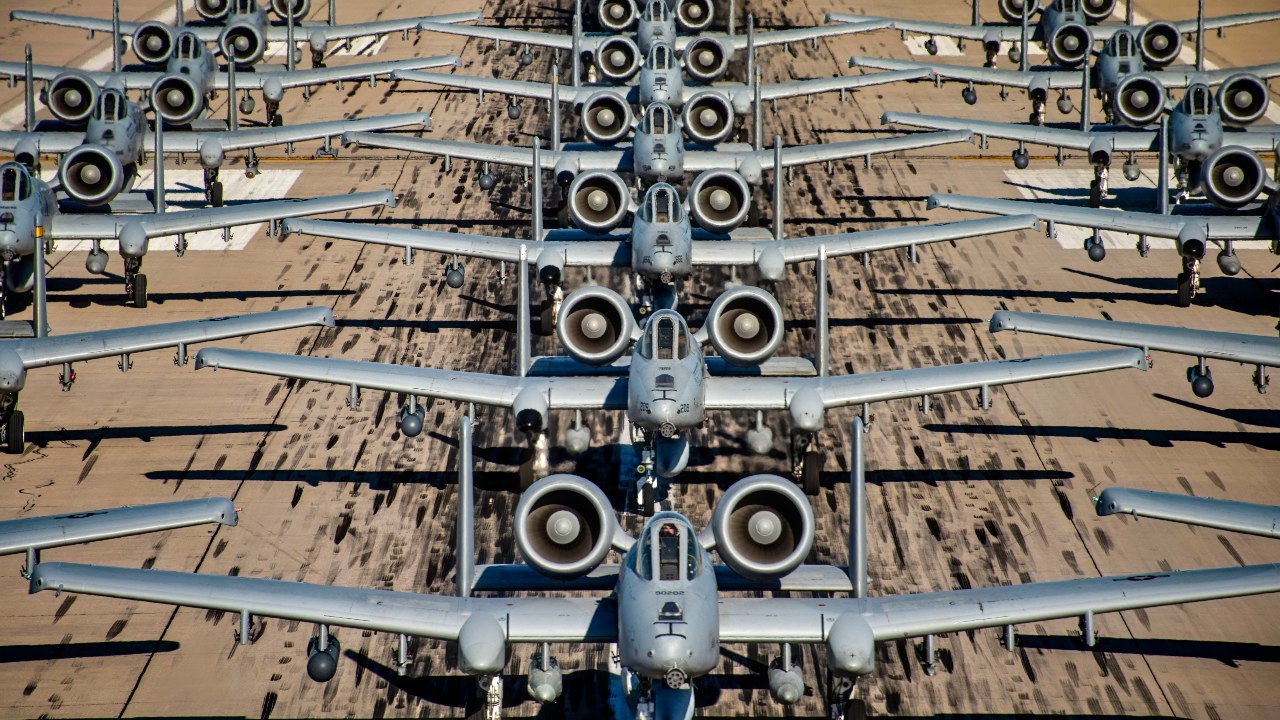
Key Points and Summary – The A-10 Thunderbolt II, known as the “A-10 Warthog,” earned its legendary reputation for toughness through its unique design and combat-proven resilience.
-The pilot is protected within a titanium-armored “bathtub” cockpit, while the aircraft’s redundant systems and high-mounted engines allow it to absorb an incredible amount of damage and still fly home.
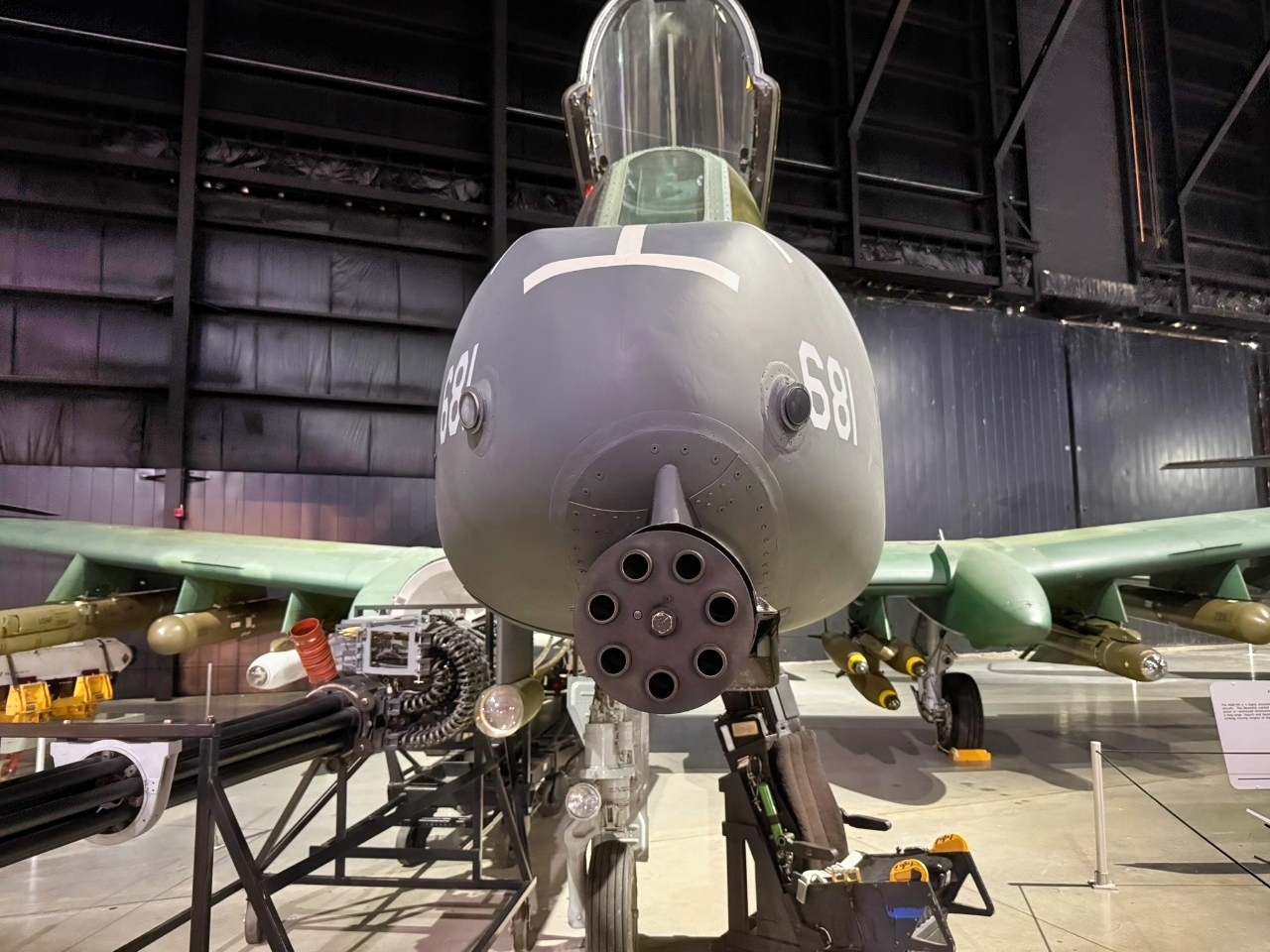
A-10 Warthog Cannon NSJ Photo. Taken at U.S. Air Force Museum on 7/19/2025.
-This survivability was famously demonstrated in Operation Iraqi Freedom, where one A-10 returned to base after losing an engine to a surface-to-air missile, and another was flown back to safety on manual controls alone after losing all its hydraulics to enemy fire.
Heavily Armed and Heavily Armored, the A-10 Warthog Was a Tough Nut to Crack
The A-10 Thunderbolt II, often called the A-10 Warthog, was developed by Fairchild-Republic, a now-defunct American aerospace firm, and was explicitly designed to blunt massed Soviet tank and other armored vehicle formations and slow their advance westward across the European continent.
In addition to a wide array of air-to-surface missiles, the A-10’s most notable weapon was its massive 30mm Gatling gun mated to the inside of the airframe.
When equipped with depleted uranium armor-piercing ammunition, the A-10’s destructive power was enormous. Combined with its relatively low speeds and a pair of high-mounted engines for redundancy and protection, the A-10 was extremely nimble in the air and benefited from an extended loitering time.
It was not just heavily-armed, however: the A-10 was also heavily armored, with the pilot essentially sitting shielded inside a titanium-plated cockpit that offered good protection from a variety of munitions.

A-10 Warthog National Security Journal Photo Essay Picture.
The aircraft itself could also absorb a substantial amount of damage, a fact attested by its combat experience in the Gulf War and other conflicts in the Middle East.
One of those testaments to toughness is recounted by the 110th Wing.
Operation Iraqi Freedom
“During the opening stages of Operation Iraqi Freedom, the wing was flying A-10A Thunderbolt II aircraft in direct support of Coalition ground forces. Affectionately known as “Warthogs,” the A-10 has a well-deserved reputation for toughness – a reputation enhanced by the 110th’s experience while serving with the 332nd Air Expeditionary Wing.”
“On April 8th, 2003 tail number 80-0258, piloted by then-Maj. Gary “Wolfman” Wolf, took off from Ahmed Al Jaber Air Base in Kuwait to support Coalition troops as they approached Baghdad,” the 110th writes. “As the aircraft provided low-altitude overhead reconnaissance for a coalition convoy commander, it was struck in the right engine by an enemy surface-to-air missile.”

A-10 Warthog NSJ Photos. Image taken on 7/20/2025.
“Although the initial impact was substantial, the aircraft never departed controlled flight. This is a true testament to the combat survivability of the A10.” said Major Wolf (retired), “I was fortunate to be flying the mighty Warthog on that fateful day.”
“Major Wolf managed to keep control of his aircraft, deployed countermeasures and turned towards friendly territory. Despite the extensive damage, he kept the crippled aircraft aloft for 45 minutes until he reached the safety of Tallil Air Base in southern Iraq, 120 miles away. After successfully landing his Warthog, pilots, ground crew and even media photographers marveled at the extent of the damage the craft had absorbed while remaining airworthy.”
Flying Over Baghdad
Another account from Operation Iraqi Freedom attests to the robustness of the A-10 design and, in particular, its ability to sustain damage while still returning to base.
Enemy fire hit an A-10, piloted by Capitan Kim Campbell from the 75th Fighter Squadron at Pope Air Force Base, North Carolina, during an operation over Baghdad.
“We were very aware that it was a high-threat environment — we’re over Baghdad,” she said. “At the same time, those are the risks you are going to take to help the guys on the ground, that’s our job, that’s what we do. Our guys were taking fire and you want to do everything you can to help them out,” Captain Campbell explained.
“We did our job with the guys there on the ground and as we were on our way out is when I felt the jet get hit. It was pretty obvious — it was loud,” Captain Campbell said.
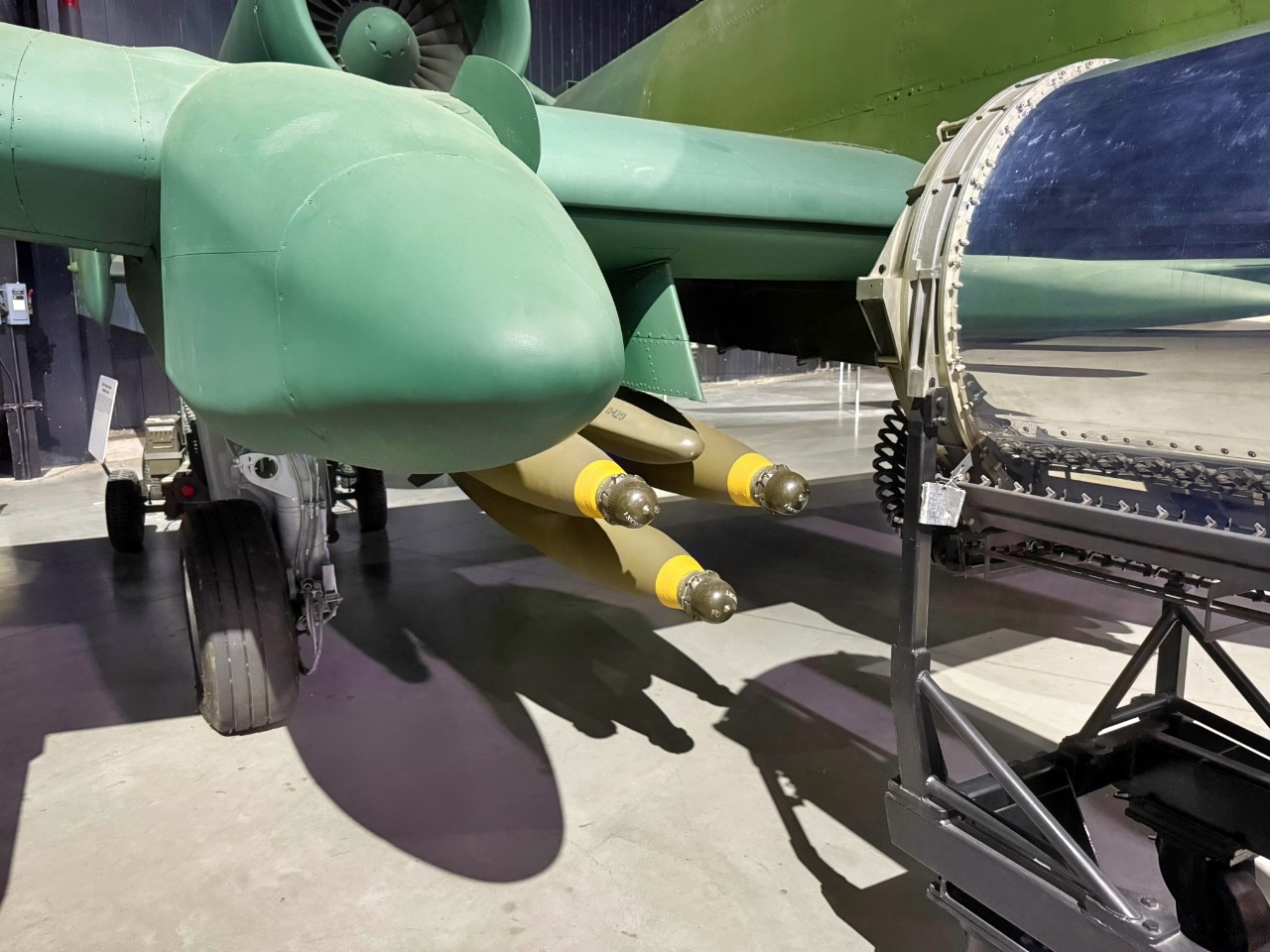
A-10 Warthog Bombs. Image Credit: National Security Journal.
The jet then became uncontrollable, and warning signs lit up inside the cockpit.
“I lost all hydraulics instantaneously, so I completely lost control of the jet. It rolled left and pointed toward the ground, which was an uncomfortable feeling over Baghdad,” she said. “The entire caution panel lit up and the jet wasn’t responding to any of my control inputs.”
Despite the damage, Captain Campbell managed to put the airplane into manual reversion, flying the plane without hydraulics, and control was restored. Ejection then, over Baghdad, would have been extremely risky.
A-10 in 4 Words: Had to Be Retired
Despite the A-10’s combat-proven record and clear robustness, the sun is setting on that Cold War-era program. Against robust air defenses in a contested aerial environment, the A-10 would be very unlikely to survive.
The pushback from lawmakers, however, has been acute. Despite the U.S. Air Force’s desire to retire the platform, the appeal of porkbarrel politics continues to be a powerful draw.

A U.S. Air Force A-10 Thunderbolt II flies a routine mission over the U.S. Central Command area of responsibility Dec. 23, 2024. A-10 Thunderbolt II pilots train and operate under night vision, allowing them to conduct presence patrols critical to regional security at any time and under any conditions. (U.S. Air Force photo)
However, considering the success the A-10 has had in the post-Vietnam era, both in the Gulf War and its renaissance during the Global War on Terror, in support of service members on the ground, has been remarkable.
About the Author: Caleb Larson
Caleb Larson is an American multiformat journalist based in Berlin, Germany. His work covers the intersection of conflict and society, focusing on American foreign policy and European security. He has reported from Germany, Russia, and the United States. Most recently, he covered the war in Ukraine, reporting extensively on the war’s shifting battle lines from Donbas and writing on the war’s civilian and humanitarian toll. Previously, he worked as a Defense Reporter for POLITICO Europe. You can follow his latest work on X.
More Military
The U.S. Navy’s Submarine Crisis Is Real


