

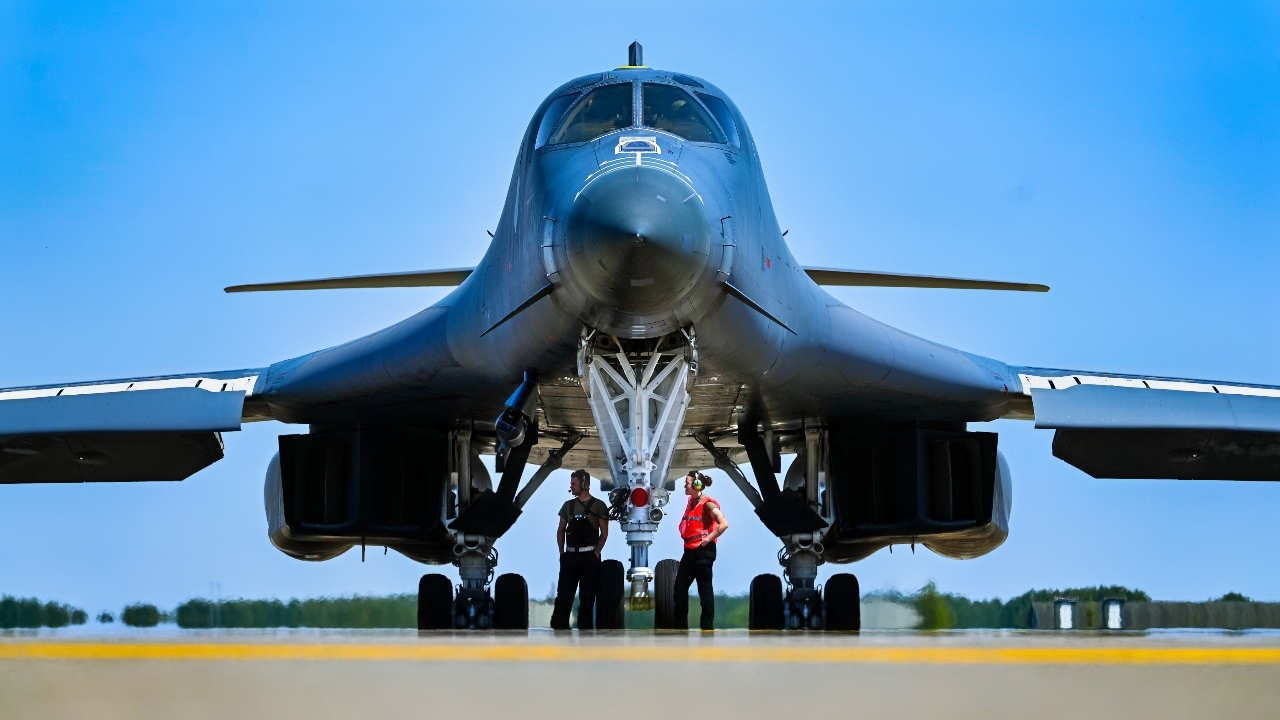
Key Points and Summary – The U.S. Air Force’s famous “boneyard” in Arizona is more than just a final resting place for aircraft; it’s a dynamic facility where retired warplanes like the B-1B Lancer are brought back to life.
-This article explores one of the boneyard’s core missions: “aircraft regeneration.”
-It highlights several compelling cases, including the B-1B bombers “Lancelot” and “Rage” and the B-52 “Wise Guy,” all of which were pulled from preservation in the desert to replace active-duty aircraft lost in crashes or accidents, often to meet legally mandated fleet sizes for the U.S. bomber force.
The B-1B Lancer Reboot from the Boneyard
The “boneyard” isn’t just a metaphor- it’s an actual place, the Air Force’s facility known as the 309th Aerospace Maintenance and Regeneration Group, located at the Davis-Monthan Air Force Base in Tucson, Arizona. That area was chosen because “Tucson’s environment is conducive to reducing rust and corrosion.”
According to an article published back in March on the Pentagon’s website, the boneyard contains “nearly 4,000 aircraft and 6,650 aircraft engines,” making it “the largest aircraft storage and preservation facility in the world.”
The boneyard, per the article, has “five core missions”: Storage and preservation, parts reclamation, disposal preparation, depot-level maintenance, and “aircraft regeneration”- essentially, preparing aircraft for a potential return to service.
“Two B-1 Lancer heavy bombers in the boneyard were returned to the Air Force and are now flying again. Also, C-23 Army Sherpas were regenerated and given to the U.S. Forest Service, and B-57 bombers were given to NASA for high-altitude coverage that included following in the path of last year’s eclipse,” the Pentagon article said.
About That B-1B Lancer
In March of last year, Military Times wrote about “Lancelot,” one of those B-1s that had returned to flight.
Lancelot had a good reason for coming back- it was replacing a different B-1 whose engine exploded during routine maintenance in 2022.
“Once the Air Force determined that repairing the torched bomber from the April 2022 mishap would cost too much, it turned to its ‘Boneyard’ — otherwise known as the 309th Aircraft Maintenance and Regeneration Group at Davis-Monthan Air Force Base, Arizona — for a replacement,” the Military Times article said. “That’s where Lancelot landed after retiring from the 34th Bomb Squadron at Ellsworth AFB, South Dakota, on March 12, 2021.”
Of the B-1 jets at the boneyard, Lancelot was one of four at the “highest level” of preservation.
“This was the one that was probably the best for not requiring as much work,” Joseph Stupic, senior materiel leader at the B-1 program office, told Air Force Times in 2023. “Some of them need structural updates and structural repairs. We looked at it and said, ‘Hey, the structure on this plane is pretty good. We can bring it into the fleet at a lower cost.’”
Meet “Rage” B-1B Lancer Bomber
Another B-1B Lancer that was in the boneyard but has returned to service is called “Rage,” and the War Zone told its story in July of 2024.
“Rage was one of 17 B-1Bs retired in 2021, which ended up at the boneyard. This was to help consolidate the B-1 fleet from 62 to 45 aircraft to help improve overall readiness rates and cut costs before completion of the type’s replacement, the B-21 Stealth Raider,” the War Zone report said.
This B-1B Lancer, like the other, was brought back to replace one that was damaged.
“It seems highly likely that the bomber has been restored to operational readiness to replace the B-1 that crashed at Ellsworth Air Force Base, South Dakota, earlier in January this year,” The War Zone reported. “As part of the [aforementioned] consolidation of the B-1B fleet in 2021, there are strict legal requirements set by Congress for the service to maintain a fleet of 45 B-1Bs.”
Other planes had returned from the boneyard in the years before that.
“In May 2019, the B-52 Wise Guy, serial number 60-0034 touched down at Barksdale Air Force Base in Louisiana to replace another one of the bombers that crashed and burned at Andersen Air Force Base, Guam, three years before. Before that, the B-52 Ghost Rider, serial 61-0007, returned to service at Minot Air Force Base, North Dakota, in February 2015 to replace a B-52 written off after an electrical fire broke out during routine maintenance in 2014.”
About the Author: Stephen Silver
Stephen Silver is an award-winning journalist, essayist, and film critic, and contributor to the Philadelphia Inquirer, the Jewish Telegraphic Agency, Broad Street Review, and Splice Today. The co-founder of the Philadelphia Film Critics Circle, Stephen lives in suburban Philadelphia with his wife and two sons. For over a decade, Stephen has authored thousands of articles that focus on politics, national security, technology, and the economy. Follow him on X (formerly Twitter) at @StephenSilver, and subscribe to his Substack newsletter.
Military Affairs
China’s Stealth Air Force Has 1 Mission


