

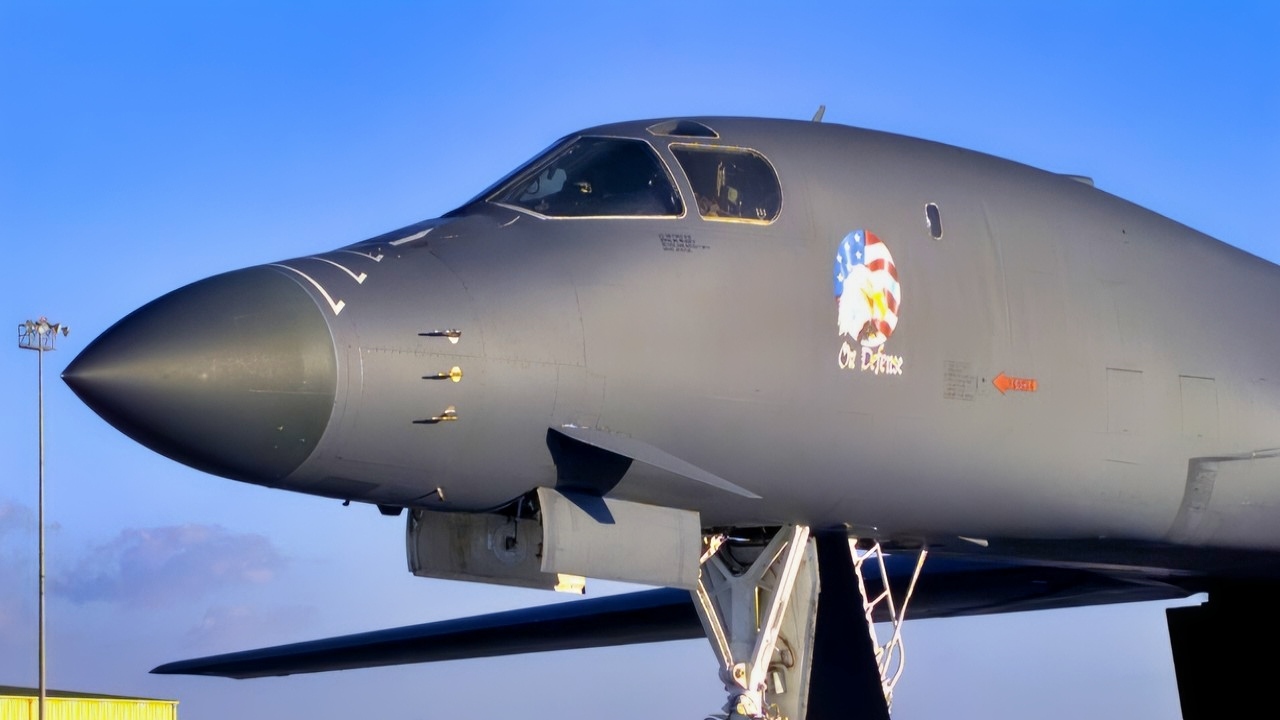
PUBLISHED on August 12, 2025, 12:10 PM EDT – Key Points and Summary – The B-1B Lancer, a versatile workhorse for the U.S. Air Force, boasts one of the most impressive weapons payloads of any aircraft in the world.
-Originally a nuclear platform, it has evolved into a formidable conventional bomber capable of carrying an astonishing 75,000 pounds of ordnance internally and is now being upgraded to carry hypersonic missiles on new external pylons.
-With the ability to launch everything from 2,000-pound bombs and naval mines to swarms of Small Diameter Bombs and standoff cruise missiles, the B-1B remains a vital “weapons truck” bridging the gap until the B-21 Raider enters service.
B-1B Bomber’s Weapons Payload Is Out of This World
The B-1B Lancer bomber is a workhorse that has served valiantly in several different conflicts the U.S. Air Force has engaged in over the decades. It was meant to be a nuclear delivery platform, and it can carry 24 atomic bombs and 84 500-pound conventional bombs.
But that’s not all. It has been modified to launch hypersonic weapons for the potential fight in the Indo-Pacific if war breaks out against China.
Its weapons capacity is second to none. In addition to the 84 Mk 82 500-pound bombs, the 500-pound bombs can be replaced by 24 Mk 84 2,000-pound bombs.
Are You Ready for This List of Weapons?
This is a massive weapons truck with an even greater munitions capacity than you can believe.
The Air Force explained it can drop “2,000-pound Mk-65 Quick Strike naval mines; 30 cluster munitions [CBU-87, -89, -97] or 30 Wind-Corrected Munitions Dispensers [CBU-103, -104, -105]; up to 24 2,000-pound GBU-31 or 15 500-pound GBU-38 Joint Direct Attack Munitions; up to 24 AGM-158A Joint Air-to-Surface Standoff Missiles; and 15 GBU-54 Laser Joint Direct Attack Munitions.”
You got all that? This is one impressive weapons payload. For this kind of excellent ordnance capacity, you can see how much the Air Force has valued the B-1B over the years.
Hypersonics and JASSMs for B-1B Lancer?
The B-1B is now being upgraded to answer the modern threat environment. That means the potential someday to fire as many as 36 hypersonic missiles and AGM-158 JASSM (Joint Air-to-Surface Standoff Missiles) on modern hardpoints in addition to all the bomb options in the conventional payload inside. These external hardpoints are called Load Adaptable Modular (LAM) pylons.
The contraptions can also carry nuclear-tipped cruise missiles. Don’t forget the 144 Small Diameter Bombs that can also be dropped, with 48 externally and the rest internally.
Historically, the B-1B was always planned to create death and destruction. The Air Force designed it to be the leading nuclear weapons delivery platform for the nuclear triad in the 1980s.
By the time the Global War on Terror emerged, the Lancer had transitioned to carry more conventional munitions, achieving ultimate levels of ground strike prowess.
Now that there are significant power threats from Russia and China, the nuclear mission is still a possibility.
Bomber Deficit Until the B-21 Raider Is Ready
The Air Force currently faces a “bomber deficit” until the B-21 Raider comes online.
The service branch has only 19 B-2 stealth bombers, so the B-1B Lancers are still needed.
With a fleet of 100 B-1Bs at one point, the Air Force retired 17 of them in 2021.
Three dozen met the chopping block in the early 2000s. Now there are only 45 left that fly out of Ellsworth Air Force Base, South Dakota, and Dyess Air Force Base, Texas.
The B-1’s history dates back to 1974, when it was known as the B-1A. However, the program was later cancelled that decade. The defense build-up by President Ronald Reagan pumped new life into what became the B-1B in 1984. Air Force generals were enthused.
It Became the Go-To Conventional Bomber
This upgraded bomber could fly 900 miles per hour at an altitude of 60,000 feet with a range of 7,000 miles. That was music to the Air Force’s ears. It had the nuclear weapons payload plus a range of bombs that helped execute the shock and awe campaign in the first and second Gulf Wars. It dropped thousands of JDAMs during the Global War on Terror.
The New START Treaty kept the B-1B from carrying nuclear weapons after the Cold War.
Still, Russia has suspended its participation in the treaty, although it has not officially withdrawn.
Meanwhile, the Air Force continues to update the B-1B. Engines have undergone a refurbishment. There are also new targeting systems. The Integrated Battle Station features modern capabilities to share data with other aircraft and the Combined Air Operations Center.
The hypersonic weapons capability is the most exciting news for the B-1B. This brings the bomber into the modern age and will enable it to serve until the 2030s, when the B-21 Raider enters active duty.
Sharing Data with the Joint Force
The radar targeting system is outstanding. It can identify and track moving targets. Moreover, it has the kind of loitering ability you would expect from a go-to bomber. While not stealthy, it can deploy its bombing runs after the suppression of enemy air defense systems when the radar-evading F-35s and B-2s conduct initial ground strikes. The data sharing capabilities also enable it to become a bomber that can receive ample support from escorting fighters.
Survivability Is Paramount for the B-1B Lancer
The B-1B is highly survivable. As the Air Force wrote, “The B-1B’s onboard self-protection electronic jamming equipment, radar warning receiver [ALQ-161] and expendable countermeasures [chaff and flare] system and a towed decoy system [ALE-50] complement its low-radar cross-section to form an integrated, robust defense system that supports penetration of hostile airspace. The ALQ-161 electronic countermeasures system detects and identifies the full spectrum of adversary threat emitters, then applies the appropriate jamming technique either automatically or through operator inputs.”
This bomber has a new lease on life. The upgrades keep it relevant. The Air Force still needs conventional strike aircraft, even those that are not stealthy, to make up for the bomber deficit. The B-1B is expected to remain in use for the next five to ten years, despite some calls for its retirement. It has enjoyed a sterling combat record, exemplifying a high level of combat dominance. The airplane is a bombing platform with excellent speed for such a big airplane. The Air Force should not retire it entirely until the B-21 is ready to enter the active fleet.
About the Author: Dr. Brent M. Eastwood
Brent M. Eastwood, PhD is the author of Don’t Turn Your Back On the World: a Conservative Foreign Policy and Humans, Machines, and Data: Future Trends in Warfare plus two other books. Brent was the founder and CEO of a tech firm that predicted world events using artificial intelligence. He served as a legislative fellow for U.S. Senator Tim Scott and advised the senator on defense and foreign policy issues. He has taught at American University, George Washington University, and George Mason University. Brent is a former U.S. Army Infantry officer. He can be followed on X @BMEastwood.
Military Matters
The F-22 Raptor Just Keeps Getting Better


