

Key Points and Summary – The U.S. Air Force’s B-2 Spirit, its most formidable stealth bomber, suffers from a “stealth bomber problem”: scarcity.
-After a 2022 crash, the fleet is down to just 19 aircraft. This “high-value, low-density” force is further constrained by “extensive” maintenance, leaving as few as “a dozen” bombers mission-capable at any given time. This small number creates a strategic bottleneck, limiting flexibility and sortie generation in a crisis.

A U.S. Air Force B-2 Spirit, assigned to the 509th Bomb Wing, Whiteman Air Force Base, Mo., is flanked by two U.S. Air Force F-22 Raptors, assigned to the 1st Fighter Wing, Joint Base Langley-Eustis, Va., while conducting a flyover over the White House in Washington, D.C., July 4, 2025. The B-2 provides penetrating flexibility and effectiveness inherent in manned bombers. (U.S. Air Force photo by Airman 1st Class Geneva Nguyen)
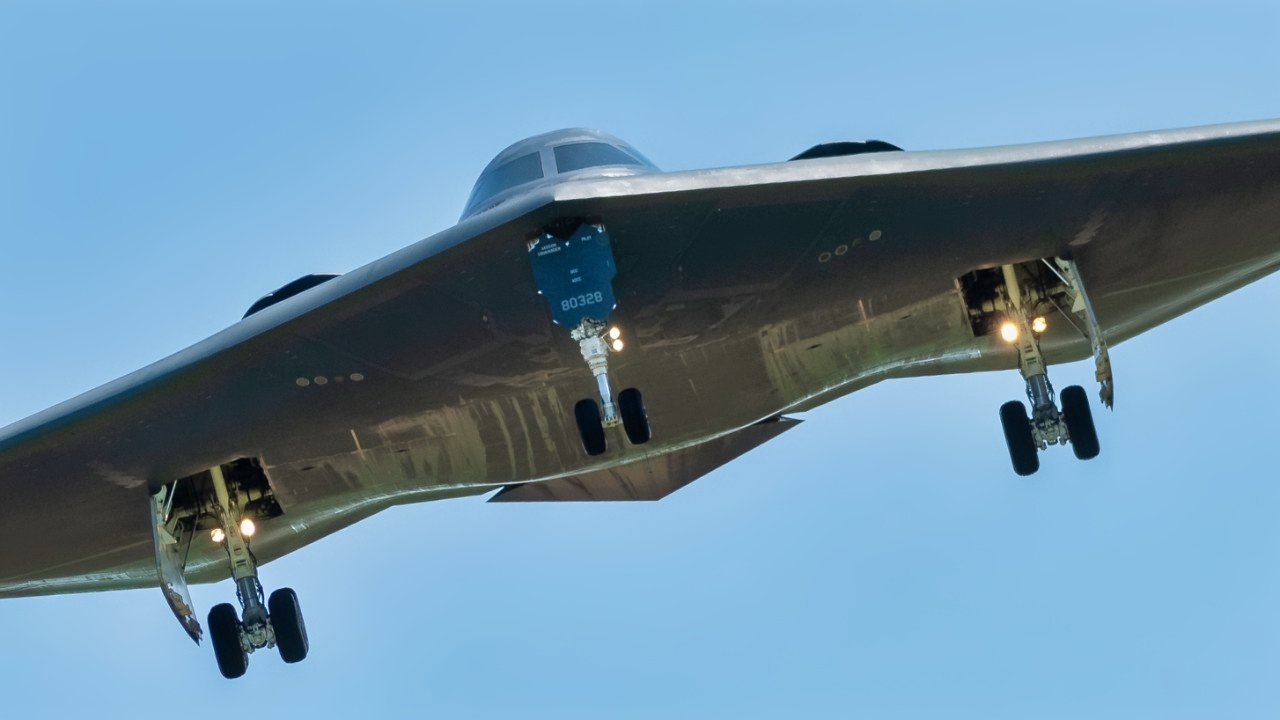
A B-2 Spirit returns to Whiteman Air Force Base, Missouri, from a deployment to Diego Garcia, British Indian Ocean Territory, May 9, 2025. The 509th Bomb Wing and its fleet of B-2 aircraft serve as part of the U.S. Air Force’s conventional and strategic combat force with the capability to project U.S. airpower anywhere around the world. (U.S. Air Force photo by Senior Airman Devan Halstead)
-This “hollow” fleet serves as a critical lesson for the B-21 Raider program, which must be produced at scale to avoid repeating the same strategic mistake.
America’s B-2 Stealth Bomber Problem
The B-2 Spirit is one of the United States’ most recognized and formidable strike platforms. It’s stealthy, long-ranged, and capable of penetrating advanced air defenses and delivering both conventional and nuclear ordnance.
Yet its force structure—specifically, the fleet size—casts a shadow over all that capability.
With the fleet of America’s most fearsome bomber reduced to just 19 aircraft after a 2022 crash, the bomber’s scarcity has significant implications: it constrains sortie generation and impacts strategic flexibility.
As the B-21 Raider, the B-2’s successor, begins to enter service in the late 2020s, the question is: will the Air Force apply the lessons from the B-2’s limitations, or simply repeat them?
The B-2 Spirit and Its History
The B-2 Spirit first flew in 1989 and entered U.S. service in 1997. 21 aircraft were initially built, but a series of crashes reduced that number to 19. In 2008, one crashed.
A second was damaged in 2022 and slated for retirement rather than repair. In the grand scheme of things, that attrition rate is quite good – but with a small fleet to begin with, losing even one bomber poses a risk to the United States and its air force.
The B-2 is stationed at Whiteman Air Force Base, Missouri, and is arguably America’s best military aircraft asset thanks to its unique capability: stealthy penetration of heavily defended airspace.
And while the B-2 is good and its capabilities impressive, the Air Force originally envisioned far more aircraft than are in service, and the maintenance, training, basic support, and logistics required to sustain the aircraft (particularly in small numbers) have been extensive.
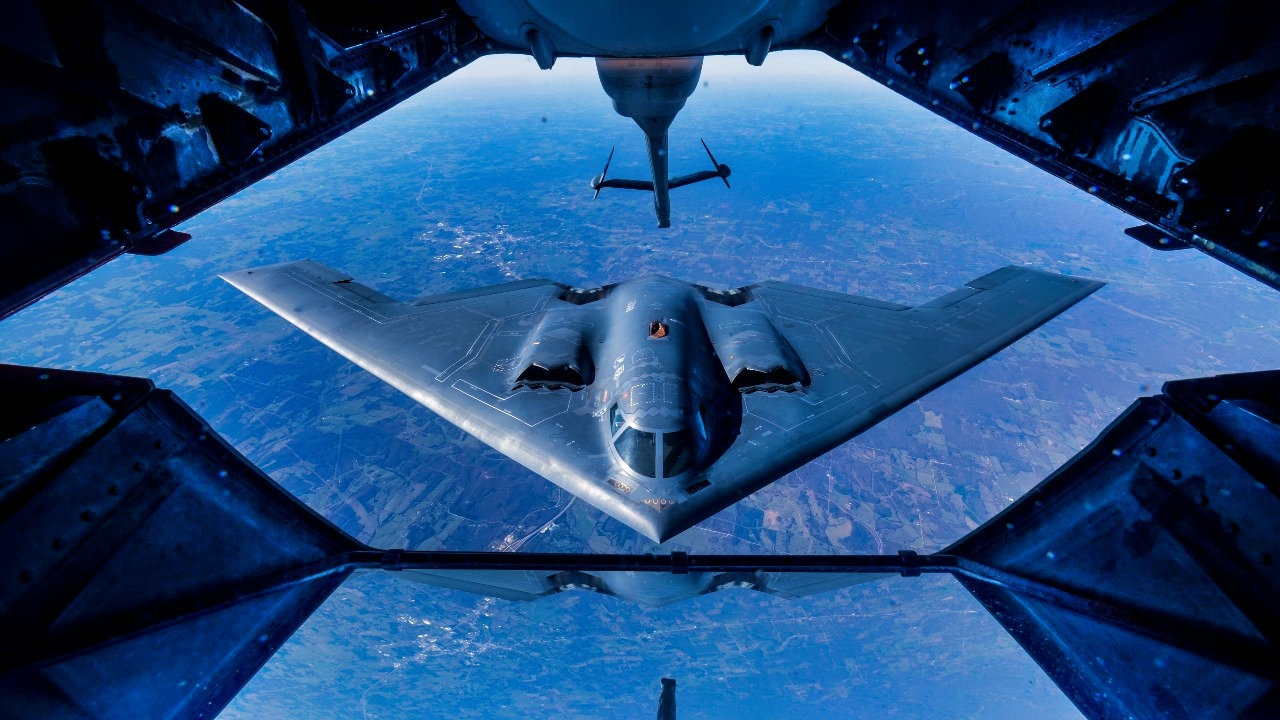
A 2nd Air Refueling Squadron KC-10 Extender from Joint Base McGuire-Dix-Lakehurst, N.J., prepares to refuel a B-2 Spirit, during a training exercise near Kansas, Nov. 10, 2016. The KC-10 Extender is an Air Mobility Command advanced tanker and cargo aircraft designed to provide increased global mobility for U.S. armed forces. Although the KC-l0’s primary mission is aerial refueling, it can combine the tasks of a tanker and cargo aircraft by refueling fighters and simultaneously carry the fighter support personnel and equipment on overseas deployments. (U.S. Air Force photo by Senior Airman Keith James/Released)

A B-2 Spirit assigned to the 509th Bomb Wing flies overhead at RAF Fairford, England, Aug. 25, 2021. The B-2 flyover was part of a Bomber Task Force mission in which aircraft conduct theater and flight training across Europe and Africa. The BTF missions, which have been occurring since 2018, provide theater familiarization for aircrew members and opportunities for U.S. integration with NATO allies and regional partners. The bomber missions enhance readiness and provide the training necessary to respond to any potential crisis or challenge across the globe. (U.S. Air Force photo by Senior Airman Eugene Oliver)
The program never scaled properly, and so the B-2 has been an expensive platform to maintain for all these years.
So, what happened? And how is it impacting today’s force?
Several recent operations have exposed how the B-2’s capability is constrained by its numbers. For example, satellite imagery and open-source reporting indicate at least six B-2s have been deployed to Diego Garcia in the Indian Ocean—roughly one-third of the fleet.
That’s also about one-half of the B-2s considered fully operational. That kind of deployment leaves very few reserved for other contingencies.
Moreover, some reports indicate that of the 19 aircraft, a subset of around a dozen may be ready for combat at any given time due to maintenance and test constraints.
That means mission planners must factor in attrition—from maintenance and accidents to heavy use—resulting in a significantly smaller effective force. The U.S. Air Force cannot depend on 19 B-2s at any one time – period.
The consequences of this are profound.
High-value missions involving the B-2 are carefully reserved, and commanders may avoid exposing them to increased wear, meaning they are, in some respects, not truly operational. B-2s that are not deployed, but which technically could be, serve as more of a deterrent than they do a reliable and usable fighting force.
And if a bomber is lost in combat or grounded for maintenance, the fleet’s ability to surge is limited. And as the global security environment becomes more complex and contested—the Indo-Pacific and Iran, for example—this kind of inflexibility could actually reduce strategic deterrence.

B-2 Spirit stealth bombers assigned to Whiteman Air Force Base taxi and take-off during exercise Spirit Vigilance on Whiteman Air Force Base on November 7th, 2022. Routine exercises like Spirit Vigilance assure our allies and partners that Whiteman Air Force Base is ready to execute nuclear operations and global strike anytime, anywhere. (U.S. Air Force photo by Airman 1st Class Bryson Britt)
The Lessons We Must Learn
The B-2 experience—from its inception to the number of aircraft finally delivered—should present essential lessons for the Air Force and planners. First of all: force density matters. Having a small number of high-end platforms is better than having none at all, but it creates bottlenecks in sortie generation, maintenance scheduling, and risk tolerance. A few aircraft cannot absorb losses or sustain high attrition without severely reducing mission capacity.
Sustainment and availability also matter. Even if the aircraft are technologically unmatched, if only half or fewer are mission-capable at any time, commanders must budget for a reduced effective fleet. Between maintenance cycles and depot throughput, to lifecycle logistics, operational constraints are always going to reduce the fleet size.
In terms of procurement and industrial base implications, there are also lessons to be learned that could affect the upcoming fleet of B-21 Raiders. Designing an aircraft is, after all, only part of the equation.
The U.S. must ensure that the production of a larger number of next-generation bombers is feasible—not just to provide a bigger next fleet, but also to keep up with China’s increasingly aggressive aircraft production.
If the U.S. does not adapt now and if its industrial capacity does not increase, then it is simply a matter of time before China fields more bombers than the United States. First, China will field more technologically inferior aircraft. Then, China will field more technologically comparable aircraft.
After that? Who knows. But it won’t be good for America.
About the Author:
Jack Buckby is a British author, counter-extremism researcher, and journalist based in New York. Reporting on the U.K., Europe, and the U.S., he works to analyze and understand left-wing and right-wing radicalization, and reports on Western governments’ approaches to the pressing issues of today. His books and research papers explore these themes and propose pragmatic solutions to our increasingly polarized society. His latest book is The Truth Teller: RFK Jr. and the Case for a Post-Partisan Presidency.
More Military
The Mach 3 SR-71 Blackbird Spy Plane ‘Broke All the Rules’ Thanks to Titanium
SR-72: The Air Force’s New Hypersonic Bomber?
Russia’s Admiral Kuznetsov Aircraft Carrier Is Now ‘Non-Operational’
New Army M1E3 Tank vs. Russia’s T-14 Armata: Who Wins Summed Up in 2 Words


