


Key Points and Summary – The F-15EX Eagle II lacks stealth, and that label blinded planners to what it does better than any U.S. fighter: haul big magazines fast, high, and often—while running a modern sensor/EW stack.
-With EPAWSS, APG-82, IRST, and open-mission software, the EX is a missile “quarterback” that multiplies the lethality of stealth aircraft and sustains tempo in salvo warfare.
-Kadena’s 2026 beddown is the blueprint: frontline DCA, maritime strike support, and long-range missileer roles.
-The real mistake wasn’t buying the F-15EX Eagle II; it was under-buying it. Expand the fleet, stabilize production, integrate HACM, and let stealth jets focus on the jobs only they can do.
-IMPORTANT: We have a request to the U.S. Air Force to visit with the F-15EX Eagle II down in Florida and interview pilots and flight crews who make this fighter so powerful. We will update our readers as soon as we have more information.
-In the meantime, enjoy original video and photos from our recent visit with the F-15C fighter at the Smithsonian and the U.S. Air Force Museum this year, included in this article.
The F-15EX Eagle II Mistake: The Air Force Needs More Of These Fighters
The F-15EX Eagle II is the most capable heavy fighter the U.S. can field quickly and in numbers—and for years, we treated it like a consolation prize.
I had my doubts, and I do have a warm place in my heart for the F-35; I am clearly on record as saying that it is the best stealth fighter on Earth.
Because it isn’t stealthy, the F-15EX Eagle II got benched in strategy slides and whiplashed in budgets, even as it delivered the three things the force actually needs in bulk: speed, magazine depth, and a proven airframe wired for modern sensors and software. In an era of missile salvos, long-range kill webs, and contested logistics, that combination is not second-tier. It’s the backbone you want when the opening nights in any war get ugly.
This isn’t an anti-stealth sermon; fifth-gen aircraft remain the point of the spear. It’s an argument about balance and mass—and an admission that the Air Force undervalued the EX and lost years it cannot afford.
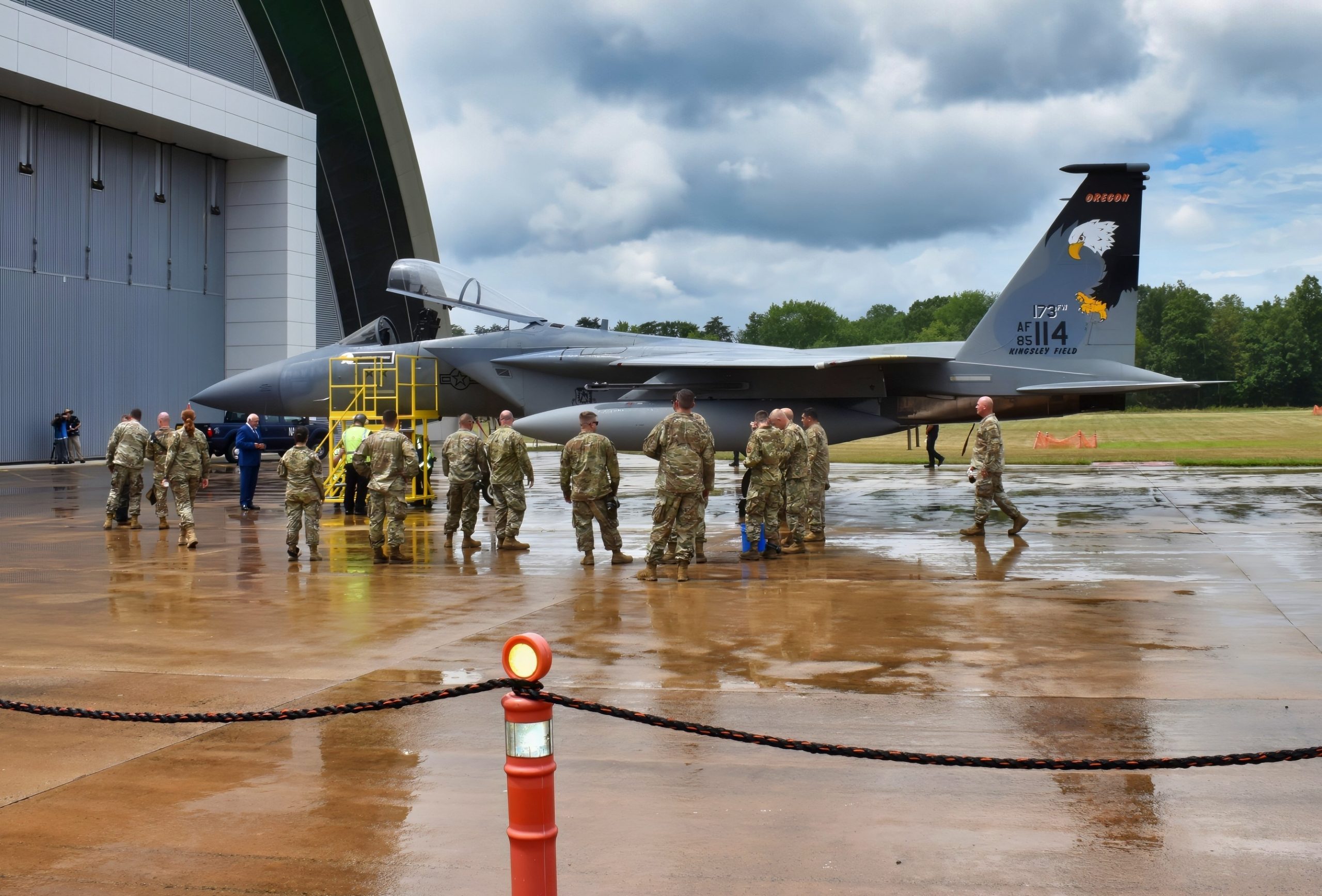
F-15C Fighter Coming in From Last Flight. Image Credit: National Security Journal.
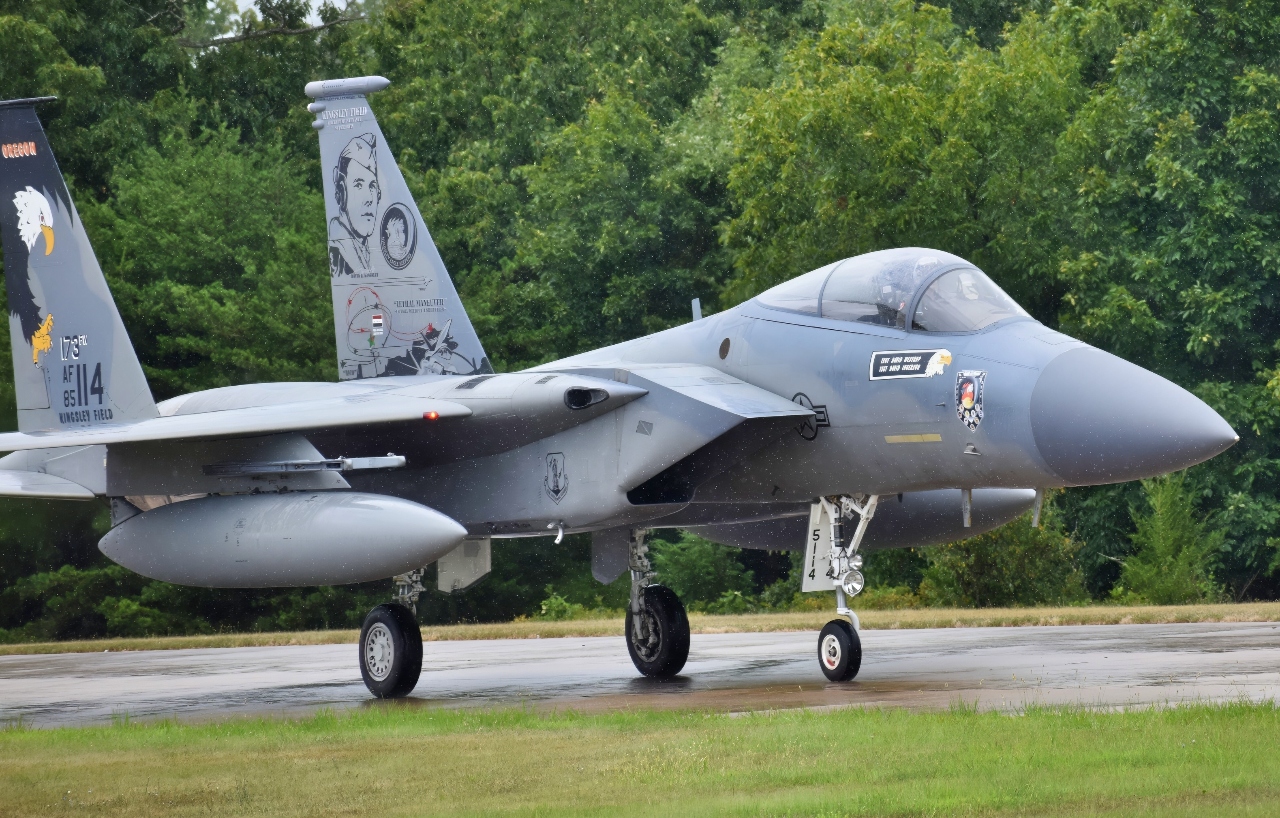
F-15C Fighter on the Tarmac. Image Credit: National Security Journal. Taken on August 13, 2025.
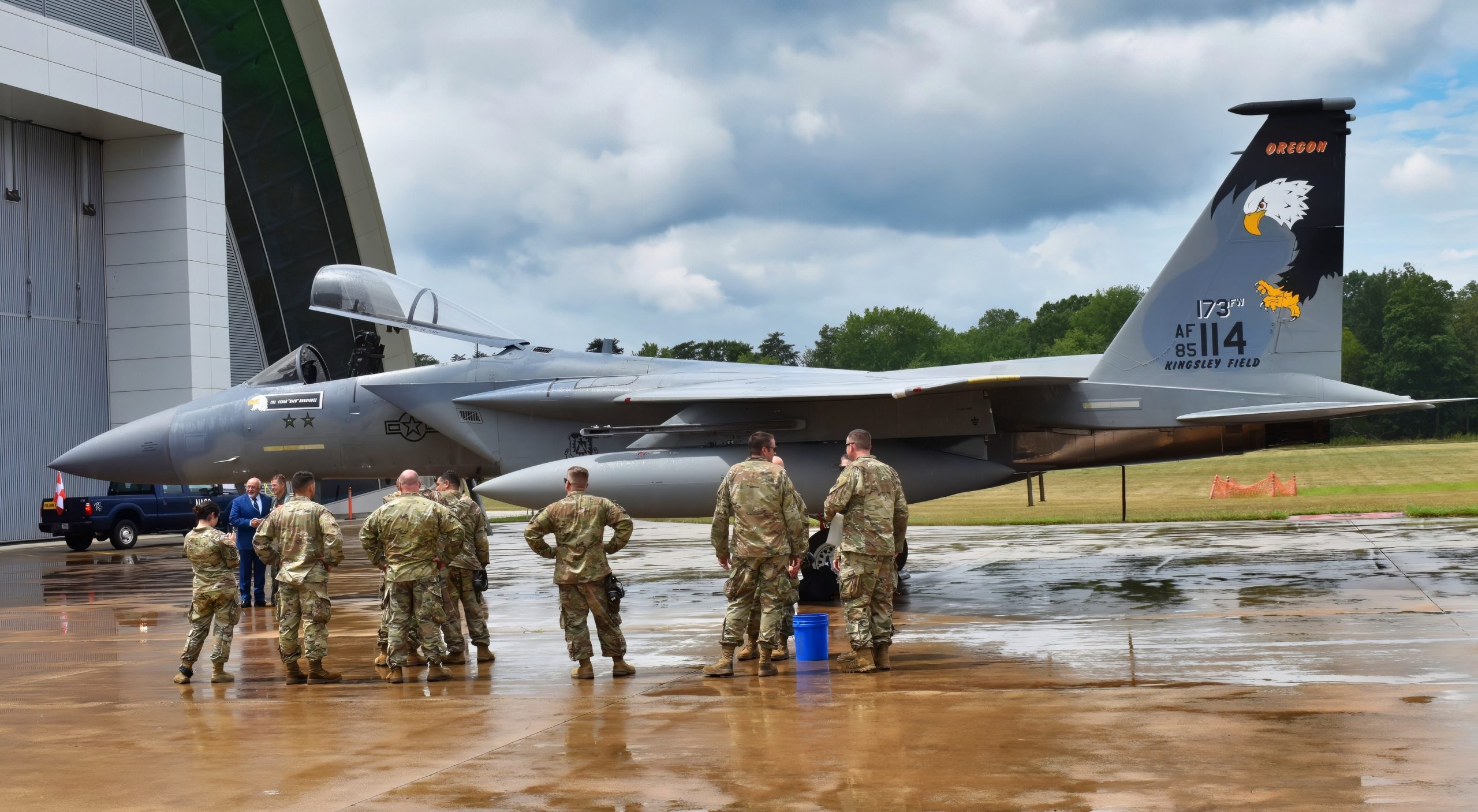
F-15C Fighter with Flight Crew. Image Credit: National Security Journal.
The “No Stealth” Hang-Up Hid the Real Value
The F-15EX inherited a stigma the minute it was proposed: fourth-gen. In an age of VLO, that label suggests “survivability gap.”
I think that’s wrong. Period. But survivability is more than radar cross-section. It’s also standoff, speed, altitude, electronic warfare, formation tactics, and weapon reach—plus the boring but decisive stuff like mission-capable rates and time to field. The EX checks those boxes.
The airframe here matters: a thoroughly modernized Eagle with a 29,500-pound payload, fly-by-wire controls, a massive APG-82 AESA radar, Infrared Search and Track (IRST) via the Legion Pod, and the EPAWSS electronic-warfare suite now in full-rate production.
In air-to-air, the jet can lug double-digit missile loads; in strike, it carries a mix of standoff cruise weapons, anti-radiation missiles, and future large-form stores under its conformal tanks and new pylons. None of that makes the EX a stealth platform—but it does make it the premier U.S. missile magazine that can sprint, climb, and fight while hauling.
Put differently: the EX exists to multiply the lethality of stealth aircraft, not to replace them. When an F-35 or F-22 silently builds the picture and seeds target-quality tracks, the EX turns that picture into volume fires at range.
The Pacific Use Case Is Hiding in Plain Sight
To see how planners actually intend to use the EX, look at Kadena Air Force Base. I did, and it was pretty telling.
Two F-15EXs deployed to Okinawa this summer to set the table for a permanent beddown of 36 jets in 2026. That’s not a nostalgia move; it’s the Air Force acknowledging that a fast, big-magazine fighter with world-class radar/EW is precisely what you want on the frontline of the first island chain.
What does an EX squadron do there?
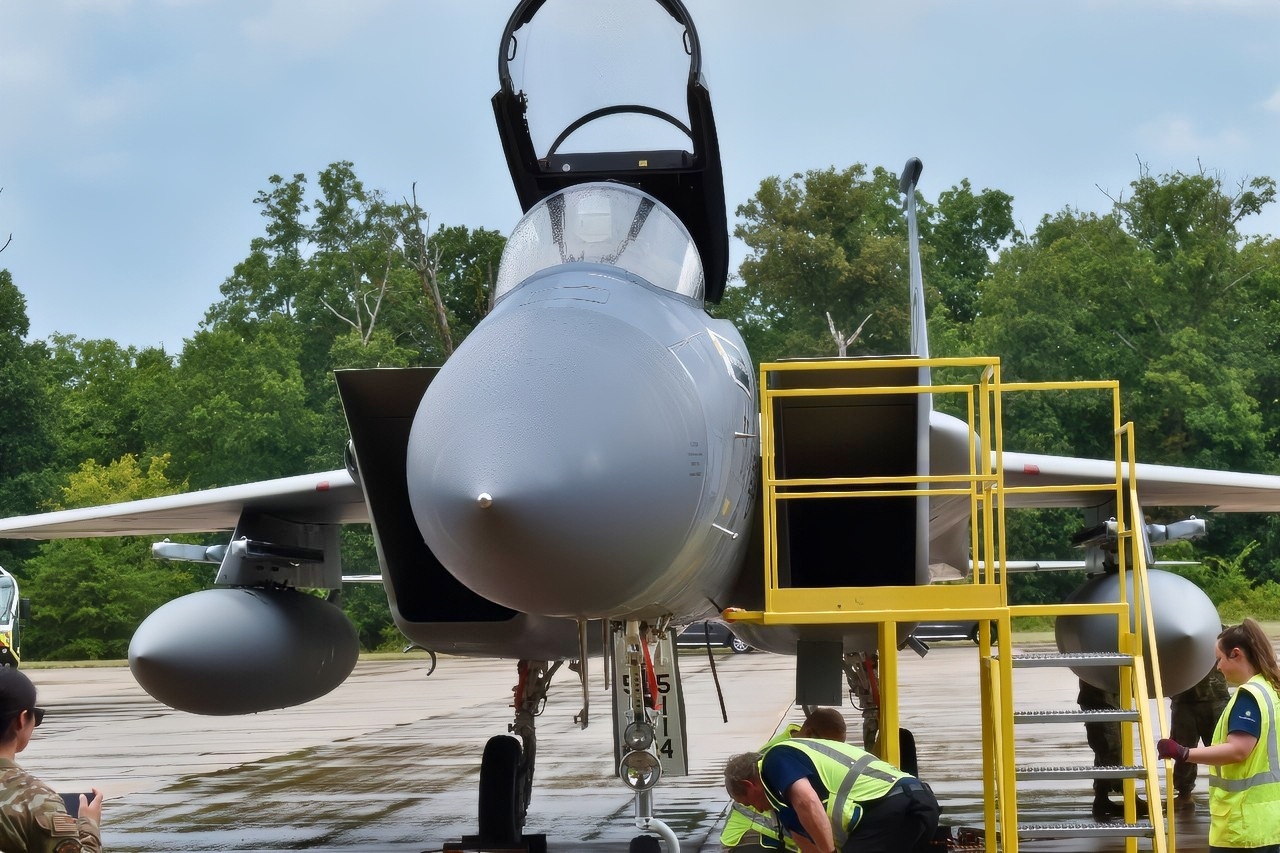
Rain on F-15C Fighter at Smithsonian National Security Journal Photo.
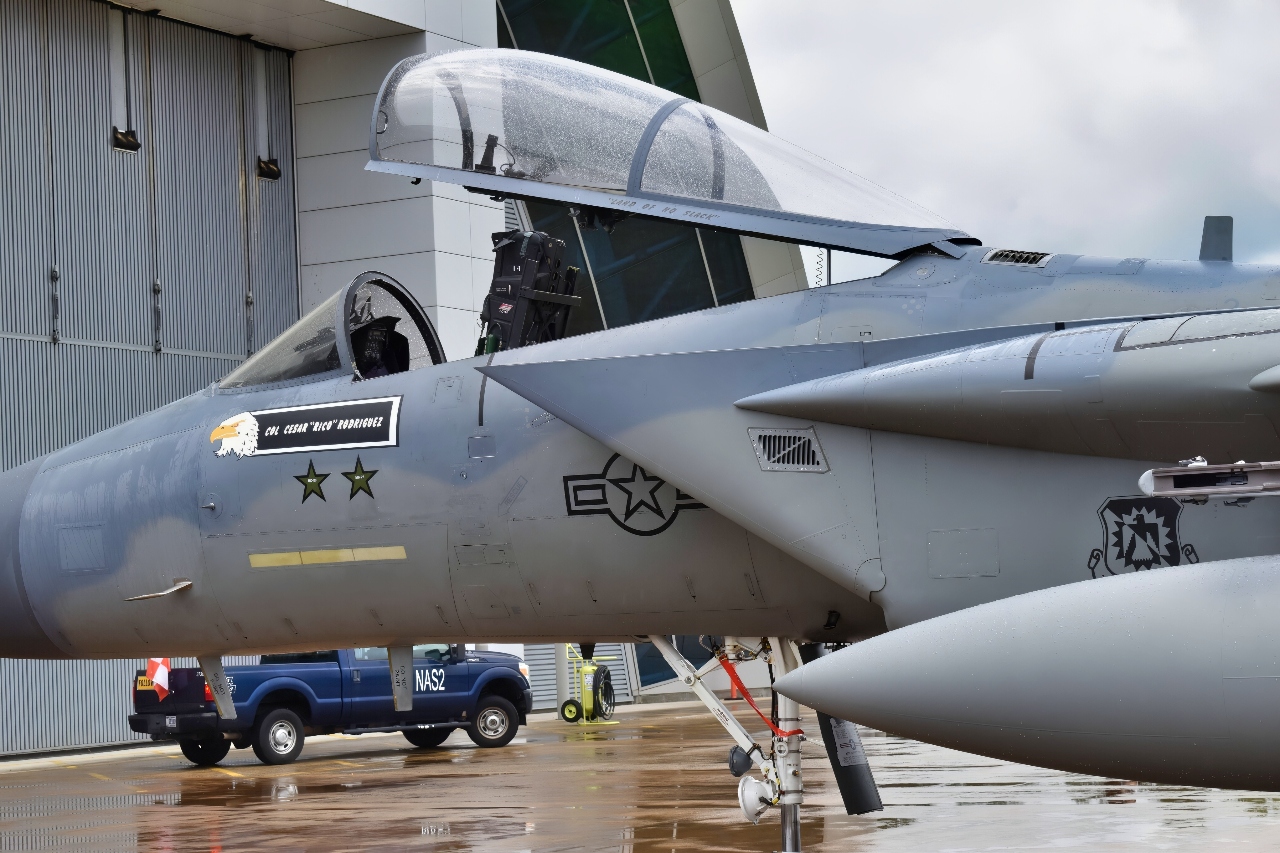
F-15C Fighter at Smithsonian August 13 2025. Image Credit: National Security Journal.
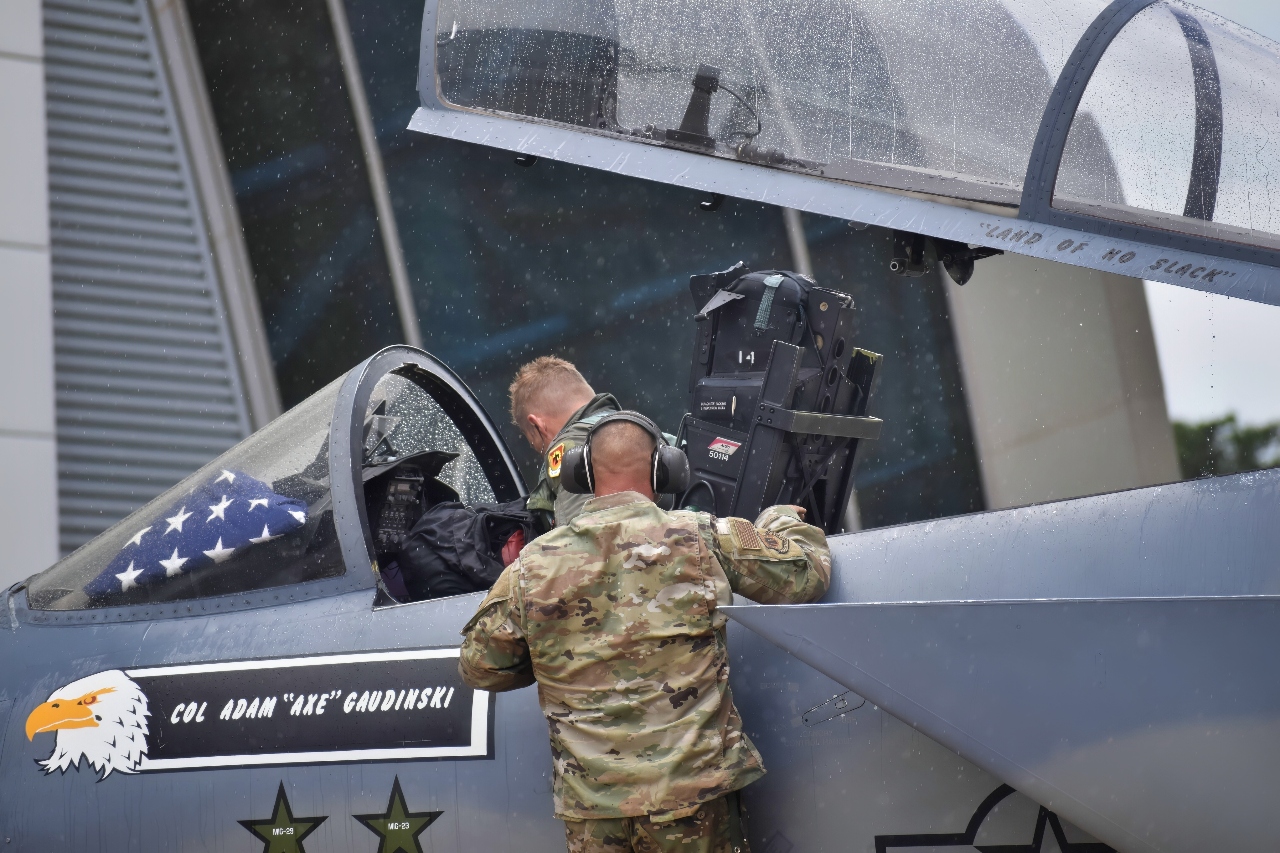
F-15C in the Rain at Smithsonian Outside DC. Image Credit: Brent Eastwood/National Security Journal.
Defensive counter-air with long-stick AMRAAM loads and IRST cueing, stretching the engagement envelope and reducing tanker dependence.
Maritime strike with Block V Maritime Strike Tomahawk from escorts or long-range air-launched weapons guided by the EX’s radar/EW picture—an air-surface team sport.
Air-to-air “missileer” alongside F-22/F-35: stealth finds, EX fires, both survive.
High-tempo alert and surge: the F-15 community already owns this mission set; the EX layers in modern sensors, processing, and jamming.
All of that is directly relevant to China’s mass of aircraft, missiles, and maritime targets—the scenario the Air Force spends most of its waking hours on.
EPAWSS + APG-82: The Software-Defined Shield
Stealth is one way to not get shot. Jamming, deception, and passive cueing are others—and the EX brings them at scale. The AN/ALQ-250 EPAWSS is more than a “defensive system.” It’s a digital EW brain that listens across bands, correlates with the radar/IRST picture, and then denies, deceives, or soaks threats dynamically. It has now cleared full-rate production and is being fielded across both F-15E and F-15EX fleets.
Paired with APG-82, the EX can run long-range search, multi-target tracking, and high-fidelity SAR mapping while supporting off-board weapons and third-party targeting. In a practical sense, that means an EX element can help sanitize a lane, feed surface and air shooters, and self-protect without wearing a stealth cloak. Add IRST and you have a non-emitting way to sniff hot metal at long range—a big deal in a jamming-heavy fight.

A F-15EX assigned to the 85th Test and Evaluation Squadron, Eglin Air Force Base, Florida, flies behind a KC-135 assigned to the 465th Air Refueling Squadron, Tinker AFB, Oklahoma, Oct. 15, 2021. In-air refueling allows fighter aircraft to stay airborne for longer periods of time without having to land to refuel. (U.S. Air Force photo by 2nd Lt. Mary Begy)

Image Credit: US Air Force.

The F-15EX, the Air Force’s newest fighter aircraft, arrives to Eglin Air Force Base, Florida March 11. The aircraft will be the first Air Force aircraft to be tested and fielded from beginning to end through combined developmental and operational tests. The 40th Flight Test Squadron and the 85th Test and Evaluation Squadron personnel are responsible for testing the aircraft. (U.S. Air Force photo/Samuel King Jr.)
No, this doesn’t make the EX invulnerable inside the densest SAM rings. It makes it useful and survivable at the ranges and roles where massed firepower matters most.
Magazine Depth Wins Salvo Wars
The next war will reward whoever generates more ready weapons on the right axis sooner. That is a magazine problem, not a stealth problem. The EX is built to carry a lot and often:
Air-to-air mass: double-digit AMRAAM loads to overwhelm defenses or cover a wide frontage on DCA. This capabilites I have always said is truly something the Air Force needs to stress.
SEAD/DEAD: AGM-88 family, future stand-in/stand-off combos to peel back air defenses without depleting scarce stealth tails.
Long-range strike: JASSM-ER class weapons today; a path to HACM (Hypersonic Attack Cruise Missile) tomorrow as the program moves into flight testing.
The kicker is sortie tempo. The EX’s maintenance concept, open-mission software, and shared Eagle logistics translate into high availability—exactly what you need when a campaign turns into a sustained salvo competition.
The Budget Ping-Pong Was the Real Mistake on F-15EX Eagle II
The Air Force originally pitched a modest EX buy to replace dying F-15C/Ds; then the total yo-yoed as leaders prioritized fifth-gen fleets. I say that’s the big mistake we need to highlight here.
More recently, Congress and the service have nudged those numbers back up, with proposals and additions beyond the notional 98-jet planning figure (we are currently looking at 129)—enough to hint at a shift in thinking, but not enough to saturate the missions crying out for EX capacity. Meanwhile, labor disruptions and supply-chain hiccups have slowed deliveries just as basing decisions—Kadena first, Guard units next—are finally locking in.
The problem with indecision isn’t just optics. Production lines, training pipelines, and depot plans all thrive or falter based on predictability. The fastest way to turn “good enough” into “too late” is to keep changing the buy. That’s the sting in the title: we undervalued the EX, and we sent the worst possible signal to the industrial base.
“But It’s Not Stealthy.” Correct—and That’s Why You Can Afford It.
This drives me totally crazy. Yes, stealth rocks. But nothing ever enemy ‘nail’ needs a stealth ‘hammer‘.
A sober, grown-up force design has tiers:
Stealth to kick doors (F-22, F-35, B-21).

Afterburners are lit as an F-22 Raptor performs an aerial demonstration at the New York Air Show at Montgomery, New York, Aug. 23, 2025. The rapid change in angle of attack causes visible vapor to form around the aircraft, giving spectators a clear view of the jet’s aerodynamic performance. This demonstration highlights the unique thrust-vectoring capabilities of the F-22, allowing it to achieve extreme agility unmatched by other fighter aircraft. (U.S. Air Force photo by Staff Sgt. Lauren Cobin)
Standoff mass to exploit openings (F-15EX, B-52, surface/subsurface shooters).
Enablers (tankers, ISR, command-and-control, EW, and space).
Trying to buy stealth for every task is how you get too few tails and too many gaps. The EX provides fifth-gen sensors and EW effects, riding on a cost-controlled airframe, with parts, maintainers, and training pipelines that already exist.
As the Air Force leans into E-7 Wedgetail, KC-46, and space-based C2, the EX slots into a software-centric kill web as a high-end conventional hauler—the truck you always need more of when the war gets real.
The Future Weapon Fit Is the Payoff
The most exciting thing about EX isn’t what it carries today—it’s what it can absorb next. Open Mission Systems make adding new seekers, datalinks, and weapon interfaces less like brain surgery and more like adding an app. As HACM matures and standoff maritime effects scale, the EX’s speed, altitude, and pylon clearance make it a natural testbed and early fielding platform. Think multi-mode anti-ship, cooperative EW, and long-range air-to-air where a few stealth jets create the picture and a dozen EXs empty their racks.
Pair that with EPAWSS growth and the platform gets more survivable over time—a refreshing change from the usual curve where threats get smarter and non-stealth airframes get squeezed.
Homeland Defense, Alert, and Surge: The Non-Sexy Missions That Decide Wars
There’s a second place the EX shines that rarely makes strategy decks: the missions you can’t not do.

F-15 Fighter at US Air Force Museum National Security Journal Photo. Taken on 7/19/2025 in Dayton, Ohio.
Homeland DCA and NORAD commitments need long-range radar, heavy missile loads, and reliable alert.
Expeditionary alert at hubs across Europe and the Middle East consume forces even when the Pacific is priority one.
Training pipelines for weapons instructors, test units, and aggressors must keep turning.
Every stealth jet pulled into one of those duties is a stealth jet not training for the first 72 hours of a high-end fight. The EX keeps those obligations covered without cannibalizing fifth-gen readiness.
What “Expand Dramatically” Should Look Like
If we’re serious, the path is straightforward:
Lock the buy well beyond the legacy replacement number—enough to fully equip Kadena (two squadrons), three to four ANG wings, and at least two Active-Duty squadrons tied to Pacific and EUCOM surge plans.
Stabilize production with multi-year procurement so Boeing and suppliers can hire, train, and deliver predictably.
Accelerate EPAWSS fielding and IRST integration across the entire EX fleet to a common software baseline, minimizing tail-to-tail variance.
Fund HACM integration on the EX explicitly, with test range time and weapons buys that let squadrons train to the tactic, not power-point it.
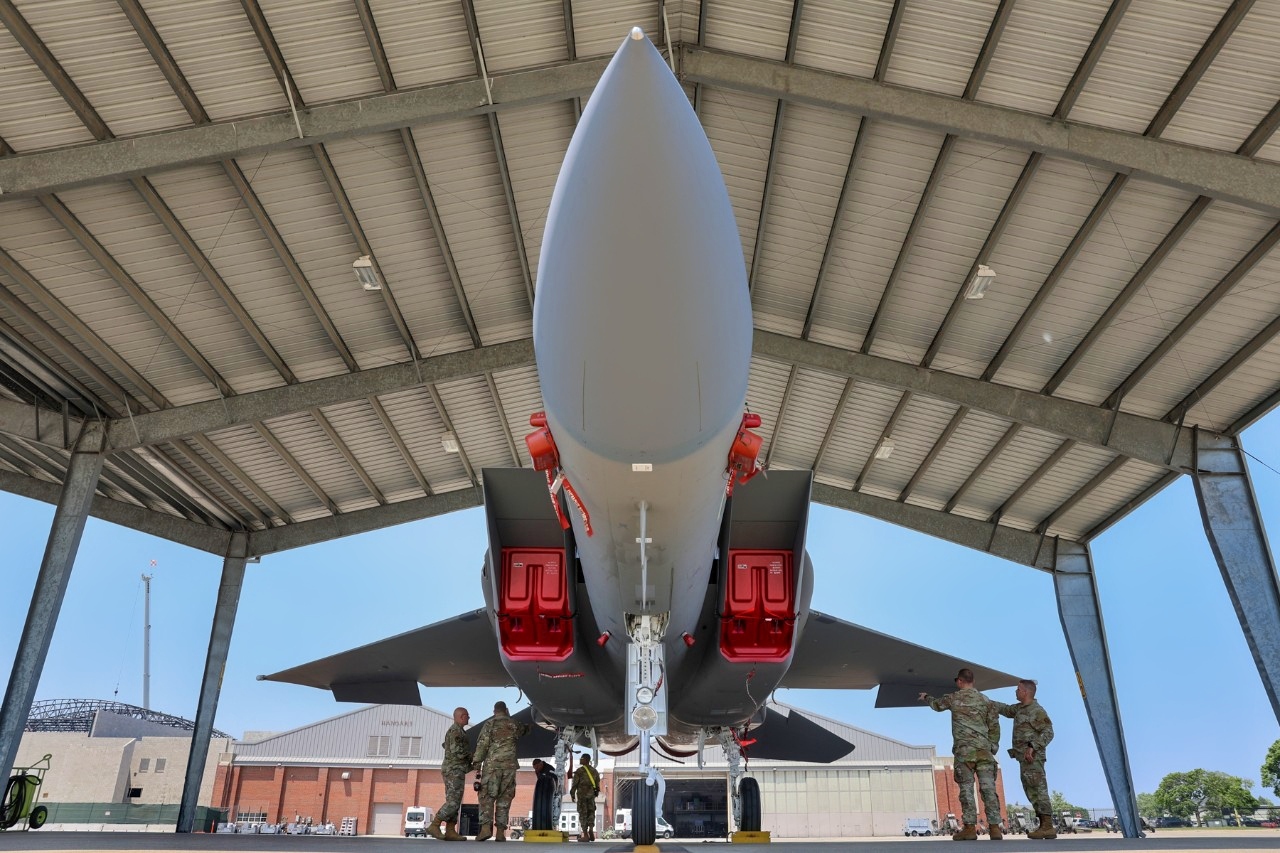
An F-15EX Eagle II from the Defense Contracting Management Agency Boeing St. Louis, sits on the flight line at Selfridge Air National Guard Base, Michigan, June 11, 2025. The aircraft visited the base as part of a site activation task force, an initial step to prepare the 127th Wing with the right infrastructure, personnel, and support the incoming F-15EX and KC-46 Pegasus missions . (U.S. Air National Guard photo by 1st Lt. Elise Wahlstrom)
Tie basing to tankers and E-7 so EX squadrons live inside a coherent kill web from day one.
Do that, and “non-stealth” becomes a feature, not a bug: lethal mass at sustainable cost.
Bottom Line: We Treated the EX Like an Apology. It’s Actually the Answer to the Mass Problem.
The F-15EX isn’t a museum piece in new paint. And as you know, I love a good Air Force Museum piece.
It’s a software-defined heavy fighter that happens to sit on an airframe we already understand. It brings magazine depth, EW brains, ridiculous payload, and speed to a fight that increasingly looks like distributed salvos over vast distances. The Air Force’s hesitation—born of a justifiable love for stealth—left capacity on the table and time on the floor.
That’s the sting. The fix is simple: buy more EXs now, integrate the next generation of standoff weapons, and let your stealth jets do the jobs only they can do. When the first week starts, you’ll want as many fast missile trucks with smart jammers as you can launch.
The F-15EX was never the wrong airplane. It was the undervalued one. The good news is that I think this is really fixable.
About the Author: Harry J. Kazianis
Harry J. Kazianis (@Grecianformula) is Editor-In-Chief and President of National Security Journal. He was the former Senior Director of National Security Affairs at the Center for the National Interest (CFTNI), a foreign policy think tank founded by Richard Nixon based in Washington, DC. Harry has over a decade of experience in think tanks and national security publishing. His ideas have been published in the NY Times, The Washington Post, The Wall Street Journal, CNN, and many other outlets worldwide. He has held positions at CSIS, the Heritage Foundation, the University of Nottingham, and several other institutions related to national security research and studies. He is the former Executive Editor of the National Interest and the Diplomat. He holds a Master’s degree focusing on international affairs from Harvard University.
More Military
Canada’s F-35 Fighter Program Has Passed the Point of No Return
USS Oriskany: The Navy Essex-Class Aircraft Carrier That Was Sunk On Purpose
Nimitz-Class Nuclear Aircraft Carrier USS John C. Stennis ‘Out Action’ for 5 Years
Australia’s Mogami-Class Frigate Buy from Japan Is a Big Deal
The F-14 Tomcat Fighter Could Stop Enemy Tanks In Their Tracks


