


A former U.S. Navy EA-18G Growler pilot said an autopilot tried to kill him on carrier landing 101 after 100 perfect autopilot-assisted carrier landings. Adam Daymude was quoted as saying the auto throttle “tried to kill me by pulling power at the exact moment that I needed to add power.” Daymude estimated the autopilot failure rate at approximately 1% of carrier landings. U.S. Navy pilots primarily land manually on aircraft carriers despite the availability of advanced autopilot systems.
Why U.S. Navy Pilots Won’t Use Autopilot to Land on Aircraft Carriers
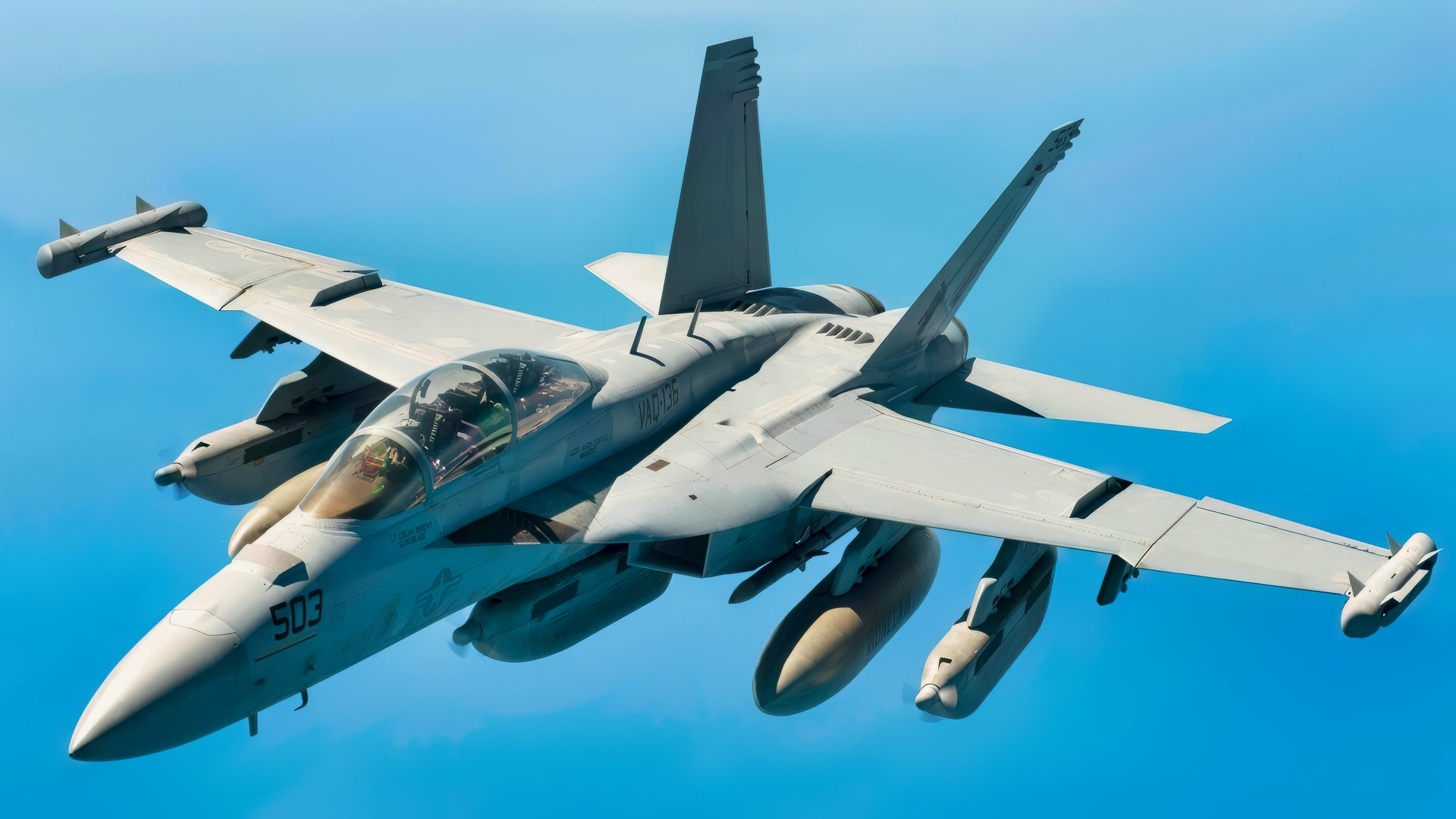
A U.S. Navy EA-18G Growler assigned to the USS Carl Vinson breaks away from a U.S. Air Force KC-135 Stratotanker from the 909th Air Refueling Squadron after conducting in-air refueling May 3, 2017, over the Western Pacific Ocean. The 909th ARS is an essential component to the mid-air refueling of a multitude of aircraft ranging from fighter jets to cargo planes from different services and nations in the region. (U.S. Air Force photo by Senior Airman John Linzmeier)

A joint test team including the Flight Test Division of the French Directorate General of Armaments (DGA/EV), the French Naval Aeronautics Experimentation Center (CEPA/10S), and the U.S. Navy’s Air Test and Evaluation Squadron (VX) 23 are leading flight tests that will enable the French fighter jet Dassault Rafale to aerial refuel with naval aviation’s F/A-18 Hornet and Super Hornet and EA-18G Growler. The tanker qualification partnership paves the way for an extended reach and enhanced interoperability for allied airpower. (U.S. Navy photo by Erik Hildebrandt) Erik_Hildebrandt
The U.S. Navy has systems capable of guiding an airplane in for a landing—some aircraft can land completely on autopilot.
The very first airplane autopilot system was developed in 1912, only nine years after the Wright Brothers’ historic first powered flight—and long before anyone thought about flying a jet aircraft, let alone taking off from a Navy ship. Lawrence Burst Sperry was the American engineer who developed the system.
Navy pilots may now use advanced, automated systems such as the Joint Precision Approach and Landing System or software-based Precision Landing Modes—also known as “Magic Carpet.” These systems enable hands-off or assisted, high-precision autolandings on aircraft carriers using a tailhook and arresting wires.
When the Magic Carpet autopilot is engaged, the plane will fly on a 3-degree glideslope to the carrier deck regardless of wind and other conditions outside, according to reporting by USNI News.
By calculating the carrier’s movement while sailing over the ocean, Magic Carpet accurately predicts the location of the landing place by the time the fighter reaches it.
These systems, along with the traditional optical landing system and guidance from a landing signal officer, enable safe carrier traps.
However, naval aviators primarily land manually to maintain essential airmanship skills for combat. Autopilot can fail in turbulent weather conditions or during high-stress, dynamic scenarios, such as a pitching deck.
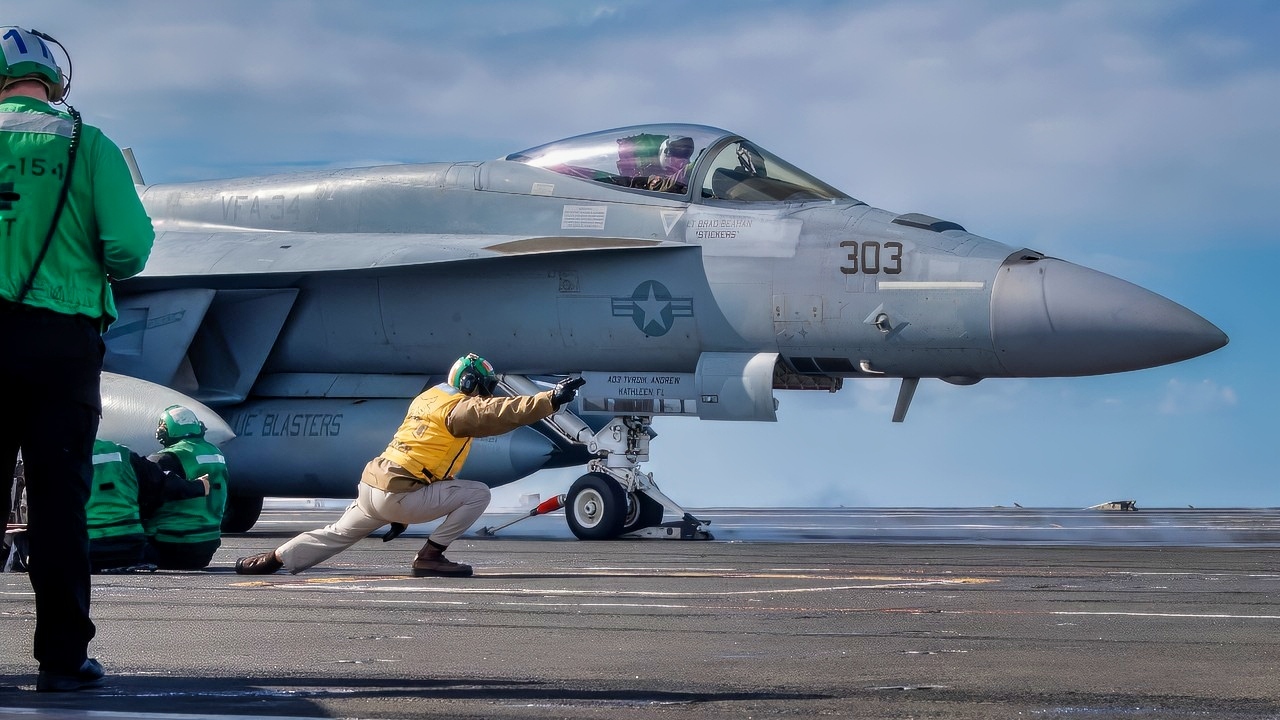
U.S. Navy Lt. Andrew Bentley signals an F/A-18E Super Hornet, assigned to the “Blue Blasters” of Strike Fighter Squadron (VFA) 34, to launch from the flight deck of the Nimitz-class aircraft carrier USS Theodore Roosevelt (CVN 71), Nov. 30, 2023. Theodore Roosevelt, the flagship of Carrier Strike Group Nine (CSG 9), is conducting integrated training exercises in the U.S. 3rd Fleet area of operations. (U.S. Navy photo by Mass Communication Specialist 3rd Class Adina Phebus)
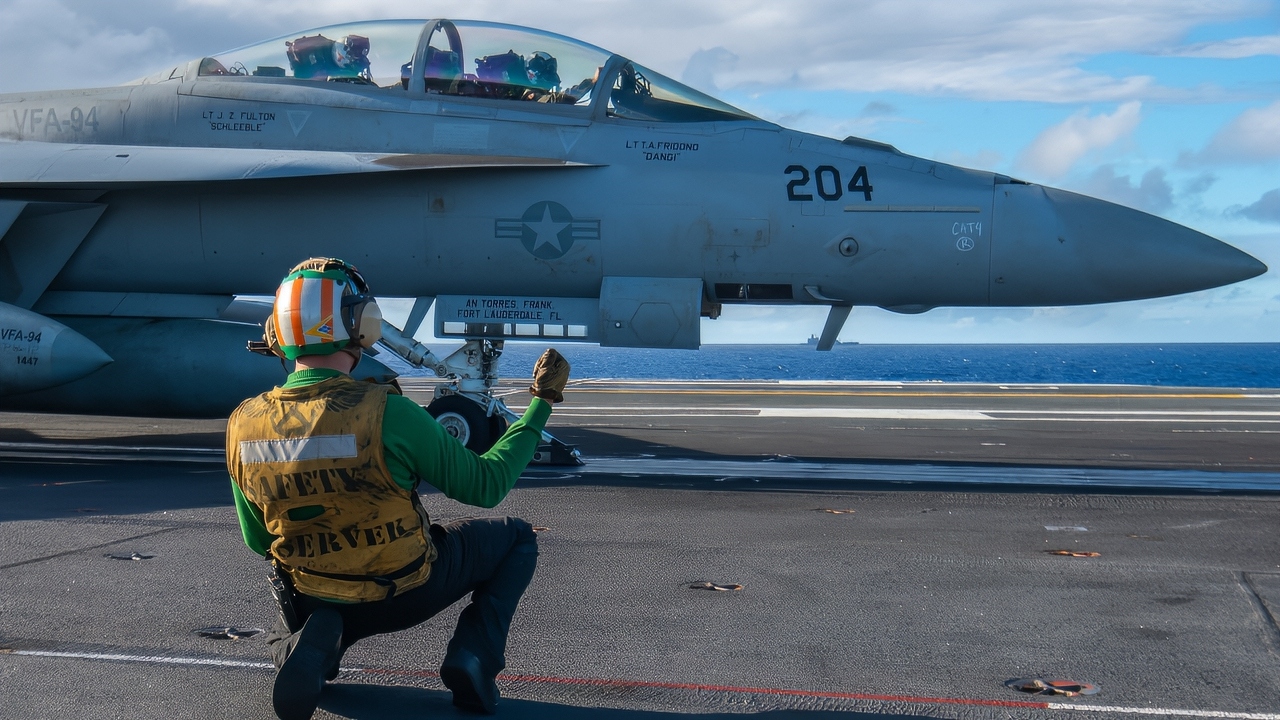
(Dec. 31, 2022) An F/A-18E Super Hornet assigned to the “Mighty Shrikes” of Strike Fighter Squadron (VFA) 94 prepares to launch from the aircraft carrier USS Nimitz (CVN 68) to participate in a long-range maritime strike demonstration. Nimitz is in 7th Fleet conducting routine operations. 7th Fleet is the U.S. Navy’s largest forward-deployed numbered fleet, and routinely interacts and operates with 35 maritime nations in preserving a free and open Indo-Pacific region. (U.S. Navy photo by Mass Communication Specialist 2nd Class Justin McTaggart)
Lieutenant Commander Matthew Dominick, a test pilot in the carrier suitability flight test department of the VX-23 Air Test and Evaluation Squadron, said that while “I am still uncomfortable with how few inputs I’m making,” the system has earned his trust. This was especially true once he started intentionally off-nominal passes.
Landing On A Aircraft Carrier, Aim For The One In The Middle:
Adam Daymude, a former Navy EA-18G Growler pilot, was quoted on Quora as saying that pilots do not trust autopilots for landings on aircraft carriers:
“There is an inherent refusal to accept autopilot as the method for recovery with Navy pilots. I will be the first to stand up and say, ‘Hell, no!’ On a nice, calm day with natural wind of 25 knots or so, the autopilot is amazing. It fails spectacularly under other conditions.”
As Daymude and other pilots argue, the autopilot struggles with the complex, non-repeatable conditions of a moving flight deck and turbulent airflow:
“A pilot will look at the wake and will know what that wake means for landing. I’m here to tell you that unless they’ve massively improved auto-recoveries in the ten years I’ve been out, I would never trust full autopilot.”
Auto-throttle or automatic systems can fail in critical moments, such as pulling power when it is needed to increase speed—this can be fatal:
“Setting auto-throttle, which will try to keep you at speed, was a bust. I flew auto throttle for half a cruise… around 100 landings, and no problems. On landing 101, the auto throttle tried to kill me by pulling power at the exact moment that I needed to add power. So, 1 percent of the time, my trusty steed is going to try and kill me.”
On final approach, Navy pilots aim for the middle arresting wire, which is either the second or third, depending on the carrier’s configuration.
Once the aircraft touches down, the pilot holds the throttles at full power for 3 seconds. This is done to keep the engines spooled and provide thrust in case a bolt occurs—meaning the plane misses every wire—or a cable snaps.
Afterward, the pilot reduces the engine to idle, and the hook is raised on the aircraft director’s signal.
Manual Landing Is Safer Than Auto Pilot Landings:
Daymude argues that manual aircraft landings on carriers are safest:
“Manual landings are still the safest way to recover. We’ve tried, in particular, I, working with our simulator software development team to build an algorithm that works in all situations.
“How do you tell a software engineer why you added power at a specific moment when it didn’t look like you needed it, but turned out to be the right correction at the time? I literally shrugged my shoulders and said, “I don’t know! The plane seemed to want to descend.” That’s called seat of the pants, and you can’t model it easily.”
Manual landings are considered the ultimate test of a naval aviator and are necessary to maintain high-level proficiency.
Pilots must be able to use visual cues—the optical landing system, lineup, and angle of attack—to ensure a safe landing.
About the Author: Steve Balestrieri
Steve Balestrieri is a National Security Columnist. He served as a US Army Special Forces NCO and Warrant Officer. In addition to writing on defense, he covers the NFL for PatsFans.com and is a member of the Pro Football Writers of America (PFWA). His work was regularly featured in many military publications.


