

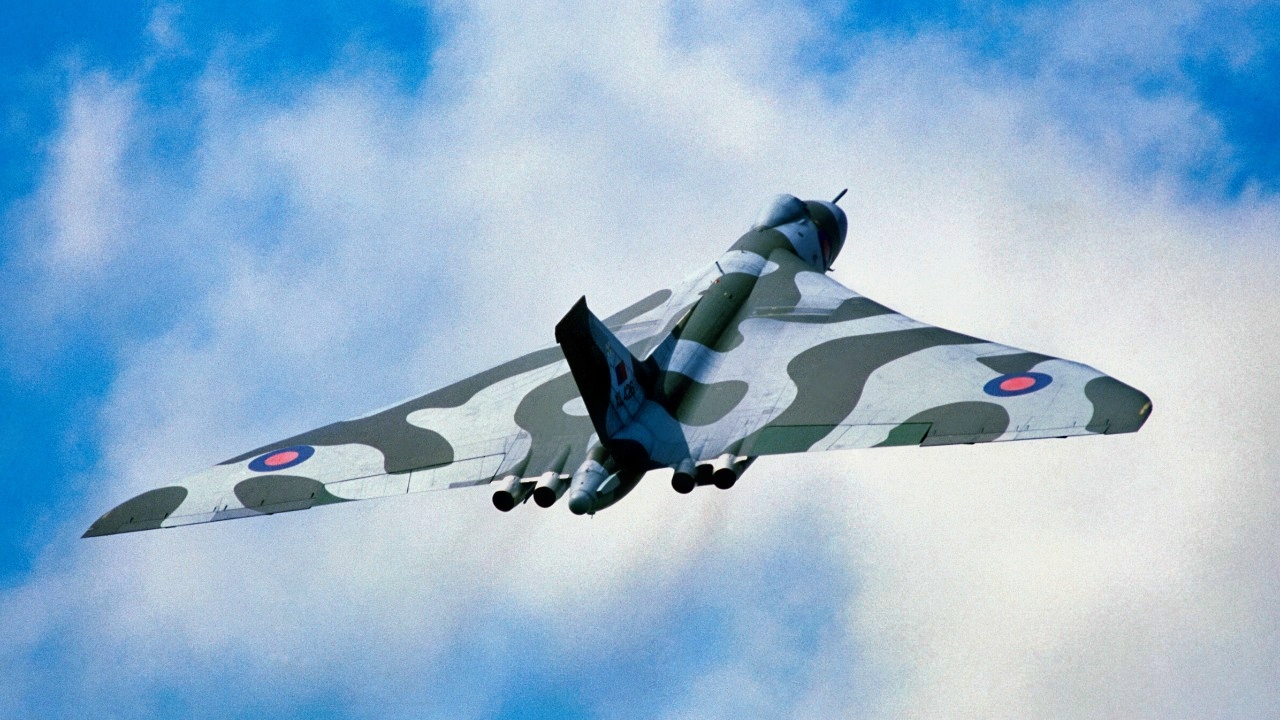
Key Points and Summary – The Avro Vulcan was a British high-altitude, long-range strategic bomber, renowned for its distinctive, massive delta-wing design.
-Developed in the late 1940s and entering service in 1956, it formed the core of the UK’s “V-bomber” nuclear deterrent force during the Cold War, initially tasked with carrying Britain’s first atomic bomb, the Blue Danube.
-Though designed for high-altitude nuclear strikes, its most famous combat mission was “Operation Black Buck” during the 1982 Falklands War, where it conducted some of the longest bombing raids in history.
-The Vulcan was retired in 1984, but remains an icon of British aviation engineering.
The Avro Vulcan Bomber Made History
The advent of nuclear bombs revolutionized warfare forever. With the nuclear arms race in full force after World War II, the newly formed NATO and Warsaw Pact sought to create bombers that could carry these new nuclear bombs.
The British answer to this new problem was the Avro Vulcan (later called the Hawker Siddeley Vulcan).
The Vulcan was an important component of the UK’s V-Force, a formation of nuclear-capable bombers manufactured by the UK. While not as widely remembered as other Cold War strategic bombers, the Vulcan was an integral part of the UK’s strategic deterrence strategy for its time.
Design and Capabilities
The origins of the Vulcan trace back to 1947, when the British Air Ministry issued Specification B.35/46. This called for a new type of bomber that could fly at high altitudes, cover long distances, and deliver nuclear weapons deep into enemy territory.
Avro’s design team, led by Roy Chadwick and later Stuart Davies, proposed a radical aircraft featuring a delta wing configuration, which was still largely experimental at the time. The prototype, known as the Avro 698, took to the skies for the first time in 1952. Its sleek, futuristic appearance and innovative aerodynamics marked a significant departure from the conventional bomber designs of the era.
In 1953, the aircraft was officially named the Vulcan, continuing the RAF tradition of naming bombers after mythological figures.
The Vulcan’s delta wing was its most distinctive feature, offering excellent lift and stability at high altitudes while also allowing for a large internal bomb bay.
This design enabled the aircraft to carry the Blue Danube, Britain’s first operational nuclear bomb. Powered by four Rolls-Royce Olympus turbojet engines, the Vulcan could reach speeds exceeding 600 miles per hour and operate at altitudes up to 55,000 feet. Its avionics suite was advanced for its time, including radar navigation, electronic countermeasures, and an autopilot system.
The crew of five—pilot, co-pilot, two navigators, and an electronics officer—operated in a pressurized and heated cockpit, allowing for extended missions in the upper atmosphere.
Britain’s Most Advanced Strategic Bomber
The Vulcan entered service with the Royal Air Force in 1956, forming a key part of the UK’s strategic nuclear deterrent alongside the Vickers Valiant and Handley Page Victor. These three aircraft collectively became known as the V-bomber force.
The Vulcan’s primary mission was to deliver nuclear weapons in the event of a Soviet attack, operating under the doctrine of mutually assured destruction. Throughout the 1960s, the aircraft was upgraded to carry more advanced nuclear payloads, including the Yellow Sun and later the WE.177 series. Around 136 of Vulcans were manufactured, making it an integral part of the UK’s nuclear deterrence.
As Soviet air defenses became more sophisticated, the RAF recognized that high-altitude bombing was increasingly vulnerable to interception. In response, the Vulcan was adapted for low-level penetration missions, flying beneath radar coverage to evade detection.
This shift in tactics required structural modifications and new training protocols, but the Vulcan proved to be a flexible and capable platform even in this new role.
The Avro Vulcan in Service
Although designed primarily as a nuclear bomber, the Vulcan also demonstrated versatility in conventional roles. It was used for reconnaissance, electronic warfare, and even as an aerial refueling tanker in its later years. However, its most famous combat role came in 1982 during the Falklands War.
Despite being on the verge of retirement, the Vulcan was called into action for Operation Black Buck, a series of long-range bombing missions targeting Argentine positions on the Falkland Islands. These missions, launched from Ascension Island, required complex aerial refueling operations and covered nearly 8,000 miles round trip.
The first raid successfully cratered the runway at Port Stanley, demonstrating the RAF’s global reach and the Vulcan’s enduring capabilities. While the strategic impact of the raids was debated, they served as a powerful psychological tool and a testament to British resolve.
Retirement and Legacy
The Vulcan was gradually retired from frontline service in the 1980s, replaced by more modern and smaller aircraft such as the Panavia Tornado. The last operational Vulcans were withdrawn in 1984, although a few were retained for training and display purposes.
One aircraft in particular, Vulcan XH558, was restored to flying condition in the early 2000s and became a beloved fixture at airshows across the UK until its final flight in 2015. Its thunderous engine roar and graceful flight captivated audiences and rekindled public interest in Britain’s aviation heritage.
The Avro Vulcan left an endearing legacy that has persisted long after its retirement. It was one of Britain’s most advanced bombers and pushed the boundaries of aircraft design, particularly in the use of delta wings and high-speed flight dynamics.
It also played a crucial role in maintaining deterrence during the Cold War, serving as a visible and credible deterrent against nuclear aggression.
The Vulcan symbolized a period when Britain sought to assert its global influence through technological innovation and strategic capability. It was also the end of an era, as the UK would cease to field strategic bombers shortly after the Vulcan’s retirement.
The Vulcan became an icon of British engineering. Its futuristic silhouette and powerful presence made it a favorite among aviation enthusiasts and a source of national pride. It appeared in films, documentaries, and countless airshows, leaving a lasting impression on generations of viewers.
While the aircraft served a shorter lifetime than its contemporaries like the American B-52, the Vulcan served as an important cornerstone in Britain’s nuclear deterrence strategy.
About the Author:
Isaac Seitz, a Defense Columnist, graduated from Patrick Henry College’s Strategic Intelligence and National Security program. He has also studied Russian at Middlebury Language Schools and has worked as an intelligence Analyst in the private sector.
More Fighters
China’s J-20 Stealth Fighter Looks Like a Powerhouse
China’s White Emperor Space Fighter Looks Fake
China’s Aircraft Carriers Have Arrived (Just Not Nuclear Carriers)


pagar
June 28, 2025 at 8:32 am
The real hero of the 1982 war.
The real hero was the argentine air force.
The argentine air force sank several or numerous royal Navy vessels and warships.
Including landing craft and destroyers. And support ships.
While using aging aircraft and unreliable or obsolete munitions.
One warship sunk was the HMS Sheffield, Another was the HMS Antelope.
One extremely and very completely useful and totally unforgettable lesson imparted by the argentine air force in 1982 (today still ignored or not impressed by many) was the fact that british sailors were forced to lash machine guns to ships’ rails as impromptu point defense against low-level air attacks.
That was how good the argentine air force was. In 1982.
Today, many navies still equip their very latest warships with just a couple of point defense anti-air gatlings.
What ARE THEY THINKING !!!
THE ENEMY WILL only SEND A COUPLE OF attack drones or aircraft or missiles for combat during a mission ???
How stupid could you get.