


Key Points and Summary – The U.S. Air Force is undertaking a comprehensive modernization of its B-52 Stratofortress fleet, transforming the venerable Cold War bomber into the B-52J variant to keep it flying into the 2050s.
-A key upgrade is replacing the aging engines with new, fuel-efficient Rolls-Royce F130s.

A U.S. Air Force B-52H Stratofortress strategic bomber assigned to the 69th Expeditionary Bomb Squadron flies within the U.S. Central Command area of responsibility, Nov. 15, 2024. The B-52H provides strategic options and flexibility to U.S. and coalition senior leaders with the aircraft’s ability to employ a wide range of weapons with precision and deliver a decisive response to adversaries who threaten peace and security across the region. (U.S. Air Force photo)
-However, the program’s new AN/APQ-188 AESA radar system is facing significant cost overruns of over 15%, triggering a Nunn-McCurdy Act notification to Congress.
-These rising costs and schedule slips are reigniting debate about the wisdom of investing billions in a non-stealthy, 70-year-old airframe versus accelerating production of the next-generation B-21 Raider.
B-52 Bomber – The Workhorse of the US Air Force is as Old as the Hills
Thanks to a high payload capacity, the United States Air Force continues to rely on the B-52, though in a much different role than originally envisioned.
The United States Air Force’s B-52 has been the core of American long-range heavy bomber airpower for decades—it’s also the oldest airplane in active service in the country, first introduced into service during the early stages of the Cold War during the 1950s. Designed to drop tons of munitions, both conventional and nuclear, on Soviet targets, the United States relied on the jet bomber heavily during Vietnam. It also served as the aircraft of choice for the airborne portion of the United States nuclear triad.
It was in that capacity, as a nuclear-capable heavy bomber, that the US Air Force planned on employing the B-52—but it has never been used to drop atomic weapons, instead dropping a variety of conventional and chemical munitions over the skies of Vietnam, and in later conflicts like the Gulf War in 1991 as well as during the Global War on Terror.
Fast forward to today, and the US Air Force has a different vision for the long-range bomber, one that leverages its incredible range to launch ballistic missiles at far-out targets in the biggest theater in the world: the Indo-Pacific.
The Tyranny of Distance
The Indo-Pacific Command is one of the six combat commands of the United States. It is also one of the most impressive.
“The United States Indo-Pacific Command (USINDOPACOM) Area of Responsibility (AOR) encompasses about half the earth’s surface, stretching from the waters off the west coast of the US to the western border of India, and from Antarctica to the North Pole. There are few regions as culturally, socially, economically, and geo-politically diverse as the Asia-Pacific. The 38 nations comprising the Asia-Pacific region encompasses 52% of the earth’s surface, home to more than 50% of the world’s population, 3,000 different languages, several of the world’s largest militaries, and five nations allied with the US through mutual defense treaties,” Indo-Pacific Command explains.
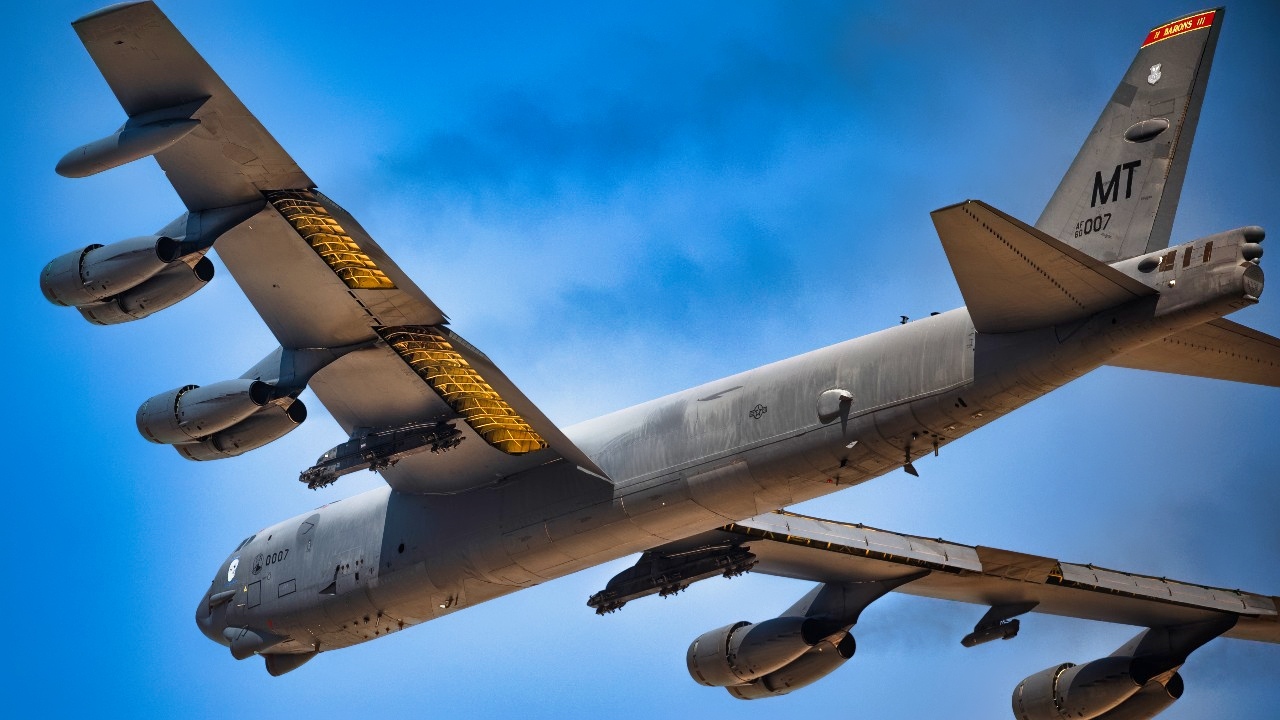
A U.S. Air Force B-52H Stratofortress strategic bomber assigned to the 69th Expeditionary Bomb Squadron flies within the U.S. Central Command area of responsibility, Nov. 15, 2024. The B-52H provides strategic options and flexibility to U.S. and coalition senior leaders with the aircraft’s ability to employ a wide range of weapons with precision and deliver a decisive response to adversaries who threaten peace and security across the region. (U.S. Air Force photo)
“Two of the three largest economies are located in the Asia-Pacific along with 10 of the 14th smallest. The AOR includes the most populous nation in the world, the largest democracy, and the largest Muslim-majority nation. More than one-third of Asia-Pacific nations are smaller, island nations that include the smallest republic in the world and the smallest nation in Asia.”
However, the region is vast, with long, open stretches of ocean separating the islands and atolls that dot the area from one another and from the continents that surround the Pacific. It is these incredibly long distances that make that theatre such a challenge. However, the US Air Force would like the B-52 to rise to that challenge—despite its age, and even as the much more advanced, sixth-generation B-21 Raider stealth bomber is poised to enter service with the US Air Force.
Updates Loading
The B-52J will supersede today’s B-52H in the near future, a new designation reflecting new engines and other upgrades, more information about which can be found here. That modernization program is extensive, but the core of the effort will be to extend the bomber’s range even further.
Additionally, the bomber will be equipped with long-range air-launched ballistic missiles, transforming the B-52 into a potent strike platform that, if all goes according to plan, will enable the US Air Force to deploy large quantities of munitions into a fight in the Indo-Pacific.
However, the costs of the B-52 upgrade program are rising, which raises the specter of the Nunn-McCurdy Act.
Rising Costs and the Nunn-McCurdy Act
One of the vital parts of the B-52’s upgrades is the installation of the AN/APQ-188 Bomber Modernized Radar System, an electronically scanned radar that replaces the bomber’s decades-old AN/APQ-166 radar.
“Replacement of the aging legacy radar is intended to increase system reliability and reduce sustainment costs. The Bomber Modernized Radar System will also provide new high-resolution ground mapping capabilities to improve target location accuracy and capabilities to track moving surface and air targets,” a report on the new radar system released by the Office of the Director, Operational Test and Evaluation stated. The new radar is based on the same technology used in the radars of the F-15 and F/A-18.

B-52 Bomber. Image Credit: Creative Commons.
The new electronic radar’s smaller footprint means the B-52s will get a new radome cover. However, the latest radar’s costs are expected to increase by over 15 percent, which risks triggering the Nunn-McCurdy Act, a congressionally mandated stop to defense projects that experience significant cost overruns.
Darlene Costello, who leads acquisitions for the US Air Force, told Breaking Defense,” We don’t believe it’s going to be a critical Nunn-McCurdy [25 percent or greater cost increases]. We don’t believe we’re close to having a critical Nunn-McCurdy, but we are beyond the significant threshold, and we’re working through the process to inform Congress of that.”
B-52 Bomber Flying Forever?
While the US Air Force is preparing to accept the B-21 Raider stealth bomber into service, that does not mean there is no place anymore for the B-52. The bomber’s prodigious payload capacity, as well as its range, mean that, for now, at least, it is here to stay. New and more efficient engines will also extend range, and combined with its extensive modernization means that it will remain a capable platform.
MORE – The B-21 Raider Bomber Test
Once finished, the B-52J project, if successful, will enable the US Air Force to deploy a significant number of stand-off munitions into combat, keeping the Cold War-era bomber combat-ready while maintaining its safety.
About the Author: Caleb Larson
Caleb Larson is an American multiformat journalist based in Berlin, Germany. His work covers the intersection of conflict and society, focusing on American foreign policy and European security. He has reported from Germany, Russia, and the United States. Most recently, he covered the war in Ukraine, reporting extensively on the war’s shifting battle lines from Donbas and writing on the war’s civilian and humanitarian toll. Previously, he worked as a Defense Reporter for POLITICO Europe. You can follow his latest work on X.
The Best Tanks on Earth
AbramsX: The Tank the US Army Wants


Pingback: Bombardér B-52: Americké letectvo se připravuje na stoletou službu legendárního stroje - Securitytech