

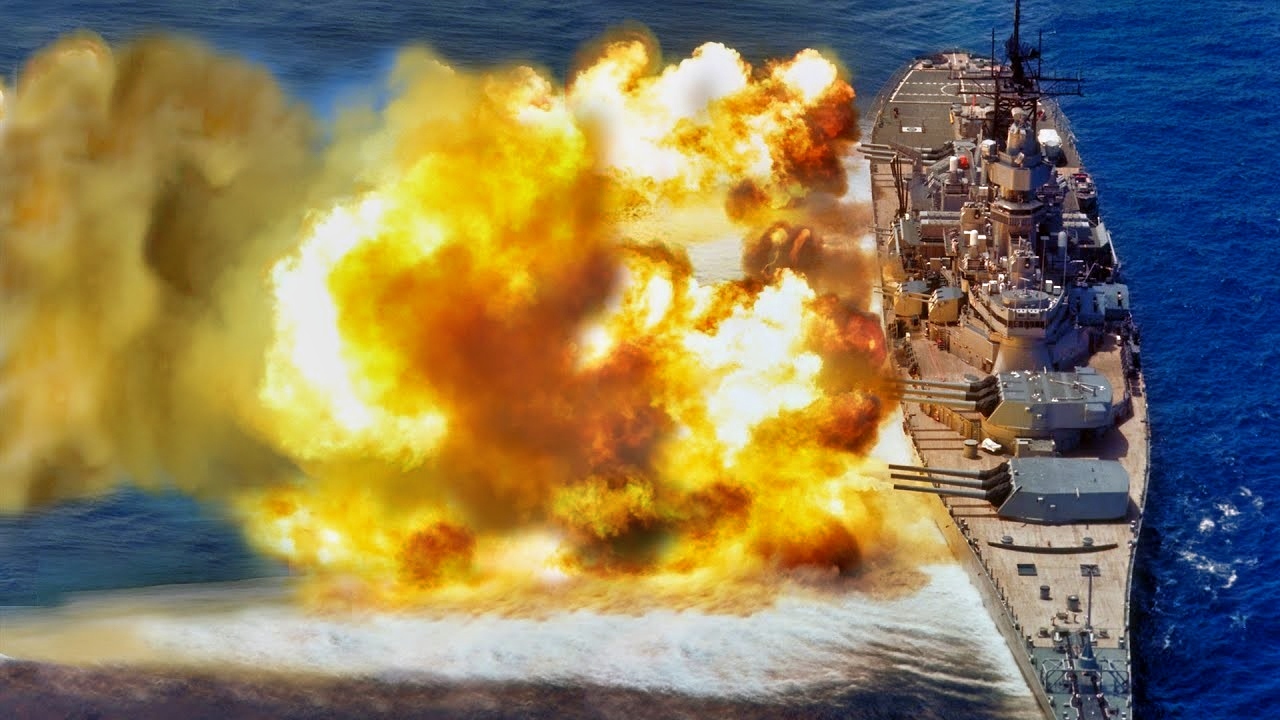
Key Points and Summary – Battlecruisers were a unique class of warship designed to combine the heavy guns of a battleship with the speed of a cruiser, a compromise achieved by sacrificing armor protection.
-This “speed is armor” philosophy proved perilous, as famously demonstrated by the catastrophic loss of the British battlecruiser HMS Hood in its duel with the German battleship Bismarck.
-The U.S. Navy’s experience with the type was limited; its initial Lexington-class battlecruisers were converted into successful aircraft carriers, like the USS Saratoga and USS Lexington, foreshadowing the end of the big-gun ship era and the rise of naval aviation.
The Story of Battlecruisers and Their Comparison to Battleships
Maritime enthusiasts the world over are obsessed with battleships. The extreme size, the lethality of the big guns, and the impressive space for sailors have fans excited when visiting historical sites after the battleships are remodeled and restored.
But what about battlecruisers? These are less well-known but still could sometimes match the combat power of battleships with more speed and less armor. The battlecruiser could bring the fight to the enemy and survive in combat while incorporating the deadly features of battleships.
The Battlecruiser Is Difficult to Classify
Few battlecruisers were built, and that is one reason why the general public is not familiar with them.
A battlecruiser had a simple characteristic. They were more heavily armored than a regular cruiser but faster than a battleship. The difficulty in classifying them arose because there was still a class of ship called the heavy cruiser – a vessel similar to the battlecruiser.
Diverse Number of Missions Set the Battlecruiser Apart
However, battlecruisers had a more robust and varied mission set. They could sail out ahead of the main strike group and create a defensive screen. The were good at destroying commercial shipping. Battlecruisers were fast enough to perform hit-and-run flank attacks. They were indeed search and destroy ships with the capability of scouting other enemy strike groups. With their speed and maneuverability, they could avoid battleships.
To save on weight, the battlecruiser was less heavily armed than a battleship. The armaments were less prominent and the guns were smaller. The battlecruiser had less range than a battleship and had to be resupplied more with fuel, food and other provisions.
The British Experience
The British in World War Two decided to keep many of the same guns on their battlecruisers as on the battleships, but scrimped on the armor to make them lighter and faster. The German battlecruisers had many smaller guns with lighter armor than those of a battleship.
The HMS Hood was the last British battlecruiser of World War II. The problem with the Hood was that its leadership was too aggressive and pushed the battlecruiser beyond its capabilities.
This meant force-on-force engagements with heavier armored German battleships. The Hood was destroyed in the Battle of Denmark Strait at the beginning of the war.
The U.S. Navy’s Limited Use of Battlecruisers
The U.S. Navy built battlecruisers in the 1920s while the British Royal Navy built their superior Invincible-class battlecruisers.
The Americans originally deemed these battlecruisers “heavy cruisers,” although the name “battlecruiser” stuck with historians. The Japanese also built Kongo-class battlecruisers.
The U.S. Navy battle planners discovered that in training exercises, battlecruisers performed well at night and in bad weather. They were able to outfox battleship strike groups with better speed. Battlecruisers could also focus their firepower on capital ships by volleying the bombardment rate making them more effective.
Converting Battlecruisers to Aircraft Carriers
The Navy decided to build six Lexington-class battlecruisers in 1916, but this number was limited by the Washington Naval Treaty of 1922. The original Lexington-class was meant to have eight 16-inch guns. Only two remained and they were later converted to aircraft carriers.
The Navy had conducted an after-action review of World War I and found that British battlecruisers were vulnerable to magazine explosions at the Battle of Jutland when three were sunk. The Americans then increased the armor, which limited the speed of the battlecruisers to 33 knots.
The two battlecruisers converted to carriers – the Lexington and Saratoga – had a high operational tempo in World War II. They were involved in many engagements, including the Battle of the Coral Sea and the Battle of the Eastern Solomons. The Saratoga sank a Japanese carrier, although the Lexington was lost at the Battle of the Coral Sea.
The Alaska-class battlecruisers were built beginning in 1940 after initial design in 1938. Not all deemed these ships “battlecruisers,” they were also identified as “cruiser killers.” Only two of the Alaska-class vessels were built.
Battlecruisers were interesting ships. They had a varied mission set and could bring a punch to the fight. They had the ability to engage a battleship but usually had less firepower and depended on their speed and agility to survive against capital ships. The British probably used the battlecruiser the most followed by the Germans and Japanese. The American experience with battlecruisers was limited.
The battlecruiser needed a strike group or convoy to be effective. They could leave the main force and perform scouting duties to identify larger enemy forces. They could be hunter-killer ships that gave friendly forces more options in striking the enemy.
The Americans converted their battlecruisers to aircraft carriers. Indeed, the advent of carrier aviation rendered the battlecruiser obsolete. They are thus not as well known as the battleship, but they had a fascinating history as “heavy cruisers” that could outwit and outgun smaller ships. This made them worthwhile at the beginning of World War II, but aircraft carriers ultimately overtook them in the order of naval battle.
About the Author: Dr. Brent M. Eastwood
Brent M. Eastwood, PhD is the author of Don’t Turn Your Back On the World: a Conservative Foreign Policy and Humans, Machines, and Data: Future Trends in Warfare plus two other books. Brent was the founder and CEO of a tech firm that predicted world events using artificial intelligence. He served as a legislative fellow for U.S. Senator Tim Scott and advised the senator on defense and foreign policy issues. He has taught at American University, George Washington University, and George Mason University. Brent is a former U.S. Army Infantry officer. He can be followed on X @BMEastwood.
More Military
The U.S. Navy’s Submarine Crisis Is Real


Yeah
July 9, 2025 at 10:43 am
Cruisers are the future of naval power. 21st century naval power. Author, please note.
How.
Cruisers, or more properly identified as super-destroyers, are a MUST today. Unlike aircraft carriers.
What are super-destroyers.
Super duper-destroyers are destroyers larger than 10,000 tons and armed to the teeth, fast and able to fight alone.
Very large destroyers or ultra large destroyers, armed with ballistic missiles, railguns, gatlin cannons all round the hull, and satcom guidance.
Or a high super-hi high-tech version of the latest north korea ship choe hyon.
The choe hyon packs more firepower than the USS new jersey. Author, please note.