

Weeks after U.S. Treasury Secretary Scott Bessent said an Oman-Iran deal on the Strait of Hormuz was imminent, the two countries appear to be moving closer to confirming an agreement that would establish a new system for moving traffic through the Strait of Hormuz.
But statements from Tehran on Wednesday, August 26, suggest that the waterway will remain restricted for some time, unless Washington agrees to its terms.
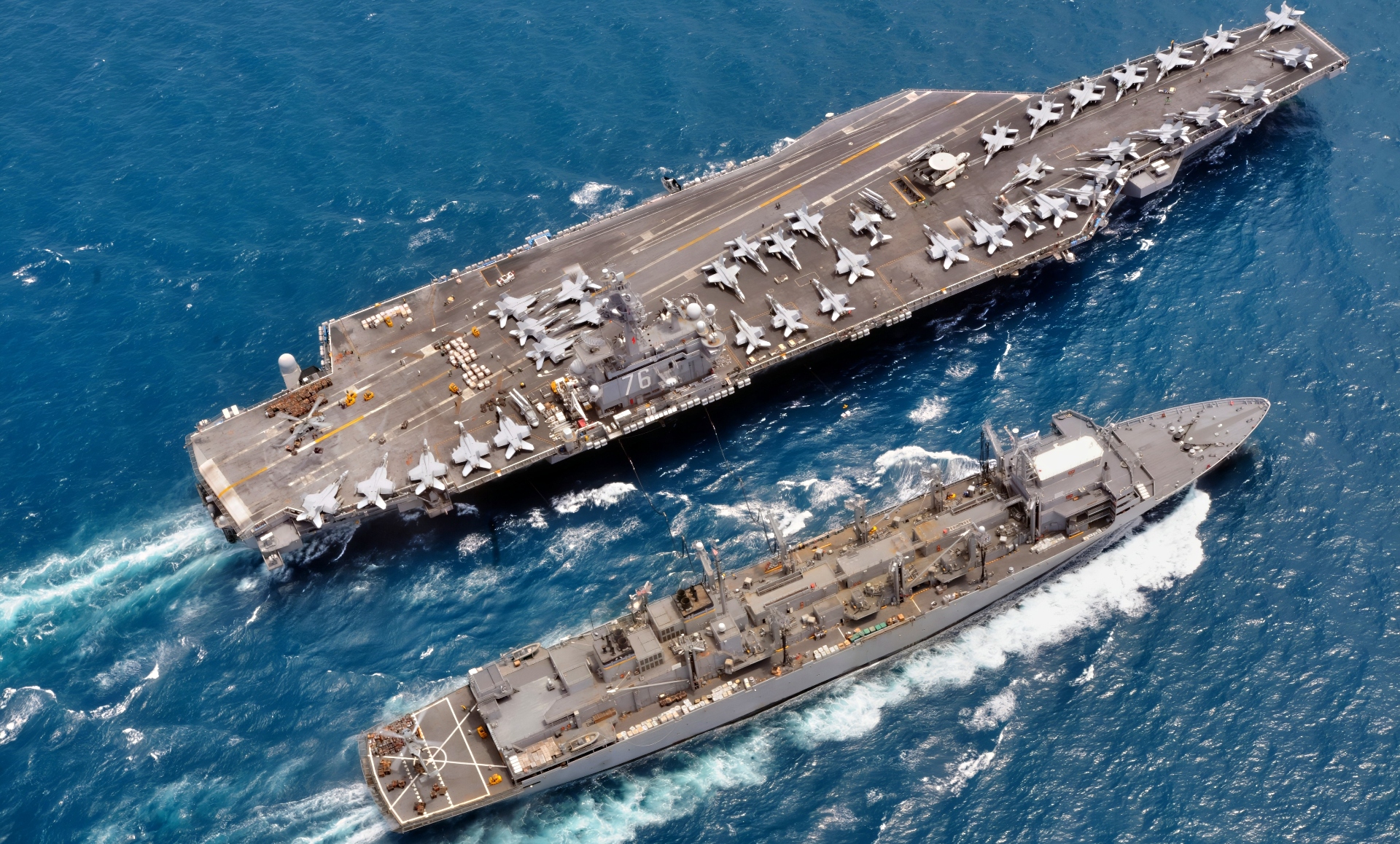
(August 15, 2008) With SH-60 helicopters moving pallets of supplies both USS Ronald Reagan (CVN 76) and USNS Bridge (T-AOE 10) work together during a replenishment at sea or RAS. With Reagan’s six galleys and approximately 4,100 Sailors it takes a lot of produce to feed that many folks and the Nimitz-class aircraft carrier got what it needed from USNS Bridge to do so.
The Ronald Reagan Carrier Strike Group is on a routine deployment in the 7th Fleet area of responsibility. Operating in the Western Pacific and Indian Ocean, the U.S. 7th Fleet is the largest of the forward-deployed U.S. fleets covering 52 million square miles, with approximately 50 ships, 120 aircraft and 20,000 Sailors and Marines assigned at any given time.
U.S. Navy photo by Senior Chief Mass Communication Specialist (SW/NAC) Spike Call

At sea (Mar. 1, 2007) – Capt. Craig “Animal” Williams (front) in a F/A 18C Hornet (front) and Capt. Richard “Rhett” Butler (back) in an F/A 18C Hornet look up for a photo as they fly over USS Ronald Reagan (CVN 76). Capt. Williams, a 22-year Naval Aviator who graduated from the United States Naval Academy, was relieved as Commander, Carrier Air Wing Fourteen (CVW-14) by 21-year Naval Aviator, Capt. Butler, a graduate of the University of Kentucky during an aerial change of command ceremony. The Ronald Reagan Carrier Strike Group is currently underway in the Pacific Ocean on a surge deployment in support of U.S. military operations in the Western Pacific. Official U.S. Navy photo by Lt. Cmdr. Tam Pham
(RELEASED)
Iran’s Islamic Revolutionary Guard Corps (IRGC) said this week that Tehran and Muscat have already reached an agreement on their shares of the waters of the strait and the revenues generated from its administration – but a senior Iranian source then told Reuters that negotiations were still underway and no final agreement had been signed.
It follows reports of talks in Tehran on Tuesday between Iranian Foreign Minister Abbas Araghchi and Omani Foreign Minister Badr bin Hamad Al Busaidi.
The two officials reportedly discussed plans to establish a temporary shipping corridor and to jointly clear mines from the waterway.
The negotiations are a step toward restoring regular commercial traffic through the Strait of Hormuz, but under conditions Tehran considers acceptable – not Washington. And Tehran says the U.S. is standing in the way of the deal.
Iran Says Washington Is Blocking the Deal
“Agreements have been reached regarding each country’s share of the strait’s waters as well as Iran and Oman’s share of its revenues,” the IRGC confirmed on Wednesday, per the Sepah News agency. “We have reached results that are acceptable to both sides,” the spokesman continued.
It followed a joint statement issued by both foreign ministers a day earlier confirming that an “interim framework” had been discussed.
Spokesman Hossein Mohebbi also said in comments published by state media that the Strait of Hormuz “belongs to Iran and the country of Oman” and that negotiations have been ongoing for roughly one month. He added that the United States must now accept Iran’s terms to keep traffic moving through the waterway.
“If the United States stops obstructing and returns to the agreement, we can open the Strait of Hormuz within the framework of the agreement reached … If the United States does not accept our conditions, the Strait of Hormuz will not be opened under any circumstances,” Mohebbi said.
A New Route
The new route, if confirmed, would change how vessels currently navigate through the strait. Iranian Deputy Foreign Minister Kazem Gharibabadi told Iranian state television on Tuesday that any commercial vessels entering the Persian Gulf from the Gulf of Oman would travel through Iranian territorial waters, while outbound vessels would use a new route that passes through both Iranian and Omani waters. Crucially, though, the Iranian official said that military vessels would not be permitted to use the corridor.
The arrangement would be temporary, with Tehran and Muscat expecting another 30 to 60 days of negotiations to establish a permanent route once the legal and technical details are worked out. The next round of talks is expected to cover everything from traffic management and information sharing to navigational security services that would likely require a fee from shipping companies.
Omani Foreign Minister Badr Albusaidi said that he was “hopeful” the new route will soon come into effect.
Shipping Traffic Is Still Restricted
Even if Iran and Oman finalize the proposed corridor, Tehran has repeatedly said in recent weeks that doing so would not automatically reopen the Strait of Hormuz.
Instead, regime officials are saying that the route would come into effect if the United States accepts Tehran’s conditions – and until then, shipping is likely to remain disrupted.
And presently, commercial movements through the waterway are restricted and inconsistent.
Data from maritime analytics firm Kpler suggest that only five commodity vessels crossed the Strait of Hormuz on Tuesday, August 25, compared with a 10-day average of 15 ships. Reuters reports that two liquefied gas tankers and one bitumen tanker left the Persian Gulf and two empty tankers entered. Compared to pre-war figures, it is a dramatic reduction.
Oil markets, however, appear to be pricing in the possibility that the Oman-Iran talks will bear fruit. Brent crude prices fell below $87 per barrel on Wednesday – the lowest level since August 10.
But Will Washington Change Course?
What happens next may depend on Washington’s next steps, and whether the White House follows through on threats made under a new economic sanctions plan announced on Monday.
The Trump administration hopes that extreme economic pressure and secondary sanctions on Iran’s remaining trading partners will do what military strikes have failed to achieve so far, but the Islamic regime remains defiant and insists that maximal economic pressure won’t change its position.
So far, Iran’s largest trading partner, China, has also indicated that it will not comply and will act only in its own interests.
About the Author: Jack Buckby
Jack Buckby is a British researcher and analyst specializing in defense and national security, based in New York. His work focuses on military capability, procurement, and strategic competition, producing and editing analysis for policy and defense audiences. He brings extensive editorial experience, with a career output spanning over 1,000 articles at 19FortyFive and National Security Journal, and has previously authored books and papers on extremism and deradicalization.


