

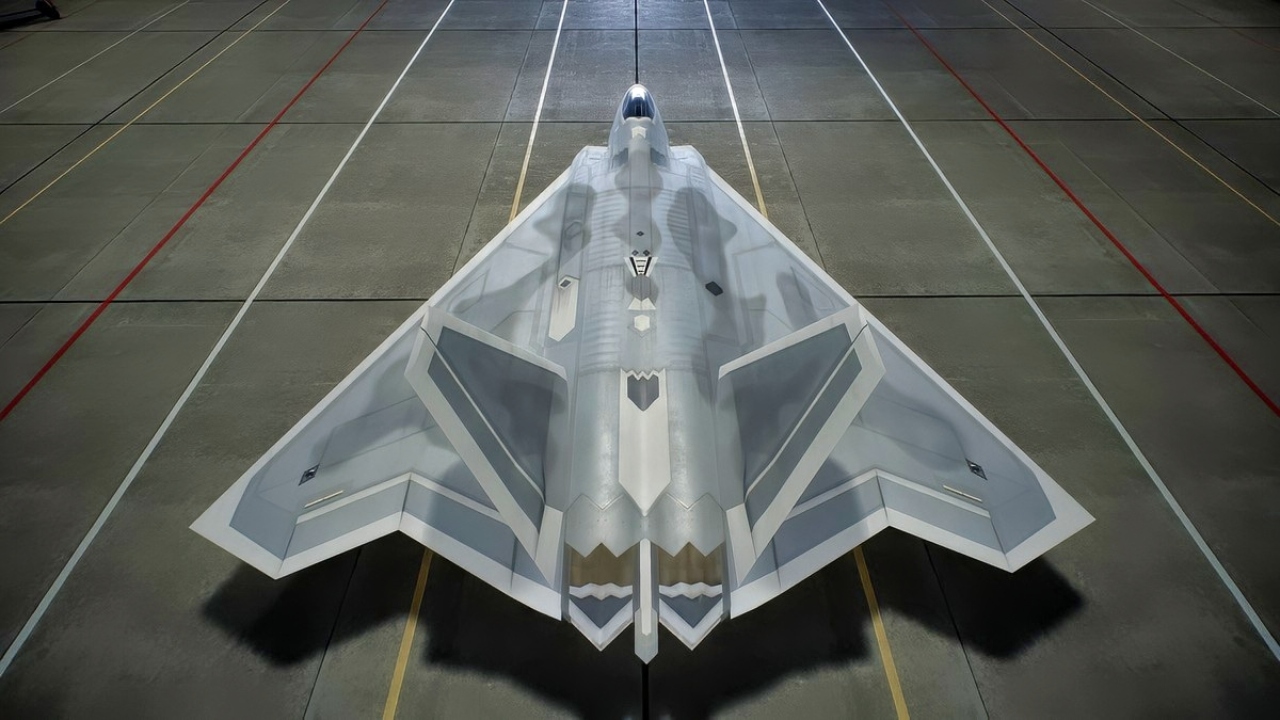
PUBLISHED on August 12, 2025, 10:17 AM EDT – Key Points and Summary – Key In the early 2000s, Lockheed Martin proposed a bomber variant of the F-22, dubbed the FB-22 “Strike Raptor.”
-The concept aimed to create a stealthy, supersonic medium-range bomber by modifying the F-22’s airframe with a larger delta wing to significantly increase its range and payload capacity up to 30,000 pounds.
-Despite initial support from Air Force leadership, the ambitious “bomber on a budget” was canceled during the 2006 Quadrennial Defense Review in favor of pursuing what would eventually become the B-21 Raider, relegating the impressive Strike Raptor to a fascinating “what if.”
The FB-22 Stealth ‘Bomber’ Explained
The F-22 Raptor—just one in a long line of many prestigious products produced by Lockheed Martin’s famed Skunk Works program—is the world’s first operational 5th-generation stealth fighter jet and remains in service with the United States Air Force 20 years after it made its official debut.
Therefore, it cannot realistically be deemed a failure. However, it would certainly be reasonable to consider the F-22 as a case study in “What if,” “What might have been,” and stunted growth potential, as then-US Secretary of Defense (SECDEF) Bob Gates made the incredibly boneheaded decision back in 2009 to kill the Raptor after acquiring only 187 airframes out of the original 381 planned.
Speaking of the “What if/What might have been” factor, National Security Journal now examines a fascinating would-be offshoot of the F-22 that never got off the ground in either the figurative or the literal sense: the FB-22 medium-range bomber.
FB-22 Concept and Premise
The notion of the world’s first true stealth fighter converted into a medium-range bomber isn’t as far-fetched as it may sound at first. After all, the first **so-called** “stealth fighter, the F-117 Nighthawk—yet another Skunk Works brainchild—wasn’t really a fighter at all but rather used purely as a bomber (and a very impressive one at that).
The proposal for the FB-22 was born in the early 2000s and had the support of senior Air Force leaders such as then-Secretary of the Air Force (SECAF) Dr. James G. Roche. The spirit and intent were to meet the Air Force’s need for a regional or medium-range bomber that was more survivable (due to the stealth characteristics) and could bridge the capability gap between fighter air-to-ground operations and long-range bombers with heavy payload capabilities.
Had the FB-22 actually come to fruition, it could have been the stealthiest fighter/bomber on the planet, and the only supersonic stealth bomber ever to enter operational service for any nation. Not to mention a potential stealth replacement for the “bomb truck” version of the F-15, the F-15E Strike Eagle (which is an excellent platform but comes with a ginormous radar cross section [RCS].
Accordingly, this so-called “Strike Raptor” would have followed the same baseline structure as the Raptor fighter, retaining up to 80 percent of its avionics, sensors, and sub-systems from the original warbird, with changes focused on the fuselage and wings.
A co-pilot would also have been added to be able to provide relief to an otherwise solo pilot on long-range strike missions. Ultimately, the fuselage was kept at the same length as a cost-saving measure, but the wings were given an elongated delta shape for increased range.
FB-22 Proposed Tech Specs and Vital Stats
Courtesy of the Lockheed Martin product card and a January 2005 report in Air Force Magazine:
-Fuselage Length: 64.33 feet
-Wingspan: 73.67 feet
-Powerplant: 2 x modified Pratt & Whitney F119 afterburning turbofan engines
-Max Airspeed: Mach 1.5+
-Combat radius: 1,800 miles
-Payload: 30,000 lb. (including 35 x 250-lb. Small Diameter Bombs [SDBs], 2 x AIM-9 Sidewinder infrared air-to-air missiles, and 10 x AIM-120 AMRAAM air-to-air missiles (AKA the “Slammer”)
To put that payload in proper perspective, the standard F-22’s bomb-carrying capacity tops off at a mere 2,000 lb.
The FB-22 in 3 Words: Just a Drawing
Alas, the FB-22 never even got built in prototype form, let alone as a production model, as it was nixed during the 2006 Quadrennial Defense Review (QDR), which instead called for a larger strategic bomber program called the Next Generation Bomber program, which in turn got superseded by the Long Range Strike Bomber program (which is now being manifested in the Northop Grumman B-21 Raider).
Samantha Franco provides some additional insights in a 29 June 2022 article for War History Online titled “There Was Almost a Stealth Bomber Version of the F-22 Raptor.”
To wit: “Before it could make it out of the concept phase, the FB-22 Strike Raptor was found to have more drawbacks than originally thought. The changes made to the airframe caused it to have significantly less maneuverability than the F-22 Raptor, which meant that, in the chance it got caught in a dogfight, the odds were likely never going to be in its favor. Against an opponent like the Mikoyan MiG-29 Fulcrum or the Sukhoi Su-27, it would be done for … It also couldn’t make it past Mach 1.92 because the thrust vectoring technology of the F-22 was cut from the FB-22’s design. As well, the question of how much these stealth bombers would cost was a major area of concern, and production was capped off at a little over 120 units.”
About the Author: Christian D. Orr, Defense Expert
Christian D. Orr is a Senior Defense Editor. He is a former Air Force Security Forces officer, Federal law enforcement officer, and private military contractor (with assignments worked in Iraq, the United Arab Emirates, Kosovo, Japan, Germany, and the Pentagon). Chris holds a B.A. in International Relations from the University of Southern California (USC) and an M.A. in Intelligence Studies (concentration in Terrorism Studies) from American Military University (AMU).
More Military
America Almost Had to Invade Japan


