

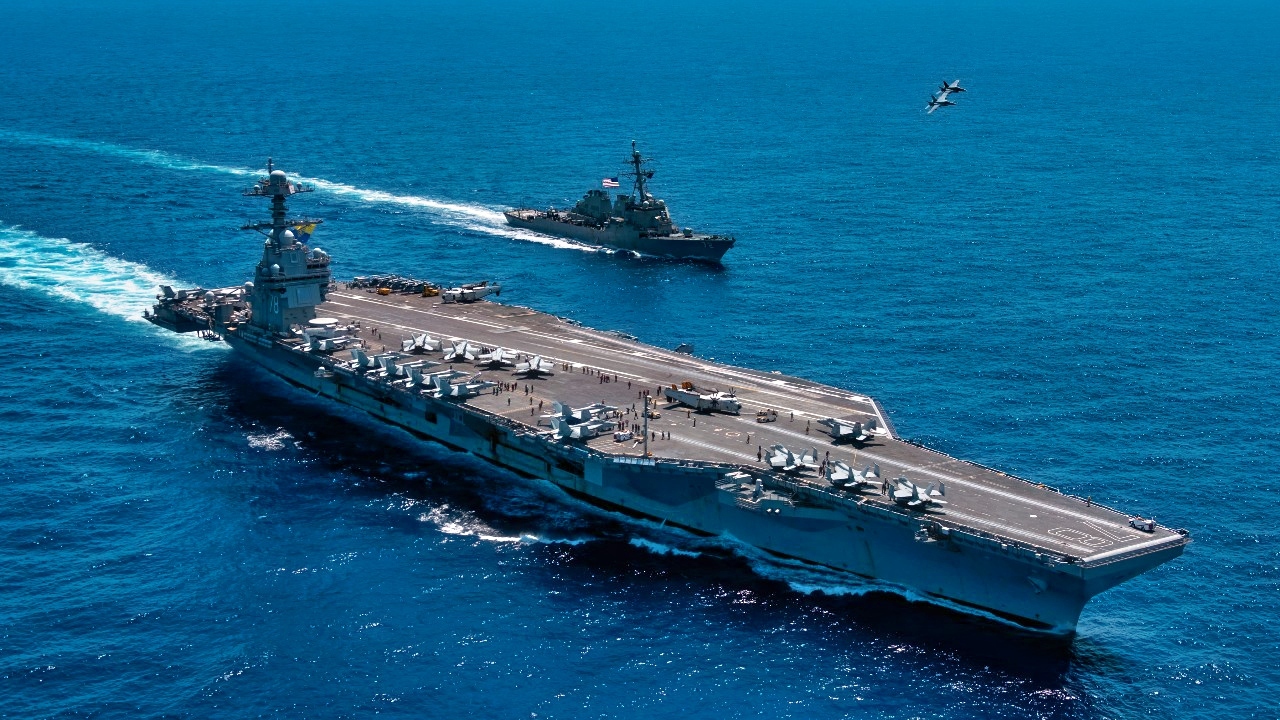
Key Points and Summary on Ford-Class Carrier – The U.S. Navy’s new aircraft carrier, the USS John F. Kennedy (CVN-79), is facing a massive new delay, with its delivery now pushed back nearly two years to March 2027.
-According to new budget documents, the delay is necessary to complete work on the ship’s troubled Advanced Arresting Gear (AAG) and Advanced Weapons Elevators (AWE)—the same systems that plagued the lead ship, the USS Gerald R. Ford.
-This setback is part of a broader crisis in the American shipbuilding industry, with the Navy Secretary admitting that “all of our programs are a mess.”
The Ford-Class Problems Keep Stacking Up
Recently-released United States Navy budgetary documents reveal that the United States’ newest aircraft carrier, the USS John F. Kennedy, is significantly behind schedule.
Buried within the massive 440-page document is a single, understated line. “The CVN 79 [USS John F. Kennedy] delivery date shifted from July 2025 to March 2027 (preliminary acceptance TBD) to support completion of Advanced Arresting Gear (AAG) certification and continued Advanced Weapons Elevator (AWE) work.”
During a House Armed Services Committee hearing last month, the Secretary of the Navy acknowledged that many of the U.S. Navy’s shipbuilding programs are behind schedule and out of sorts, though he expressed his hope that the Navy would be able to resolve a lengthy list of problems in the future.
“All of our programs are a mess, to be honest,” said John C. Phelan, the Navy secretary. “We are behind schedule, over budget,” Phelan said. He added that “our best-performing one [program] is six months late and 57% over budget… So, we are working very hard to get these fixed. The Navy has begun to make some rapid changes at the public shipyards, and we’ve been talking with Electric Boat and Huntington Ingalls [HII].”
More Problems for the Navy
The USS John F. Kennedy is the second of four planned Gerald R. Ford-class aircraft carriers. The lead ship of the class, the USS Gerald R. Ford, was delivered to the U.S. Navy 32 months, or over 2.5 years, behind schedule. The carrier’s elevators, which shuttle weapons and planes through the ship to the top, were nonfunctional at the time of delivery and required several years to repair.
Phelan was joined by Acting Chief of Naval Operations James W. Kilby and General Eric M. Smith, commandant of the Marine Corps. The hearing can be seen, in its entirety, here.
Besides the problems experienced by the first two aircraft carriers of the Gerald R. Ford-class, the Secretary also explained that the Virginia-class submarines and the Columbia-class ballistic-missile submarines are also both behind schedule.
Not only that, but the costs of the Constellation-class frigates are increasing, and some of the upcoming Arleigh Burke-class guided-missile destroyers are falling behind schedule. Some of the U.S. Marine Corps’ amphibious warfare ships are also in poor condition.
“The United States Navy and Marine Corps are prepared and ready to fight and win, anytime and anywhere,” Navy Secretary Phelan said. “However, our naval superiority is under threat. For too long we have allowed our shipbuilding industry to erode, hollowing out the very capacity we need to maintain credible naval deterrence. That must change.”
A spokesman for Huntington Ingalls told Bloomberg that HII is “addressing first-of-class production and supply base challenges impacting submarine and aircraft carrier programs,” and that some of the mistakes made in building the USS Gerald R. Ford had been identified and would be fixed. However, he acknowledged that those lessons couldn’t be applied to the USS John F. Kennedy, as that ship was already in a very advanced stage of construction.
Whether the anticipated March 2027 delivery date can be adhered to remains to be seen. Another question is whether the lessons learned from building the USS Gerald R. Ford and the USS John F. Kennedy can be applied to the latter two Ford-class carriers in time.
About the Author: Caleb Larson
Caleb Larson is an American multiformat journalist based in Berlin, Germany. His work covers the intersection of conflict and society, focusing on American foreign policy and European security. He has reported from Germany, Russia, and the United States. Most recently, he covered the war in Ukraine, reporting extensively on the war’s shifting battle lines from Donbas and writing on the war’s civilian and humanitarian toll. Previously, he worked as a Defense Reporter for POLITICO Europe. You can follow his latest work on X.
More Military
The U.S. Navy’s Submarine Crisis Is Real


