


Key Points and Summary – The U.S. Navy’s next Ford-class aircraft carrier, the future USS John F. Kennedy (CVN-79), is now facing a two-year delivery delay, pushing its arrival to March 2027.
-The setback is blamed on persistent developmental issues with its new Advanced Arresting Gear and Advanced Weapons Elevators, compounded by workforce and supply chain problems.
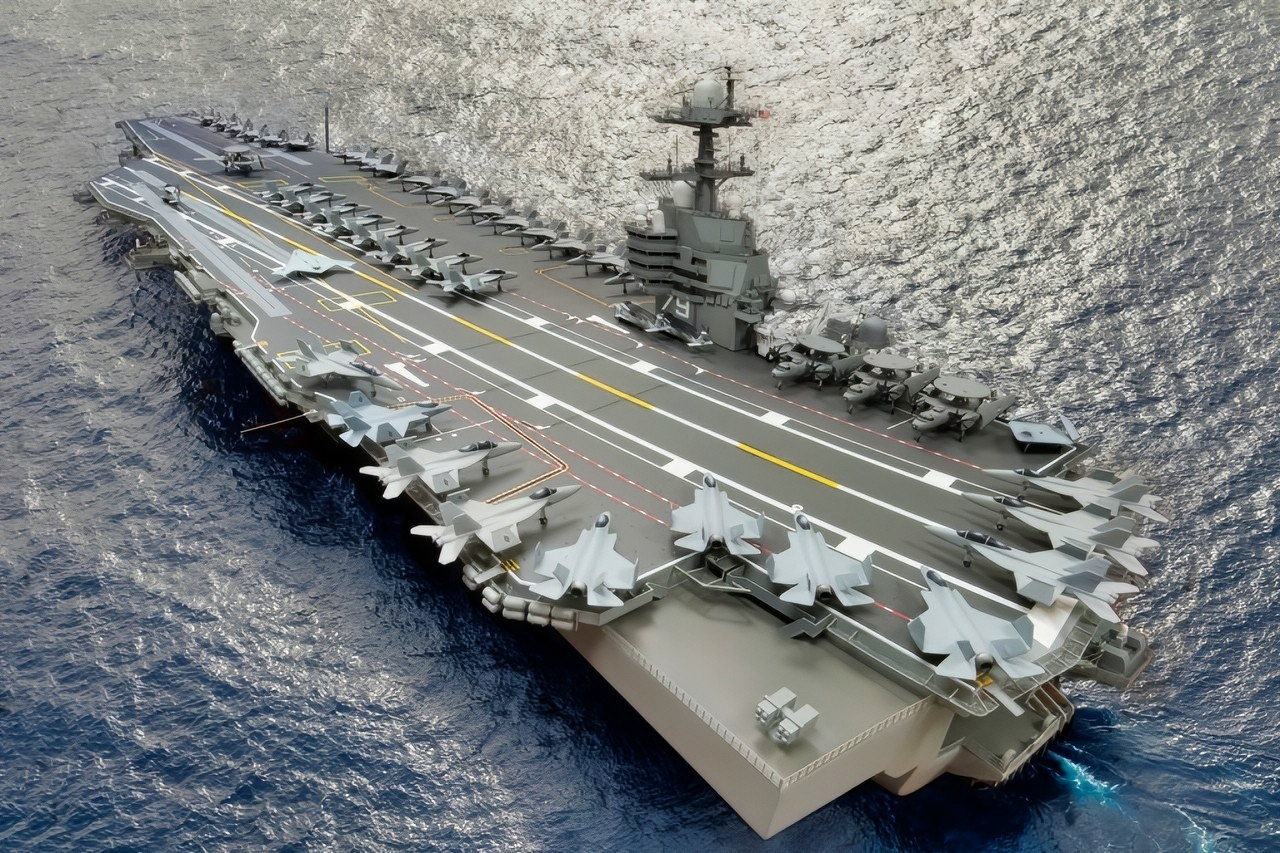
USS John F. Kennedy Aircraft Carrier Model
-This delay is strategically critical, as it coincides with the 2026 retirement of the USS Nimitz. For approximately a year, the Navy will be left with a reduced fleet of only 10 operational carriers, stretching its global presence thin.
The Ford-class Aircraft Carrier USS John F. Kennedy Delayed Two Years
The next Ford-class aircraft carrier is facing a two-year delay. This would leave the U.S. Navy with only 10 operational carriers for about a year. It should be noted, however, that only about six carriers operate at sea at any time.
The impending May 2026 retirement of America’s oldest active aircraft carrier, the USS Nimitz (CVN-68), will leave the Navy shorthanded and spread its assets even thinner.
The future USS John F. Kennedy (CVN-79) is now expected to be delivered in March 2027, according to the Navy’s Fiscal Year 2026 budget justification documents. The carrier was supposed to be delivered this July, according to last year’s budget plans.
“The Navy is exploring opportunities for preliminary acceptance of the vessel prior to formal delivery and is coordinating closely with stakeholders to ensure the fastest possible transition to fleet operations and a combat-capable carrier,” a Navy spokesperson said in a statement reported by USNI News.
What Is The Issue With the USS Kennedy?
This delay is due to ongoing issues with the ship’s Advanced Arresting Gear (AAG) and weapons elevators. Consequently, the Navy will temporarily operate with one fewer aircraft carrier, reducing the fleet to 10 ships for about a year.
The Navy’s Fiscal Year 2026 budget justification states the delay is necessary “to support completion of Advanced Arresting Gear (AAG) certification and continued Advanced Weapons Elevator (AWE) work.”
Both the AAG and the AWE are new technologies being pioneered by the Ford-class.
Difficulties with these two systems, combined with persistent shipyard workforce shortages and supply chain disruptions, were cited as directly causing the new 2027 delivery estimate, according to the Army Recognition Group.
What Is The New Advanced Arresting Gear?
The AAG is a modular, integrated system consisting of energy absorbers, power conditioning equipment, and digital controls. It is designed as the follow-up to the Mark-7 (Mk-7) arresting gear.
The Navy is currently utilizing the Mk-7 Mod 3 and Mk-7 Mod 4 designs on all Nimitz-class aircraft carriers.
The AAG architecture, Health Monitoring Assessment and Prognostics technology, and digital control system provide built-in test and diagnosis capabilities, resulting in a system that requires less maintenance and manpower to operate than the Mk-7.

The world’s largest aircraft carrier, USS Gerald R. Ford (CVN 78), sails in the Atlantic Ocean, July 4, 2025. Gerald R. Ford, a first-in-class aircraft carrier and deployed flagship of Carrier Strike Group Twelve, incorporates modern technology, innovative shipbuilding designs, and best practices from legacy aircraft carriers to increase the U.S. Navy’s capacity to underpin American security and economic prosperity, deter adversaries, and project power on a global scale through sustained operations at sea. (U.S. Navy photo by Mass Communication Specialist 2nd Class Tajh Payne)
The higher reliability and safety margins these improvements provide should allow sailors to focus on other areas of need. The system is also designed to enable arrestment of a broader range of aircraft, from the lightest unmanned aerial vehicles to the heaviest manned fighters.
The AAG was developed to replace the “legacy hydraulic arresting systems with an electromagnetic turbo-electric engine designed to recover a wider range of aircraft weights.”
That includes lighter unmanned aerial systems (UAS). It also aims to reduce the stress loads on airframes during launch.
The current Mk-7 Mod 3 arresting gear is a hydraulic system designed to quickly stop aircraft by using a tail hook to engage a series of cables stretched across the deck.
This system can bring a 50,000-pound aircraft to a stop in less than 350 feet.
The Advanced Weapons Elevator
AWEs are electromagnetic systems used on the USS Gerald R. Ford (CVN-78) to move ordnance from weapons magazines to the flight deck.
They are faster, have more than double the capacity of older hydraulic systems, and can operate more smoothly with fewer crew members due to their advanced electronic and electromagnetic propulsion.
These elevators were a significant technological challenge, but now that they have been completed, they are a critical part of the carrier’s operational capability.
Huntington Ingalls Industries spokesman Todd Corillo said that lessons learned from building the Gerald R. Ford will make it easier to build the remaining carriers in the Ford-class.
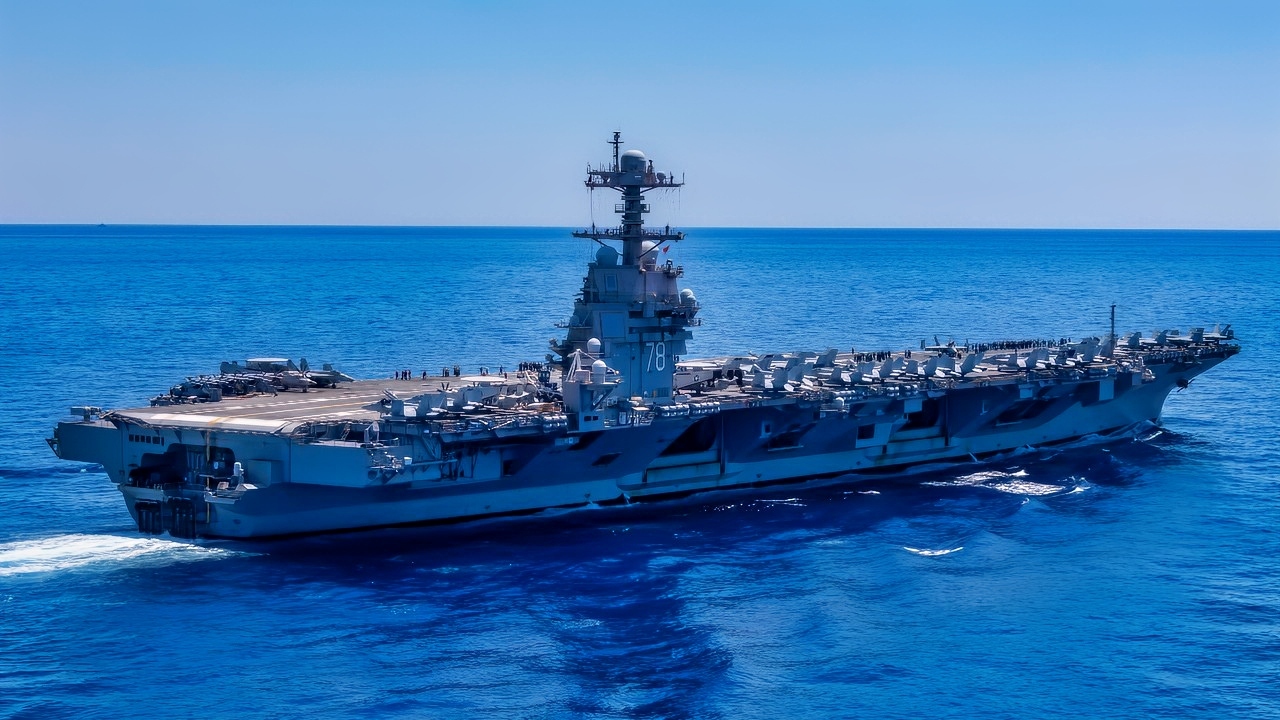
The world’s largest aircraft carrier, USS Gerald R. Ford (CVN 78) transits the Mediterranean Sea, August 1, 2025. Gerald R. Ford, a first-in-class nuclear aircraft carrier and deployed flagship of Carrier Strike Group Twelve, is on a scheduled deployment in the U.S. 6th Fleet area of operations to support the warfighting effectiveness, lethality, and readiness of U.S. Naval Forces Europe-Africa, and defend U.S., Allied, and partner interests in the region. (U.S. Navy photo by Mass Communication Specialist Seaman Brianna Barnett)
“Specifically, John F. Kennedy’s construction was fairly advanced when many Ford lessons were realized, precluding timely implementation of lessons learned for Kennedy,” Corillo said in a statement. “In contrast, Enterprise (future CVN-80) and Doris Miller (future CVN-81) have been able to incorporate, leverage, and capitalize on Ford lessons learned earlier in the construction process.”
Further Deliveries Delayed…Of Course
The latest Navy budget reports show that the Enterprise is also facing a delay of nearly one year. The carrier is now slated to deliver in July of 2030, instead of last year’s projection of September 2029.
“The CVN-80 delivery date shifted from September 2029 to July 2030 due to delays in material availability and industry/supply chain performance,” according to the Navy’s budget books.
It was only last year that the Navy’s budget forecast an 18-month delay for the Enterprise, pushing the delivery from March 2028 to September 2029, USNI News reported. That date keeps moving backward.
The Ford-class carriers, like the Columbia-class ballistic missile submarines and the Virginia-class attack submarines, are all behind schedule and over budget.
All of these overruns call into question whether the Navy will be able to successfully budget and build the hoped-for F/A-XX stealth fighters, which would replace the carrier air wings’ aging F/A-18E/F Super Hornets.
The delay of the carrier stretches an already-thin Navy even thinner, constraining the service’s ability to respond to global crises.
About the Author:
Steve Balestrieri is a National Security Columnist. He served as a US Army Special Forces NCO and Warrant Officer. In addition to writing on defense, he covers the NFL for PatsFans.com and is a member of the Pro Football Writers of America (PFWA). His work was regularly featured in many military publications.
More Military
The First 48 Hours of a War With China ‘Could Be Ugly’
Russia Tried to Build Their Very Own F-22 Raptor. Calling It a Disaster Would Be a Gift
The Royal Navy’s Queen Elizabeth-Class Aircraft Carriers Simply Summed Up in 4 Words


