

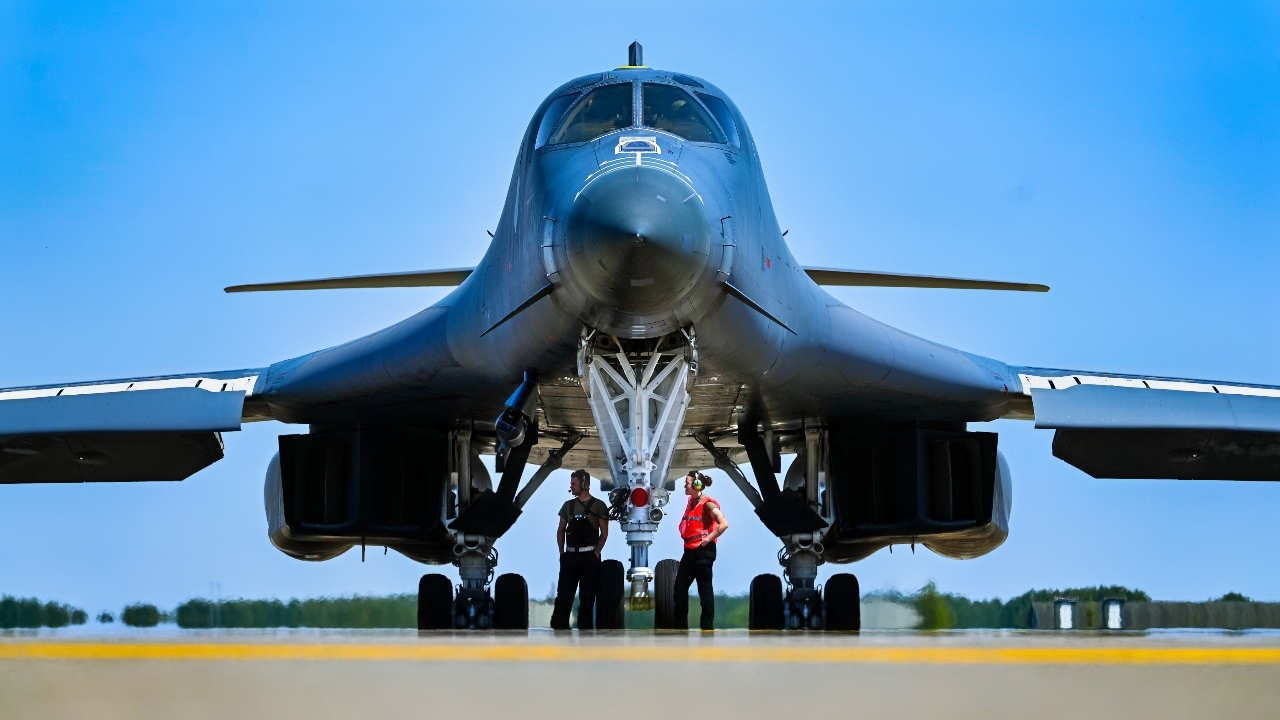
Key Points and Summary – The Rockwell B-1B Lancer, nicknamed “the Bone,” has a unique and tortured history, evolving from a canceled high-altitude nuclear bomber into the most versatile conventional bomber in the U.S. inventory.
-Re-engineered for low-level penetration, its nuclear mission vanished with the Cold War’s end.
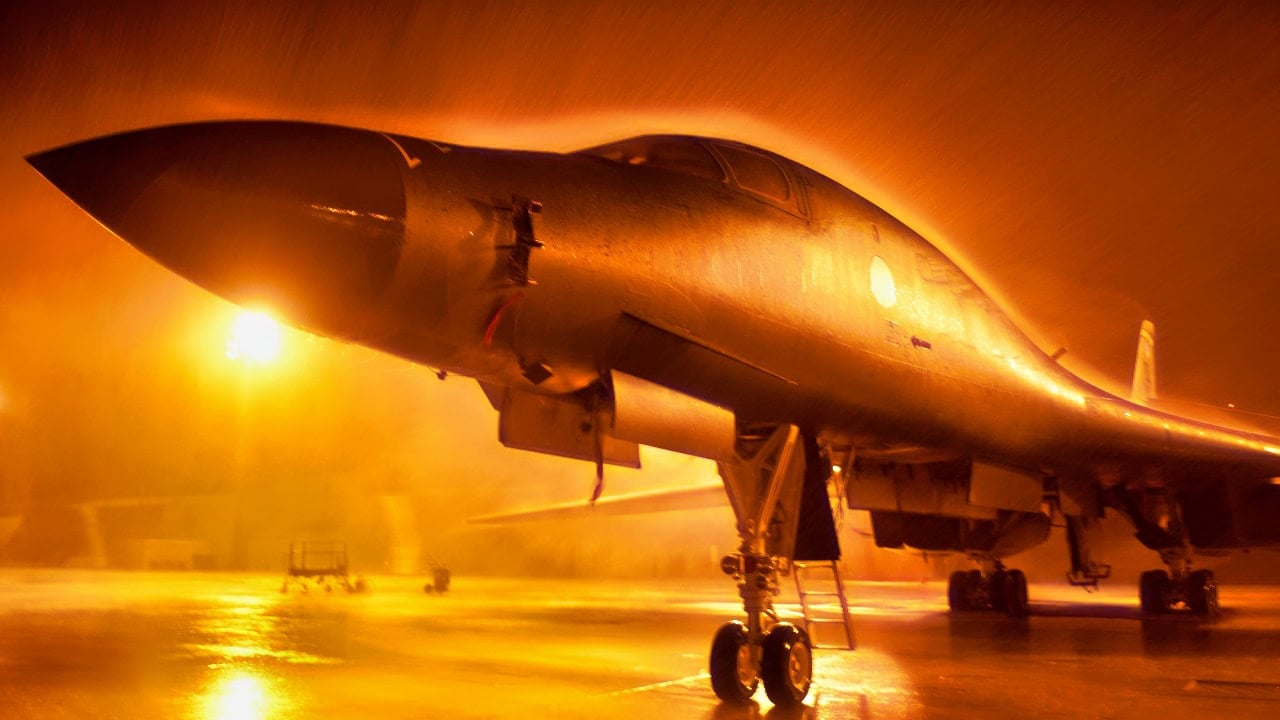
B-1B Lancer Bomber. Image Credit: Creative Commons.
-It was then reborn as a conventional powerhouse, carrying the largest payload of any U.S. bomber.
-In the skies over Afghanistan and Iraq, the B-1B’s unique combination of speed, payload, and long loiter time made it a legendary and life-saving close air support asset for troops on the ground.
Speed, Payload, and Loiter: What Made the B-1B a Legend
The B-1B Lancer has been a critical component of the U.S. strategic bomber fleet since its acceptance in 1986. The B-1B is one of the largest bombers in service and has the largest carrying capacity in the U.S. Air Force.
It served with distinction in Iraq and the later Global War on Terror. However, as time has passed and enemy air defense systems have become more advanced, the B-1B has found itself unable to keep pace with the ever-evolving battlefield and is being replaced by stealth systems.
Beginning of the B-1
The B-1 program began in the 1960s as the Air Force sought a bomber that could combine the speed of the B-58 Hustler with the payload and range of the B-52 Stratofortress. This led to the development of the B-1A, a high-speed, high-altitude bomber capable of flying at Mach 2.2.
However, the rise of advanced surface-to-air missile systems and the increasing viability of cruise missiles led to the cancellation of the B-1A in 1977. The program was revived in 1981 under President Ronald Reagan, resulting in the B-1B, a redesigned aircraft optimized for low-level penetration and conventional bombing.
The B-1B sacrificed some of the B-1A’s speed for reduced radar cross-section and improved survivability. The first B-1B flew in 1984, and it entered service with Strategic Air Command in 1986.
Initially, the B-1B was designed to serve as a nuclear bomber, complementing the B-52 and the emerging B-2 Spirit. It was equipped to carry nuclear gravity bombs and air-launched cruise missiles.
However, with the end of the Cold War and the signing of arms reduction treaties such as START and New START, the B-1B’s nuclear mission was phased out. By 2007, the aircraft had been officially converted to a conventional-only bomber.
This transition involved physical modifications to prevent the aircraft from carrying nuclear weapons, including welding sleeves into pylon attachment points and removing nuclear-specific wiring from bomb bays.
The B-1B in Action
The B-1B’s combat debut came in 1998 during Operation Desert Fox, where it targeted Iraqi military infrastructure. It proved its value again in 1999 during Operation Allied Force in Kosovo, where six B-1Bs delivered over 20 percent of the total ordnance while flying less than 2 percent of the sorties.
The aircraft’s ability to carry a large payload and deliver precision strikes made it a key asset in modern warfare.
During Operation Enduring Freedom in Afghanistan, the B-1B became a crucial component of the U.S. air campaign. In the first six months of the operation, eight B-1Bs dropped nearly 40 percent of the total tonnage delivered by coalition air forces, including thousands of Joint Direct Attack Munitions (JDAMs).
In Operation Iraqi Freedom, the aircraft flew less than 1 percent of missions but delivered 43 percent of the JDAMs used.
Its ability to loiter for extended periods, carry a massive payload, and deliver precision strikes made it indispensable in these conflicts.
Keeping the Lancer Relevant
Since 2015, the B-1B has played a central role in Bomber Task Force missions, which involve deploying bombers to various global locations to demonstrate readiness and support allied integration.
These missions have included operations in Europe, the Indo-Pacific, and the Middle East. In 2024, the B-1B executed a historic 34-hour mission from Dyess Air Force Base to strike targets in Iraq and Syria, returning without landing.
The aircraft has also participated in Operation Noble Defender, simulating cruise missile threats and integrating with NORAD assets to defend North American airspace.
As of 2025, the Air Force operates 45 B-1Bs, with many retired to the boneyard at Davis-Monthan Air Force Base. The aircraft has set nearly 50 world records for speed, payload, and range in its class.
It is slated to be replaced by the B-21 Raider, a next-generation stealth bomber designed for both conventional and nuclear missions. Dyess Air Force Base, the long-term home of the B-1B, will be among the first bases to receive the B-21.
The B-1B Can No Longer Keep Up
Despite the B-1B’s supersonic speeds, it struggles to keep pace with the rapid pace of innovation.
Since its inception, America’s adversaries have been investing in sophisticated and highly integrated air defense systems. Russia and China, in particular, possess advanced long-range air defense systems that put the B-1B at risk should it try to perform a bombing run.
Russia’s latest system, the S-500, has a range of around 600km and works in tandem with the S-400, S-300, and other SHORAD systems.
Due to the START treaties, the B-1B cannot be used as a nuclear-capable platform, unlike the B-52.
Stealth bombers have also rendered the B-1B obsolete. Bombers like the B-2 Spirit and the B-21 Raider are able to bypass enemy defenses altogether and deliver precision strikes on enemy positions. This allows them to remain relevant in current and future combat scenarios as radar systems develop even further.
The B-1B, unfortunately, does not have this luxury. Its supersonic capabilities no longer hold the advantage they once did. With the development of advanced AA missiles and stealth systems, the B-1B simply is not relevant anymore. Its only use is as a long-range missile platform, similarly to how the Russians use the Tu-160.
About the Author: Isaac Seitz
Isaac Seitz, a Defense Columnist, graduated from Patrick Henry College’s Strategic Intelligence and National Security program. He has also studied Russian at Middlebury Language Schools and has worked as an intelligence Analyst in the private sector.
More Military
Russia’s Air Force Is Falling Apart


doyle
August 30, 2025 at 1:25 pm
The b-1 is the US military’s main key to starting ww3.
The reason is its speed.
It’s fast enough to exactly emulate the japanese G4M bomber of the pacific war.
The G4M was a fast long-range bomber that attacked throughout the pacific during ww3, uh, ww2.
It replaced the earlier G3M that was so famous for terrible jap air attacks on civilian areas in china.
The G4M was actually faster than the A6M zero. See the relevance.
Take my advice, the B-1 will be one of the ‘secret’ weapons US will use to kickstart the coming ww3 !
The US has long been furiously planning for ww3.
To hell with US, and also to HELL, hell, hell with japan.