

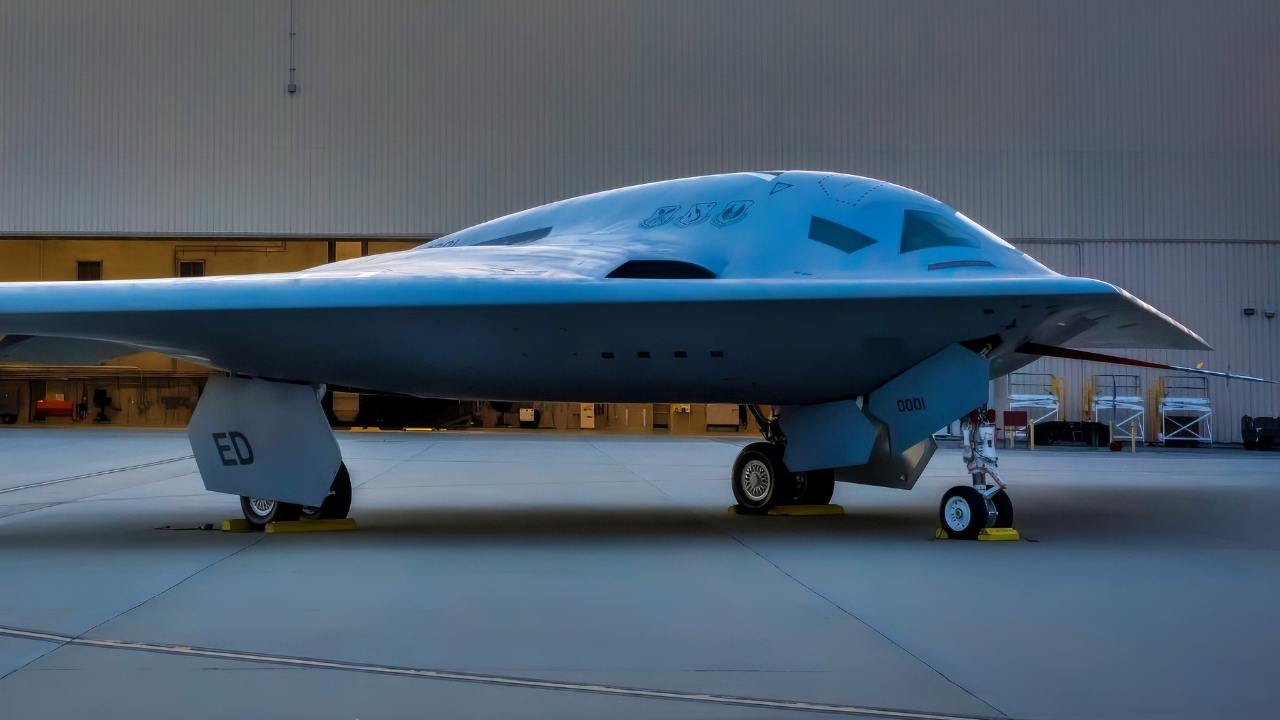
PUBLISHED on August 14, 2025, 8:24 AM EDT – Key Points and Summary – The B-21 Raider, America’s next-generation stealth bomber, is deliberately smaller and lighter than its B-2 Spirit predecessor for several key reasons.
-This design choice significantly enhances its stealth, reducing its radar cross-section to the size of a “mosquito.”
-The B-21 incorporates more advanced, fifth-generation-plus stealth technology for 360-degree low observability, unlike the B-2’s frontal focus.
-This smaller, more agile airframe also offers greater operational flexibility and prioritizes precision over raw payload, reflecting a modern doctrine of delivering smarter, more effective munitions with fewer, more survivable platforms.
Why Is The B-21 Raider Smaller Than The B-2 Spirit?
The sixth-generation B-21 Raider stealth bomber closely resembles the B-2, of which it is an evolution. But the Raider is a smaller aircraft, with a wingspan estimated at 132 feet, compared with the B-2’s 172 ft. The B-21 is approximately half the empty weight of the B-2 Spirit.
The platform is designed around the need to accommodate complex inlets and exhausts, as well as a large weapon bay, within its flying-wing profile. It then must fly efficiently at speeds above Mach 0.8.
The two aircraft are strikingly similar. But why is the B-21 Raider smaller than the B-2 Spirit?
It Was Part of the Plan
The B-21’s smaller size is a deliberate design choice. According to engineers, the bomber’s reduced size enhances the plane’s strategic and operational advantages.
Bigger isn’t always better in stealth aircraft. Sensors, signal processing methods, and the integration of multi-band systems all have evolved, meaning that modern radar systems are much better at detecting aircraft – even those built for stealth.
While stealth aircraft minimize their radar cross section through angular shapes that deflect waves, radar-absorbent materials (RAM), and extreme attention to reflective parts such as leading edges, fins, and air intakes, low-frequency radars have developed a certain proficiency for detecting stealth aircraft.
The smaller the aircraft, the smaller the radar cross-section and radar return. The radar cross-section of the B-1 Lancer bomber is 10 square meters. The B-2 bomber has a radar cross-section of 0.0001 square meters – the same as the F-22 Raptor – which is approximately the size of a bumblebee.
The B-21 bomber is virtually invisible to UHF/VHF radar. It appears to be about the size of a mosquito, according to reports and expert commentary.
Stealth Characteristics Play A Huge Part in the B-21
Size differences are important. But the primary differences between the aircraft are not related to size at all, but rather to technology.
The B-2 features Gen-1 stealth technology, which was developed in the 1980s and 1990s. This technology is still effective, as seen during the B-2’s June airstrikes inside Iranian airspace. The B-21, however, features far more advanced Gen-5+ technology – this is the best technology available today.
The computerized, AI-assisted design of the B-21 was such that the placement of every surface, bolt, and seam was calculated to reduce signature across radio frequency, infrared, and acoustic spectrums. The result is an aircraft that has 360-degree low observability.
In contrast, the B-2 was built with stealth optimization only from the front; the aircraft is much more detectable from the rear.
Smaller, More Flexible, Survivable:
The B-21’s compact design will allow it to more effectively penetrate regions affected by China’s anti-access/area denial defenses, ensuring it can deliver precision strikes or gather intelligence in high-threat environments where the larger B-2 might be at considerable risk.
The B-21’s smaller size also translates into greater operational flexibility. The B-2 Spirit, with its massive wingspan and heavy payload capacity, was designed for long-range, high-payload missions, often carrying large nuclear or conventional munitions over intercontinental distances.
The B-21’s open-system architecture will allow frequent updates to its onboard systems, not only affecting the types of weapons it can carry, but also making it easier to improve the bomber’s avionics.
The B-21 reportedly is capable of taking off and landing on smaller, more austere airfields. The aircraft will not require the climate-controlled hangars that the B-2s need.
The B-21 Raider Prioritizes Precision Over Payload
Advances in weapons and targeting systems have changed the Air Force’s doctrine. The massive Arc Light bombing by B-52s over Vietnam is no longer the standard. Instead, the B-21 will focus on delivering precision weapons.
The B-2 Spirit has a weapons payload of 40,000 pounds. The B-21’s payload will be smaller – possibly half of that total. But, armed with more precise weapons, the Raider will be more effective than its predecessor.
The smaller B-21 will have greater flexibility and play a key role in multi-domain operations, integrating with space, cyber, and ground-based assets to provide a comprehensive and coordinated response to threats, one that includes the influence of the CCA “loyal wingman” program.
About the Author: Steve Balestrieri
Steve Balestrieri is a National Security Columnist. He served as a US Army Special Forces NCO and Warrant Officer. In addition to writing on defense, he covers the NFL for PatsFans.com and is a member of the Pro Football Writers of America (PFWA). His work was regularly featured in many military publications.
Note: This piece has been updated since publication.
Military Matters
The F-22 Raptor Just Keeps Getting Better


Thomas Tradmonovich
August 14, 2025 at 8:29 pm
Uh, not sure why you mentioned Lockheed Martin twice when the B-21 Raider was designed and is being built by Northrop Grumman.
Krystal cane
August 15, 2025 at 9:55 pm
And the cost of a small country. We’re cutting back everything in our country including education to build these types of things to give billionaires even more money pretty soon there won’t be anybody smart enough to assemble these things because you’ve totally screwed up the economy Republicans